
Global Market News
Global Equities Make Gains
Global equities made gains this week, trading in record territory despite the ongoing U.S. government shutdown. The S&P 500 and Nasdaq ended the week up 1.68% and 1.77%, respectively, and the Dow Jones increased 1.76% on the week. The U.S. 10-year Treasury note declined to 4.12%, while the price of West Texas Intermediate crude oil tumbled more than 6% to $60.67 per barrel amid an OPEC+ output increase. Volatility, as measured by the CBOE Volatility Index, rose to 16.65 over the week.
Government Shutdown Delays Economic Data Releases
Due to the U.S. government shutdown that began on October 1st, several key federal agencies—including the Bureau of Labor Statistics (BLS), the Bureau of Economic Analysis (BEA), and the Census Bureau—have suspended the collection and release of economic data. This includes critical reports such as the monthly jobs report, the Consumer Price Index (CPI), and GDP estimates, which are essential for policymakers, businesses, and investors to assess the health of the economy. Without these reports, the Federal Reserve and other institutions must rely more heavily on private-sector data sources like ADP, job boards, and industry surveys, which may lack the comprehensiveness and consistency of government data. However, this week, markets seemed to take private data in stride, including an ADP private employment report, which showed a 32,000 job decline, which has largely been attributed to a rebenchmarking rather than actual labor weakness. Despite an apparent steadiness in the labor market, consumer confidence is slipping; the Conference Board’s index fell to 94.2 in September, as Americans grew more concerned about job availability.
International Developments
The West Responds to Russian Drone Escalation
Russian drone incursions have escalated across Europe this week, forcing the temporary closure of Munich airport on Thursday after multiple drone sightings disrupted flights and stranded thousands of passengers, while similar incidents in Denmark and Norway have heightened concerns about Moscow’s hybrid warfare tactics. Denmark’s intelligence service directly linked the drone activity, naval provocations, and GPS interference to Russia, framing them as pressure campaigns designed to destabilize Europe without sparking outright conflict. Russia has denied responsibility, but governments are moving quickly in response. Germany is considering granting police authority to shoot down drones, G7 nations warned they will target countries helping Moscow evade sanctions or increase oil purchases, and Washington confirmed it will share real-time intelligence with Ukraine to support long-range strikes on Russian energy infrastructure. Together, these developments show both Europe’s vulnerability to unconventional threats and the West’s determination to harden its defenses while simultaneously squeezing Russia’s financial and military capacity.
Trump’s Plan for Security in the Middle East, from Gaza to Qatar
Trump this week unveiled a comprehensive plan for Gaza, calling for the establishment of a “deradicalized, terror-free” zone administered by technocrats, the staged release of hostages, and an international stabilization force to oversee both demilitarization and reconstruction. The proposal, framed as a U.S.-backed blueprint for ending the conflict, seeks to undercut Hamas while presenting Washington as the central power broker in Gaza’s political future. In a significant development, Hamas agreed to release all remaining hostages—alive and deceased—under the terms of Trump’s plan, and expressed willingness to relinquish control of Gaza to a neutral Palestinian body. The move was met with widespread approval from Arab nations, including Saudi Arabia, Egypt, Jordan, Qatar, and the UAE, who praised Trump’s initiative as a sincere effort to end the war and advance regional peace. At the same time, the White House issued a sweeping new executive order pledging that any armed attack on Qatar would be treated as an attack on the United States, authorizing the use of “lawful and appropriate measures — including … military force” if necessary. The defense commitment underscores both Qatar’s strategic value as host to the largest U.S. military installation in the Middle East and its increasingly central role in ongoing Gaza ceasefire and hostage negotiations.
Milei’s Peso Turmoil
Argentina’s currency crisis intensified this week as the peso fell sharply, forcing the central bank to spend heavily to stabilize markets and raising fears that reserves are running dry. President Javier Milei’s reform program, once praised for its bold austerity and deregulation, is now under pressure following setbacks in provincial elections that weakened his political base. The sales highlight the strain the peso is under, even after the U.S. pledged aid at the end of September by announcing a $20 billion bailout package, including a swap line with Argentina’s central bank, U.S. purchases of dollar-denominated Argentine debt, and standby credit via the Exchange Stabilization Fund. The measures briefly calmed markets, lowering bond yields and helping the peso recover, but they have drawn sharp criticism at home: U.S. farmers accuse Argentina of dumping exports into Chinese markets after receiving aid, and lawmakers warn of risks to taxpayers. Analysts caution that while the bailout buys time, Argentina’s structural weaknesses – high debt, weak institutions, and volatile capital flows – remain unresolved, threatening to reignite the crisis if Milei’s reforms stall.
US Social & Political Developments
Trump Administration Announces “Armed Conflict” with Suspected Narco-Terrorists
Following the three recent strikes against suspected cartel drug-running boats in the Caribbean off the coast of Venezue, President Trump has declared that the U.S. is in “armed conflict” with narco-terrorists. According to memos sent by the White House to congressional committees on national security, the United States “is in a non-international armed conflict with these terrorist organizations.” As congressional Democrats have argued that Trump must have war powers to continue, they have introduced War Powers Resolutions to halt further strikes. The administration maintains that it has operated within the bounds of both domestic and international law, pursuant to the congressional authorization for military force for the Global War on Terror. When asked about the possibility of regime change in Venezuela, President Trump commented, “We’re not talking about that.” Venezuelan President Nicholas Maduro has condemned the boat strikes as an attack on Venezuelan sovereignty; Venezuela has also begun the mobilization of a civilian militia in response.
Government Shuts Down Amid Budget Impasse
The U.S. government has shutdown, following an impasse in Congress over the budget. While the House passed a 45-day funding extension, the measure stalled in the Senate, falling short of the 60 votes needed. The primary causes of conflict are disagreements, along partisan lines, over cutting $8 billion to “green” programs and $5 billion to foreign aid, insurance subsidies, and $500 million in public funds for news outlets. While Trump favors a budget that would fund the government for a full year, other proposals offer stopgap measures that would reopen the government through November and January, respectively. In a warning issued by Vice President JD Vance, the administration says it will resort to firing more federal workers if the shutdown lasts for more than a few days. The White House has also withheld funding for infrastructure and clean energy projects in Democratic-led states, intensifying political pressure. Meanwhile, Democratic leaders are demanding increased health care funding in exchange for reopening the government, but Republicans insist negotiations on subsidies will only begin after the shutdown ends.
Corporate/Sector News
OpenAI and Nvidia Set Record Highs
OpenAI reached a record valuation of $500 billion this week, becoming the most valuable private start-up in the world after employees sold $6.6 billion in shares to investors in a second sale, underscoring both the company’s dominance in generative AI and the extraordinary appetite for exposure to the sector. At the same time, Nvidia became the first public company in history to surpass a $4.5 trillion market capitalization, as demand for its GPUs and Ai infrastructure continues to drive earning higher and cement its position as the backbone of the global AI economy. Together, the milestones illustrate how artificial intelligence has become the defining force in capital markets. OpenAI’s rise reflects private investors’ conviction that it will remain the leader in generative models and applications, while Nvidia’s ascent shows how essential hardware suppliers are to the entire ecosystem. Analysts note, however, that such lofty valuations carry risks. OpenAI still faces the challenge of converting momentum into sustainable, large scale revenues, and Nvidia must defend its market share amid intensifying competition.
Berkshire Hathaway Set to Acquire OxyChem in $9.7 Billion Deal
Berkshire Hathaway is poised to acquire OxyChem, Occidental Petroleum’s chemical division, in an all-cash deal valued at $9.7 billion, with the transaction expected to close in Q4 2025. Occidental plans to use roughly $6.5 billion of the proceeds to pay down debt, trimming its balance sheet and refocusing on its core oil and gas operations. The deal represents Berkshire’s largest acquisition in years and shows the deep financial and strategic intertwinement between the two companies – Berkshire already holds roughly 27-28 percent of Occidental’s equity. While investors reacted by pushing Occidental shares down about 7%, the sale reflects a bet by Buffett & Co. that OxyChem’s underlying chemical assets (in PVC, chlorine, caustic soda, etc.) have durability and upside cyclically. The move also removes a volatile non-core division from Occidental and gives Berkshire direct exposure to downstream chemical margins, though Occidental retains responsibility for legacy environmental liabilities.
U.S. Government Takes 5% Stake in Lithium Americas
Through the Department of Energy (DoE), the U.S. has taken a 5% equity stake in Lithium Americas, as well as a 5% interest in the Thacker Pass lithium project. The stake was arranged as the renegotiation of a $2.26 billion loan to Lithium Americas from the federal government, granted in 2024 during the Biden administration. The U.S. further agreed to allow the company to draw the first $435 million from the loan agreement, as well as to defer $182 million of debt servicing for five years. The CEO of Lithium Americas touted the Thacker Pass project, a joint venture with General Motors, as an effort to strengthen American supply chains and disengage from Chinese sources of critical minerals.
Recommended Reads
9 Technologies That Transformed Investing—From the Telegraph to AI
The dawn of the post-literate society
The Supreme Court Just Became the Last Line of Defense for Fed Independence
Surging US power costs defy Donald Trump’s pledge to halve bills
Fujifilm aims to become ‘TSMC of biopharma’ with new US plant
This week from BlackSummit
In Search for Geopolitical & Geoeconomic Tipping Points: Thomas Mann’s Reflections
John E. Charalambakis
BlackSummit Team
The FACS Team
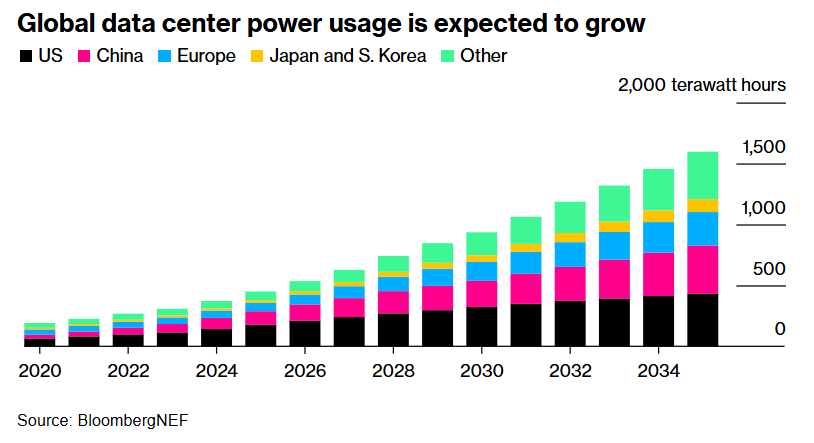
Image of the Week
Video of the Week
The Real Energy Cost of AI, Explained With Steaks and a Data Center Trip
Source: The Wall Street Journal
