
The Wooden Nickel is a collection of roughly a handful of recent topics that have caught our attention. Here you’ll find current, open-ended thoughts. We wish to use this piece as a way to think out loud in public rather than make formal proclamations or projections.
1. Random Yen Thoughts
I think too many people are jumping to conclusions when it comes to the story of Yen intervention and from a number of different angles. Rather than join in, I’d prefer to just share some charts that have caught my attention that have been overlooked by most of the mainstream press.
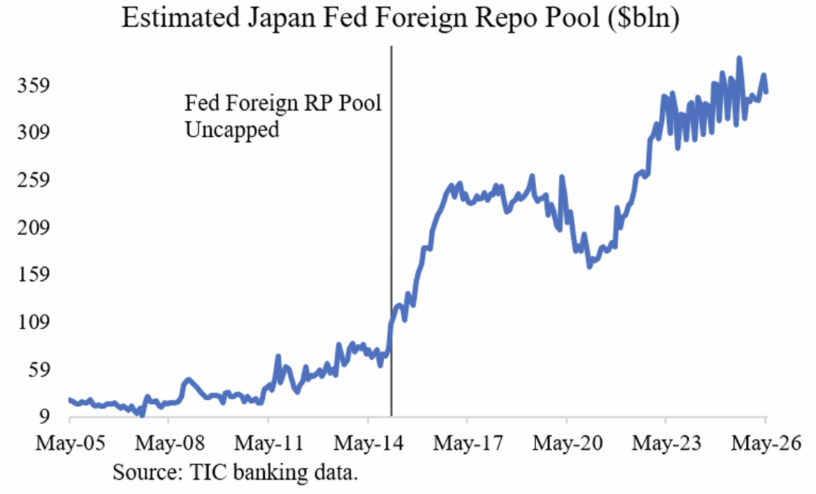
- The argument that Japan needs to sell Treasuries to support the Yen is nonsensical. They have direct swap lines with the Federal Reserve. They have a bond portfolio in the Moreover, Japan has over $300B at their disposal that they can draw down like a checking account. They do not need to sell Treasuries to get access to dollars. If they ever do there is no financial instrument that will hedge your portfolio on that day.
Figure 1: Japan Has Plenty of Access to USD Without Selling Treasuries, Source: Joseph Wang
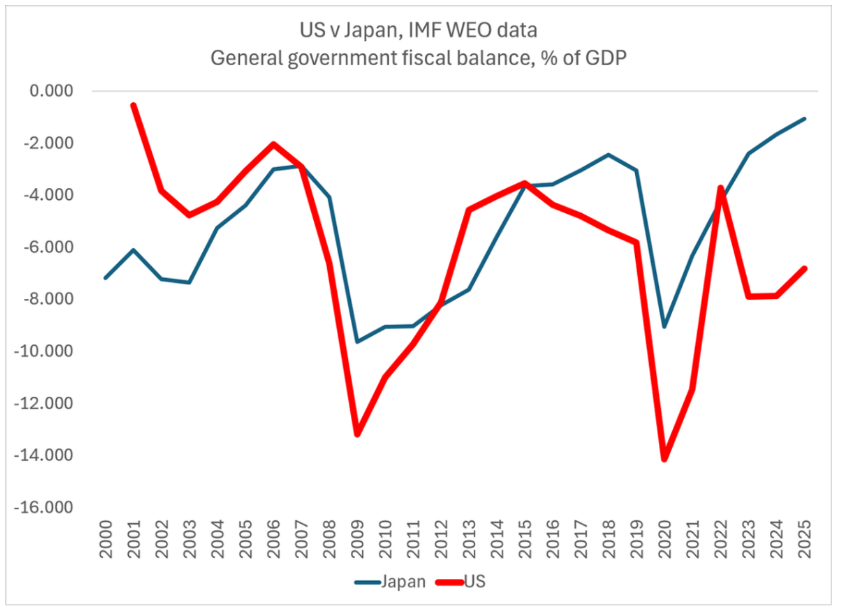
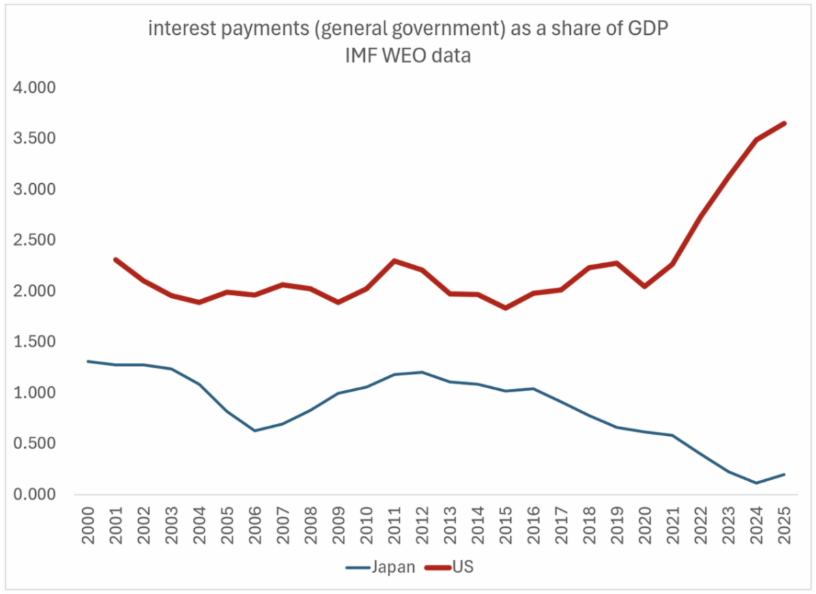
- The Yen is, from a fundamental view, pretty undervalued it seems. Japan’s primary fiscal standing is very well balanced and has been improving year after year; they may even run a surplus this year. And interest payment comprise a miniscule proportion of GDP than say the US and that’s with 10 year and 30 year JGB yields at their highest point in decades.
Figure 2: Japan’s Annual Deficit is Not the Issue, Source: Brad Setser
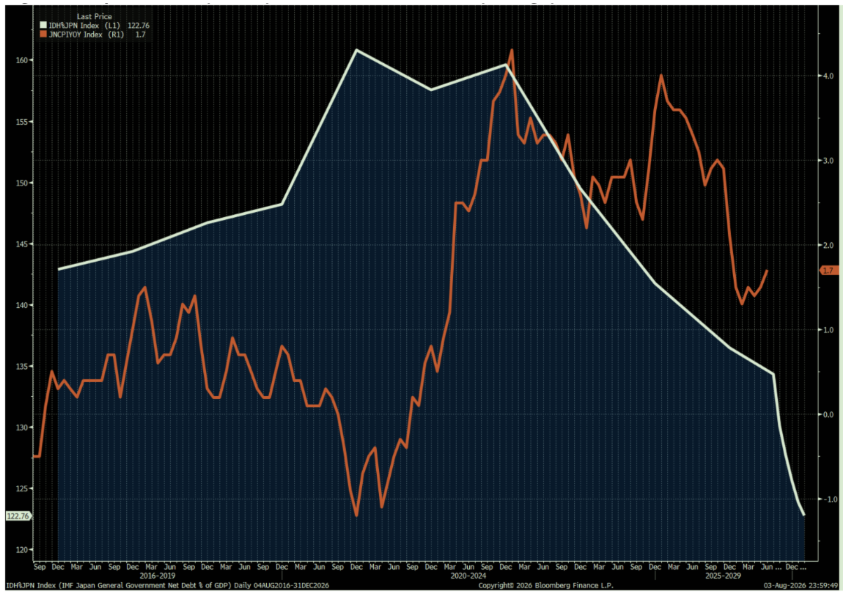
- Net Central Government Debt, as a Percentage of GDP, has fallen 40 points since 2021. From 160% of GDP to 120% of GDP. And during that time, inflation has slowed from over 4% to under 2%. They have not simply inflated it away. Rather, their consistently positive Current Account generates income via higher yields parked abroad.
Figure 3: Japan’s Debt (White) Has Fallen As Inflation (Orange) Has Cooled
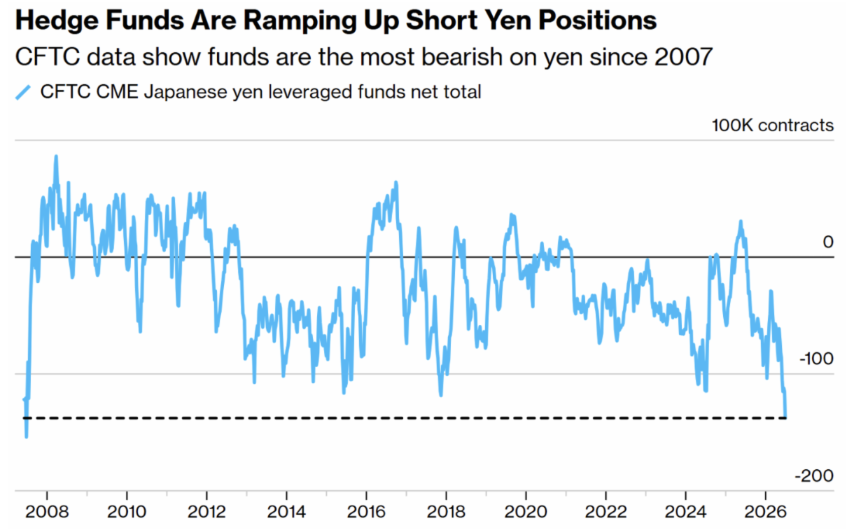
- Being short the Yen has been a popular position for years. And it’s worked for long periods of time. But there’s been plenty of pain too as evidenced by past unwinds of carry trades. Yet as of about 5 weeks ago levered short bets against the Yen were at their highest level since 2007.
Figure 4: Short Yen Has Gotten Extreme
I don’t think there’s a neat and buttoned-up explanation as to why the Yen has gotten as weak as it has. Reasons for intervention by the Ministry of Finance and the Treasury make some sense, but the ultimate end goal is more murky. Best guess? Don’t be shocked to hear the tune of the Mar-A-Lago accord get replayed in the coming months. A Yen in free fall does not bode well for many of the policy preferences of members in the administration, not to mention probably encourages a Renminbi response.
2. DeepSeek 2.0
Risk assets in general, and chips stocks specifically, got their replay of the January 2025 DeepSeek selloff in mid-July, at least if you follow major press headlines. Once again, the culprit was an open-source Chinese model (Kimi K3) and its alleged competitiveness against the frontier leadership of US AI labs, namely OpenAI and Anthropic. I would argue, however, that the market’s reaction to Kimi K3 was more of a yawn than hysteria and that very little of the chip sell-off seen during the month of July had anything to do with Kimi.
The Philadelphia Semiconductor Index is down just over 20% from its late June highs at the time of this writing. It is only down 6% since the release of Kimi 3; the majority of its losses to date actually occurred before the release of Kimi 3, down ~17%. If the market is afraid of a new Chinese open-source model ruining the AI trade, then someone forgot to tell the equities of semiconductor companies.
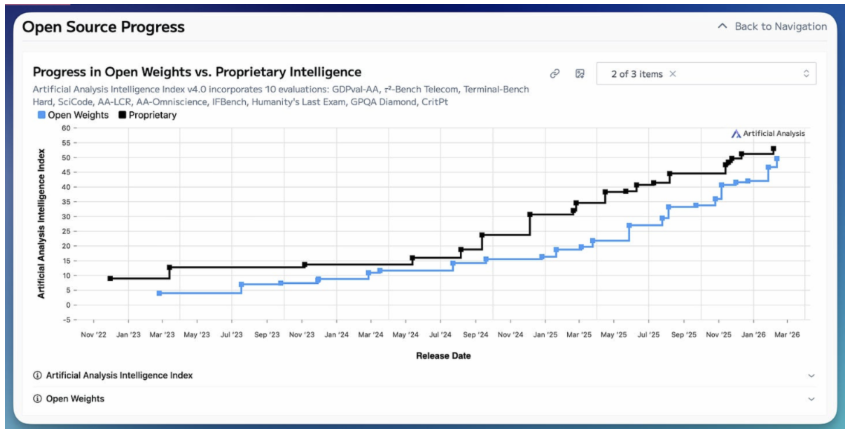
The Kimi 3 story is a bit of a paradox. It is both a very big deal and not much of one at all. Starting with the latter. The trend for most of the last 3 years has been for open-source models to be somewhere between 6 and 9 months behind the best-of-breed models produced by the private labs. Given the quality and the progress of OpenAI and Anthropic since the winter, we shouldn’t be surprised by what open-source models are able to do; it is par for the course (with one caveat I would add later).
Figure 1: Open Source Has Consistently Been ~6-9 Months Behind, Source: Artificial Analysis
Second, Kimi is an economically inefficient model. Extremely so in fact. That may not have mattered in an era in which we were just exploring what kind of models could be built, at what scale, and improving them via the brute forces of more computing and data, but we’ve crossed over to an era whereby the usage of LLMs and their related products is the dominant variable for hardware choices, the allocation of budgets and physical resources, and determinant for where and how value gets created in this AI paradigm.
Nowhere is this more evident than the labs themselves who have found “product-market fit” as the saying goes. Anthropic entered 2026 at just under $10B of annualized revenue. Today, it stands close to $80B. It took Salesforce over 25 years to add $45B in revenue and a substantial portion of that is inorganic via acquisitions. Adobe was founded in 1982 and will do ~$25B in revenue this year. Anthropic has added as much revenue in seven months as these two software icons have done in decades.
Figure 2: Inference and Agentic Use Cases Have Propelled Revenue at the AI Labs
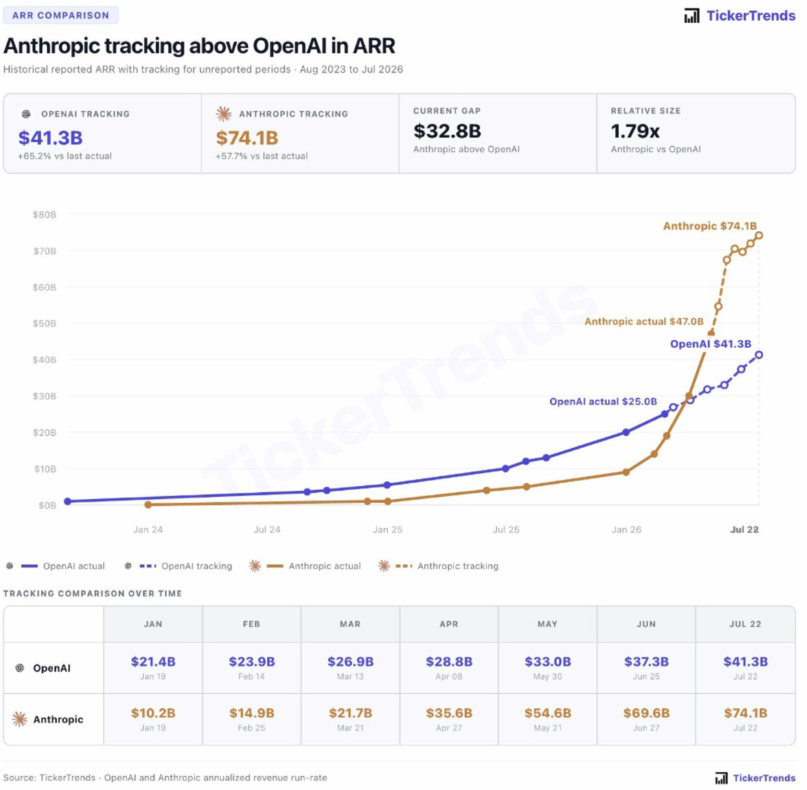
Anthropic’s models have been out for years and have been at the leading edge for much of that time; selling access to that intelligence in raw form didn’t produce the chart above. But it was only until the viral release of Claude Code, along with an upgraded model, this past winter that set its growth on an exponential curve and has now pushed it to profitability on a GAAP basis. 2026 has been a year, as forecasted, where usage would move from niche products and one-off experiments to a gradual ramp in formal enterprises and would be a tool in the global services market that is valued at tens of Trillions of dollars. And to be competitive in that market you have to be able to output work that is economically useful in a cost-competitive manner. Labor is the largest expense for most organizations. Augmenting that cost is paramount when implementing AI tools which is why Kimi’s microeconomic disadvantages matter more than the overall model capability. The market has moved and it moved a while ago. We should not be measuring a model based on the tools of 2023 when the expectations and capabilities have shifted so dramatically.
But that is why, to bring back the paradox, Kimi is a big deal. Because for most knowledge work there is a level whereby marginal effort on a task does not yield worthwhile benefits; there is a point where, for a specific task, a work output is good enough. I do not need a chainsaw to slice a piece of meat when a knife will do; more power and ability is not always necessary.
The significance of Kimi is less so the full strength of the model; if a Ferrari had the steering of a unicycle it wouldn’t be an effective mode of transportation. Rather the significance is that there is a means of doing the sort of agentic work to augment labor without having to pay the full margin of the leading labs. And currently the race has moved from beyond building the best model to building the best total product: a model or engine plus the steering mechanism (or harness in AI parlance). Kimi’s arrival opens the competitive door to every company under the sun: established enterprise vendors from Microsoft to Crowdstrike to Amazon can employ their respective advantages (in data, applications, security, etc.) and employ new underlying models, or to mix them, with an immaterial change in outcome (in most cases) compared to simply serving up a flavor or ChatGPT or Claude. It also opens the door for new startups to develop their own new products. Whereas OpenAI and Anthropic seek to start with a model and build on top of it, established players can start with existing solutions and customer relationships to work backwards into a more economic model.
Who will win? Only time will tell.
