Out of the blue, I got a call from a friend yesterday asking: “Can Oracle pay its bills?” The response that jumped out of my mouth was simple: “In today’s financial investment world, investing is like spying: It requires a lot of imagination.”
The reason for this question was none other than the fact that Oracle was downgraded by S&P Global to BBB-, just one notch above junk status. However, such action, as we understand it, is a symptom of the underlying cause of confusion related to AI that some are calling a mania. AI will transform daily life, but it doesn’t mean that the massive investments made will pay off. The deeper concern regarding Oracle dealt with massive expenditure for AI-related investments, more than $23 billion in negative cash flow (expected to increase to over $40 billion in 2027), and, of course, the dependence of its future income on OpenAI. The latter underwrites half of Oracle’s future revenues, but OpenAI has no credit rating and certainly no profits.
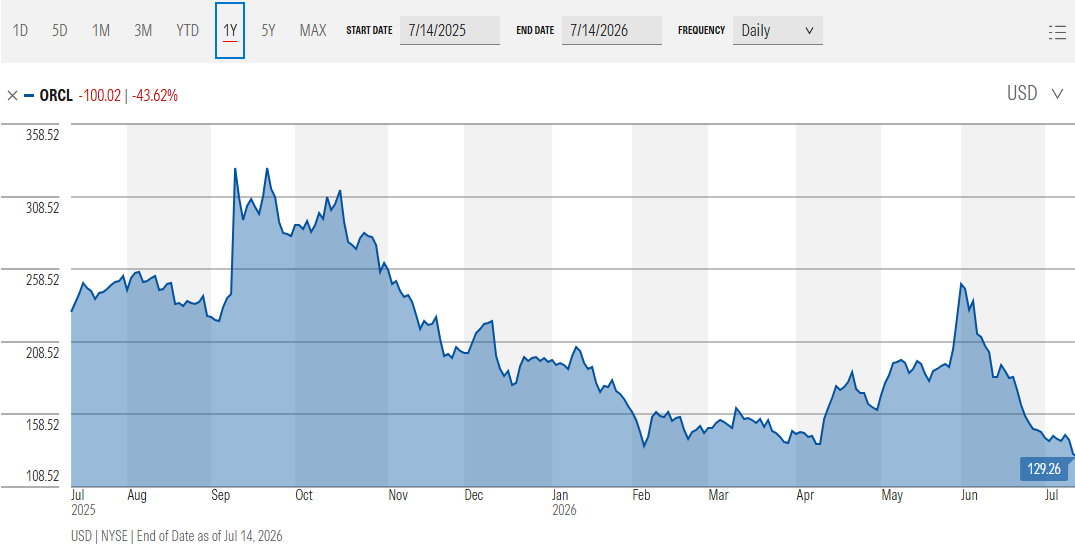
The market confusion surrounding Oracle is a trademark of what is happening in the markets now, but first let’s look at Oracle’s stock price behavior in the last 12 months.
Is demand for AI infrastructure services real? Absolutely! Will demand for AI services increase? Most definitely! Will productivity increase? Certainly! Will there be haircuts due to inability to pay the bill? Concerns are mounting.
In its latest report, the Bank for International Settlements, known as “the central bank of central banks,” provided a serious warning, explaining that the massive investments in artificial intelligence could trigger a financial crisis, especially under current conditions of rising confusion, record level government and corporate debt, and geopolitical uncertainty. Any shock would be amplified because of such a mix.
In our previous commentary, we discussed how William Holbrook Beard’s painting “The Bulls and Bears in the Market” reflects America’s capital dynamism, as the painting relates to the market crash of 1873. The causes of that crash can be identified as overinvestment in the railroads during Reconstruction, overextension of credit, speculative moves, interconnectedness of global finance, and demonetization as the global economy was moving from silver to the gold standard, all of which led to bank failures, stock market crashes, and a depression. It should be noted that the depression took place despite technological and industrial expansion, including a doubling of iron production and a twenty-fold increase in steel output between 1870 and 1890.
Herman Melville’s Moby Dick (1851) didn’t make an impression when it was initially published. After all, what was the meaning of a story where a sea captain is obsessed with a titular white whale? Let me rephrase it: How in the world did the audience miss the distinctively American crew, made up of white and Black Americans, Native Americans, Africans, Indians, and Pacific Islanders during rising racial tensions? How did they miss the collective fatal mistake early in the novel, when Captain Ahab informs the men that he has no plans to fulfill the ship’s mission to harvest oil from whales? How pathetic is it when Ahab informs them that all he cares about is his little vengeance against Moby Dick – the great white whale that took his leg – and the crew willingly signs on to his monomaniacal quest? How pathetic was it for the church in the late 1930s to accept Hitler, and how pathetic for today’s investors not to see that rising debt levels are a trap that can underwrite a silent depression? Charismatic narratives around causes like AI, much like despots, can sway the public and inflict enormous pain on institutions and markets. Moby Dick’s message is clear: Forward seeking profits and ambitions can underwrite tragedies.
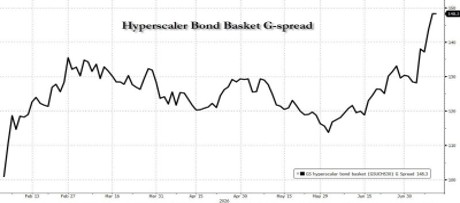
Let’s reinforce the discussion above by looking at the spreads related to AI bonds. As shown below (courtesy of Zerohedge), such spreads (including those of the bonds issued by hyperscalers of the likes of Meta, Google, Amazon, etc.) are rising over government bonds, signifying concerns and rising financing costs which could make the whole endeavor even more questionable.
Fifty years ago, Bob Dylan, in his famous LP titled Desire, included the song “Black Diamond Bay.”
“And all the remnants of her recent past
Are scattered in the wild wind…
As the storm clouds rise and the palm branches sway
On Black Diamond Bay…
In his bare feet with a rope around his neck
While a loser in the gambling room lights up a candle
Says, ‘Open up another deck.”
He hung there from the chandelier.
She cried, ‘Help, there’s danger near
Please open up the door!’
Then the volcano erupted
And the lava flowed down from the mountain high above.”
In a long-running study by Professor Hendrik Bessembinder, a finance professor at Arizona State University, we discovered a spreadsheet cataloging U.S. stock market history across 29,000 stocks over the last 100 years. After reviewing this spreadsheet, several questions jumped out, such as: when Black Diamond Bay’s volcano explodes, who and what will stand? In the study, more than 96% of stocks did virtually nothing for investors. Most stocks could not even match the return on one-month Treasury Bills.
In 1935, Ernest Hemingway wrote that “all modern American literature comes from one book by Mark Twain called Huckleberry Finn.” The novel (1884) is the tale of a troubled kid named Huck who is rafting down the Mississippi River with a runaway enslaved man named Jim. Huck feels obliged to return the runaway slave to the woman who enslaved him, while at the same time he wants to see Jim as a free man. Huck finally decides to go against the norm, obeying the moral voice of his heart and consciousness, and pronounces “All right then, I’ll go to hell.” This is the moment when hypocritical moralism was defeated by redemptive awakening. The tragedy of the story, of course, is that Jim is re-enslaved and dehumanized. Professor Hendrik Bessembinder’s study can be seen from Huck’s viewpoint.
The crash of 1873 was a defeat for the promise of Reconstruction that followed America’s Civil War.
“As the island slowly sank
The loser finally broke the bank in the gambling room.
The dealer said, “It’s too late now.
You can take your money, but I don’t know how
You’ll spend it in the tomb.”
The tiny man bit the soldier’s ear
As the floor caved in and the boiler in the basement blew
While she’s out on the balcony, where a stranger tells her
“My darling, je vous aime beaucoup.”
She sheds a tear and then begins to pray
As the fire burns on and the smoke drifts away
From Black Diamond Bay.”
