
Global Market News
Global Equities Make Gains
Global equities made gains this week amid hopes that trade tensions are easing. The S&P 500 and Nasdaq ended the week up 1.45% and 1.07%, respectively, and the Dow Jones increased 0.94% on the week. The U.S. 10-year Treasury note declined a couple of basis points to end the week at 4.39%, while the price of West Texas Intermediate crude oil dropped more than 3.5% to $65.16 per barrel. Volatility, as measured by the CBOE Volatility Index, ended the week nearly 12% lower, closing Friday at 14.93.
Global Economy Grows By 2.4% in First Half of 2025
In the first half of 2025, the global economy grew by approximately 2.4%, consistent with its long-term trend, despite ongoing tariff-related volatility. Trade volumes remained strong, and corporate earnings showed resilience, growing by 12% before mid-year. Equity markets in both the U.S. and Europe reached record highs, driven by optimism around technology and AI. However, J.P. Morgan cautions that growth may slow in the second half due to policy uncertainty and geopolitical risks. Furthermore, analysts give caution to the continued rise in equities due to high valuations and rising market concentration in big names such as the Magnificent 7.
International Developments
Trump Announces Tariffs on Japan, the Philippines, and Indonesia
This week, President Trump announced new tariffs on Japan, the Philippines, and Indonesia. Under a newly signed trade deal, Japanese imports will face a 15% tariff, down from the previously threatened 25%. Trump described the agreement as a “massive” deal, claiming Japan will invest $550 billion into the U.S., with the U.S. receiving 90% of the profits. In addition, Trump revealed that Philippine and Indonesian imports will be subject to a 19% tariff, part of a broader strategy to pressure countries into opening their markets to American goods.
International Calls for End to War in Gaza, France Recognizes State of Palestine
Amid the worsening humanitarian crisis in Palestine, the foreign ministers of 28 countries, including Canada, Japan, and the UK, issued a joint statement demanding an immediate end to the war in Gaza. Over 100 aid organizations echoed this urgency in an open letter, warning that mass starvation is spreading across the region. In a major policy shift, French President Emmanuel Macron announced that France will officially recognize the state of Palestine, with the formal declaration planned for the UN General Assembly in September. Macron emphasized the need to stop the war and save civilian lives, marking France as the first major Western power to take this step. U.S. and Israeli government officials have condemned France’s decision, with U.S. Secretary of State Marco Rubio calling it a “reckless decision”.
Russia and Ukraine Hold Peace Talks Amid Anti-Government Protests in Kyiv
Russia and Ukraine held their first round of peace negotiations in seven weeks on July 24 in Istanbul, focusing on prisoner swaps and humanitarian issues. However, the talks ended without progress on a ceasefire or plans for a leaders’ summit, as both sides remained far apart on key demands. Meanwhile, Ukraine has experienced anti-government protests, sparked by President Zelensky’s signing of a controversial bill that weakened the independence of anti-corruption institutions. Protesters in Kyiv expressed fears of increasing authoritarianism and a rollback of democratic reforms.
US Social & Political Developments
Congress In Turmoil Over Epstein Files
This week, Congress was thrown into turmoil over the issue of releasing files related to Jeffrey Epstein. House Democrats forced multiple procedural votes aimed at compelling the release of Epstein-related documents, as many Democrats believe President Trump and Attorney General Pam Bondi are trying to shield politically sensitive information related to Trump’s past ties to Epstein. The controversy led House Speaker Mike Johnson to end the legislative session early, calling the situation a distraction and accusing Democrats of playing political games. However, some Republicans, including Rep. Thomas Massie, broke ranks, demanding transparency and warning that the issue could erode voter trust and hurt the GOP in the midterms. The House remains divided, with no clear path forward.
Trump Signs AI Action Plan
On Wednesday, President Trump signed three executive orders aimed at reshaping the U.S. artificial intelligence industry and unveiled a sweeping AI Action Plan titled Winning the AI Race. The plan outlines over 90 federal policy actions across three pillars: accelerating innovation, building AI infrastructure, and leading in global AI diplomacy. Key initiatives include easing regulations for data centers, creating national programs to boost skilled labor, and establishing a single federal standard for AI regulation to avoid fragmented state-level rules. AI company stocks saw a notable rise following the president’s announcement.
Corporate/Sector News
AstraZeneca Announces $50B Investment in US
AstraZeneca has announced a massive $50 billion investment in the United States by 2030, marking its largest-ever manufacturing commitment globally. The move comes amid the Trump administration’s threats to impose tariffs on foreign-made pharmaceutical products, a policy shift aimed at boosting domestic drug production. The investment will fund a new drug substance facility in Virginia, as well as expansions in California, Indiana, Maryland, Massachusetts, and Texas, supporting both manufacturing and R&D. The company stated that this expansion aligns with its goal of reaching $80 billion in annual revenue by 2030, with half of that expected to come from the U.S. market.
Chevron Venezuela License Reissued
The Trump administration has reissued a license for Chevron to resume oil production and exports from Venezuela. Chevron had previously operated in Venezuela under a Biden-era license, which was revoked by the Trump administration in February. This move is reportedly tied to a prisoner swap deal that saw the release of 10 Americans detained in Venezuela in exchange for the return of over 250 Venezuelans held in El Salvador. The new license includes strict guardrails to prevent the Maduro regime from profiting directly from Chevron’s operations, such as blocking royalty or tax payments to the Venezuelan government.
Microsoft Confirms Chinese State-Linked Hacks
Microsoft has confirmed that recent cyberattacks exploiting vulnerabilities in its SharePoint software were carried out by Chinese state-linked hacking groups. These groups used zero-day vulnerabilities (a vulnerability or security hole in a computer system unknown to its developers) to gain unauthorized access to hundreds of organizations, deploying a malicious web shell to steal data and potentially install ransomware. The affected systems were on-premises SharePoint servers, while SharePoint Online in Microsoft 365 was not impacted. Microsoft has released urgent security patches and is urging organizations to update their systems and enhance their cybersecurity defenses.
Recommended Reads
Stablecoins Could Trigger a Crisis at the Heart of the Financial Industry
How higher education failed America’s poor
JPMorgan Is Now Worth More Than Three Largest Rivals Combined
Five charts explain Trump’s cuts to foreign aid
War, geopolitics, energy crisis: how the economy evades every disaster
This week from BlackSummit
CROSSROADS: US, Canada, Europe, China, India & Japan
BlackSummit Team
CROSSROADS: Middle East, Asia, Latin America, Sub-Saharan Africa
BlackSummit Team
BlackSummit Team
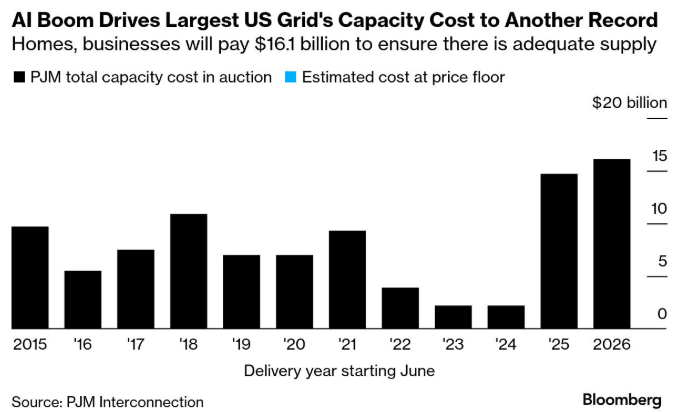
Image of the Week
Video of the Week
AI Power Demand May Soon Strain Global Supply
Source: Bloomberg
