
The Wooden Nickel is a collection of roughly a handful of recent topics that have caught our attention. Here you’ll find current, open-ended thoughts. We wish to use this piece as a way to think out loud in public rather than make formal proclamations or projections.
1. If I Was A Bond Bull
If I was a bond bull the argument I would make would go something like this.
Too much noise has entered the discussion arena when it comes to why yields have risen and what the consequences are. Let’s take a Pareto Principle approach to it; 80% of the explanation comes from a minority of data/catalysts.
In this case, while we can debate monetary policy, the Fed’s balance sheet, global capital flows, Treasury operations, and more (and all deeply entertaining, enlightening and at times insightful), the KISS explanation (keep it simple stupid) is simply that the economy is running very hot and that high yields correlate very strongly with elevated 10 year yields. An 86% R-squared actually
Figure 1: Nominal GDP Growth Impacts Yields More than Anything, Source: Goldman
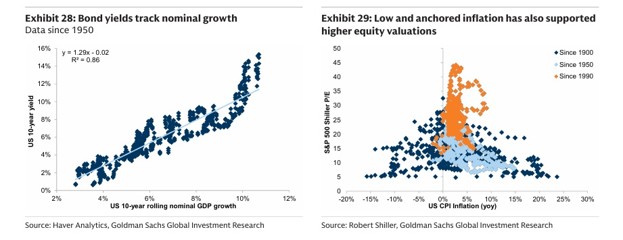
And how hot is the economy running? Nominal GDP growth is over 6.5% at the moment. And this probably understates GDP growth given the effect of imports under the AI investment boom. For an economy as large, mature, and with a scarce labor supply it’s hard to imagine further acceleration (or an acceleration in the second derivative) from here.
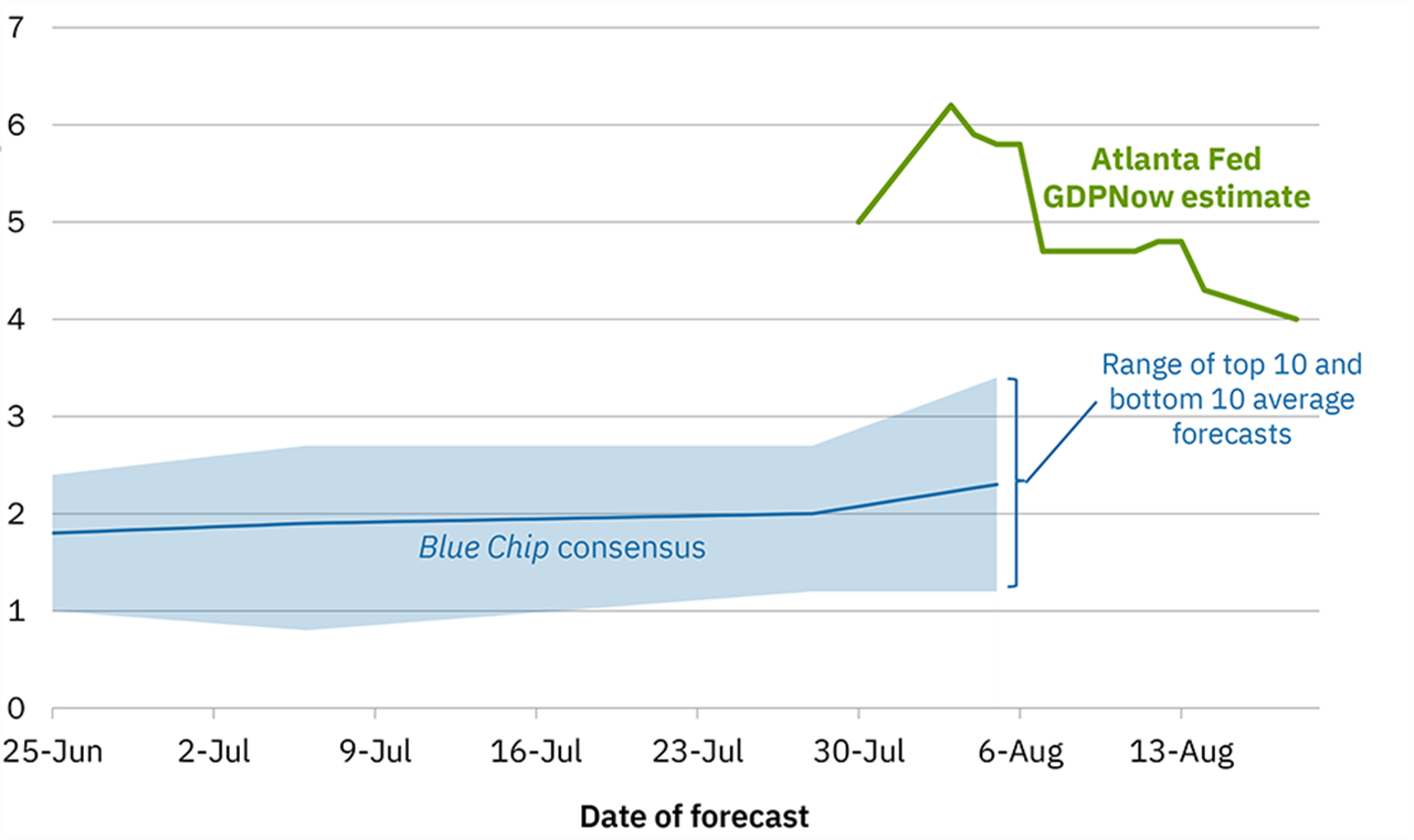
Second, market implied rates and estimates of inflation have come down dramatically. No matter which one you use (Truflation – in white -, Inflation Swaps – in blue -, TIPs breakevens – in orange -) they have all come down to the 2-2.25% range.
Figure 2: Inflation Measures Have Come Down Rapidly
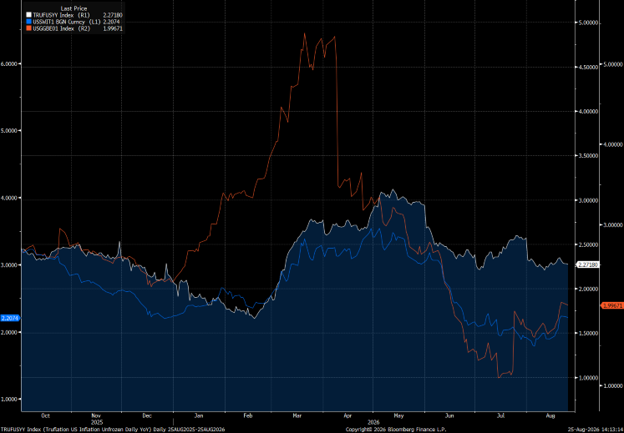
Finally, positioning. While I take CFTC data with a massive grain of salt (derivative positions are rarely a pure play trade and instead are a part of another instrument or holding) rarely do market participants get more bearish on bonds than they are currently. The last time they were this bearish the 10 year was at 4.4% and rallied 60bps fast. And if you don’t think positioning can have an outsized effect on market movements then Jane Street would like a word.
Figure 3: Bearish Bets on 10 Year Are Near All-Time Highs, Source: CFTC
2. If I Was an AI Bear…
One of the more ignorant and lazy arguments made about the proliferation of AI/LLMs/agentic AI made today is that it still lacks product-market fit. That there isn’t enough breadth or diversity of adoption. That it’s all just for “coders.”
LLMs are agnostic about the content. There’s nothing magical about the file structure of a pdf, Word Document or Excel sheet. These artifacts are just as much “code” as a script in C++ or Python. Thus, hand waving away the penetration or LLMs and the layers of software built above them as merely something for coders is deeply ignorant and dismissive. If it is made of bits and bytes it may as well be code. The number of fields who utilize digital inputs or output something made of bits and bytes is endless.
But what is a good argument rooted in skepticism is to point out that not all work done is deterministic. Specifically, LLMs and their associated tools are quite good at answering questions and completing tasks. What they still lack is the sustained and persistent ability to know what questions to ask and why they matter. To be more specific, most work in coding or mathematics, two fields where AI has made remarkable penetration and newsworthy breakthroughs, are deterministic in nature. Either the solution is right or it is not. Either the code works or it does not. But much in economic life, if not the vast majority of it, is not so easily verifiable and binary in nature. There are times when solutions work and they are good enough and there are other times where better is needed. Most of what we do exists on a continuum and is not so cleanly verified as “yes this works” or “yes that’s the right answer.”
And that is where growth in the adoption and installation of AI in the general economy could asymptote for a while. I think the far fetched idea articulated years ago that it isn’t helpful or it’s just a fad has long left the station. But if I was an AI bear that would be the argument that I make; that the sample being paraded as proof of utility can not be extrapolated going forward and not at the same rate. There are natural frictions and incentives at play in other fields and environments that coding and mathematics are liberated from that make the latter ideal for AI’s adoption.
And as history has showed us, you don’t even need much of a slowing to cause immense damage…
3. What if the AI Trade is More 2005 Than 1998?
“We’ve never had a decline in housing prices on a nationwide basis,”… “What I think is more likely is that house prices will slow, maybe stabilize … I don’t think it’s going to drive the economy too far from its full-employment path, though.”
It’s natural to parallel the buildout and race going on in AI to the dot-com bubble given that both are concentrated in the technology sector. But ever since Oracle threw down the gauntlet last Fall and kicked off the spree to spurn cash flow I’ve begun to wonder if it’s actually the GFC that is the better parallel for investors to have in the back of their mind. Not in terms of size and potential impact but rather because of structure.
There were many sins within the GFC but the structural shortcoming was to extrapolate near term price dynamics into long lived assets and lever it up; and that’s even before we talk about the spurious nature of most of those securities. You can see something similar happening with the AI trade in markets. More and more capital being brought to bear, and with more debt in the picture, to finance long-lived assets, housed with computing equipment that does not live forever, based on a certain assumption about the price of tokens which has very little history to extrapolate off of.
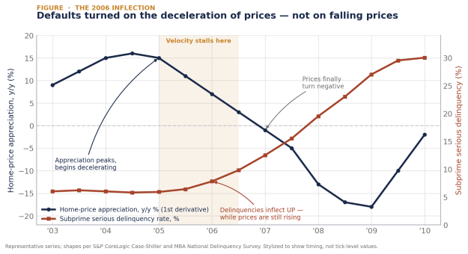
While the dot-com era went out like a light switch getting turned off the GFC unraveled slowly and then rapidly. Few will remember but by the time Bear Stearns had to shut down and liquidate two of its hedge funds in July 2007 housing prices had only fallen ~2% since their peak the prior year. And they weren’t the first cracks in the system. Defaults actually started rising before housing prices declined. It may be that any fractures that develop within the AI ecosystem first arise from a slowing of growth rather than outright declines.
Figure 4: Delinquincies Started Rising on Slowing Growth, Not Falling Prices, Source; Groundbreaker
4. Recommended Reads and Listens
a. What is the ROIC on a New AI Data Center?
b. The Second Derivative: Why No One Understands the AI Boom
