
Welcome to the latest edition of the Carbon Market News Roundup, our bi-weekly briefing on the evolving landscape of global carbon markets and climate-related regulation. Our previous issues, along with the rest of our commentaries, may be read here.
This fortnight’s roundup shows a carbon market system growing more interconnected and consequential. EUAs climbed toward €88 as diplomats moved to tame volatility ahead of a tighter post-2030 cap. Shipping remains suspended between global gridlock and regional advance, with October’s IMO vote looming while the EU pushes ahead regardless. CBAM keeps maturing from a materials tax into a harder-to-circumvent trade instrument, extending into downstream goods. And voluntary markets are professionalizing under converging pressure. There, buyers now demand quality, regulators are investigating registries, and governments are building integrity infrastructure. Across all four, the throughline is that carbon pricing is hardening, widening, and facing sharper scrutiny everywhere at once.
EU ETS – Regulations Updates & EUA Price Movement
EU allocates €430mn ETS revenues to SAF for 2025
Argus Media, Kiara Campagne Nieva
What the 2026 ETS review means for transport
Transport & Environment
EU countries back carbon market changes to curb price spikes, diplomats say
Reuters, Kate Abnett
EU ETS Review: Managing the EU ETS for Decarbonization
ERCST, Andrei Marcu, Philippe Chauveau, Alexandra Maratou, Elizabeth Lesaulnier, Helen Bevernage, Marco Sangiovanni
The EUA’s steady climb from roughly €82 in early September to a €88 spike around September 23, before settling near €87 tracks well with the fortnight of developments. EU ambassadors backed reforms on September 23 to strengthen the Market Stability Reserve and extend price-spike safeguards beyond 2030, precisely as prices were testing new highs. That coincides with ERCST’s and T&E’s reviews of a 2026 ETS overhaul that tightens the cap, extends coverage to aviation, shipping and SAF funding, and signals durable scarcity. These are all bullish fundamentals reflected in the chart’s upward trajectory and volatility.
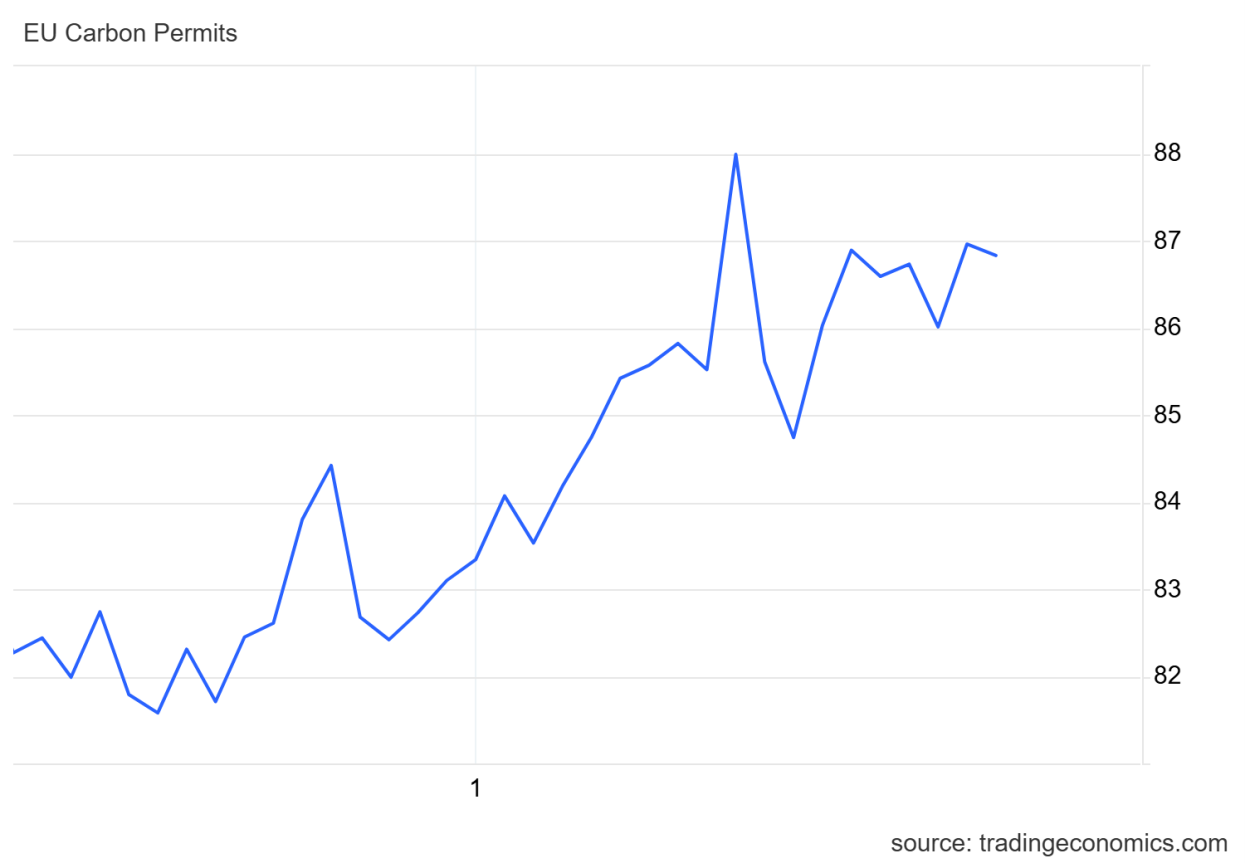
The single-day spike to €88 and sharp pullback mirrors the kind of volatility diplomats’ September 23 agreement on stronger stability-reserve safeguards was designed to dampen. With reform proposals reinforcing long-term scarcity via tighter caps, SAF funding and wider transport coverage, the market’s higher, choppier trading range looks structurally driven.
Maritime & Shipping Updates
IMO’s shipping carbon levy vote returns next month, one year on
Environmental Technology
Yacht sector must prepare for potential expansion of EU ETS
Superyacht News
Shipping’s transition being hampered by policy uncertainty, yet industry progress continues
Global Maritime Forum
Switched ON for zero emissions: designing for a rulebook that keeps moving
SeaTrade Maritime News
It has been a year since the IMO’s Net-Zero Framework was adjourned at the eleventh hour, and the vote returns to the Marine Environment Protection Committee in October, with sentiment reportedly having swung back toward adoption at MEPC 84 even as the US, Saudi Arabia, the UAE, Panama and Liberia remain opposed. The Global Maritime Forum’s latest “2030 breakthrough” report puts a number on the cost of that delay, calling the failed October 2025 vote the single most transition-regressive event in the five years it has tracked the sector, with scalable zero-emission fuel newbuild orders falling from 9.5% to 5.7% of tonnage on order and shipping-specific sustainable debt issuance declining year-on-year. Meanwhile, the EU is not waiting. Its ETS review proposes extending carbon pricing down to yachts between 400gt and 5,000gt from 2031, a reminder that regional rules are advancing regardless of what happens at the IMO in December. Policy uncertainty has become a material drag on investment, financing and fleet renewal across the sector.
Kongsberg Maritime’s strategy chief argues that owners ordering ships today are buying into “a rulebook that refuses to sit still,” and that the fragmentation of IMO, EU ETS, FuelEU Maritime and national rules will not resolve into one tidy global standard any time soon. Therefore vessels should be designed to stay compliant across a range of outcomes rather than betting on a single one. This is an approach that has already made fully electric RoPax designs 8-15% cheaper over their lifetime than diesel equivalents on some European short-sea routes. Read alongside the yacht sector’s own advice to prepare now for EU ETS expansion regardless of the final scope, and the Global Maritime Forum’s warning that regulatory clarity is essential to unlock investment the consistency is that waiting for certainty is now the riskier strategy. Whether or not the NZF passes in October, maritime carbon markets are trending toward more coverage and the owners, designers and financiers moving on efficiency and fuel flexibility must position appropriately for all outcomes.
EU CBAM Updates
Strengthening the EU carbon border adjustment mechanism and closing loopholes
European Parliament
European Aluminium welcomes vote to strengthen CBAM
Aluminum International Today, Jess Mills
EU Expands CBAM To Fight Carbon Leakage
Carbon Herald, Vasil Velev
European Parliament backs wider CBAM coverage for downstream steel and aluminum products
Yieh Corp
The European Parliament’s Environment Committee vote to strengthen CBAM, and the plenary mandate that followed it in September, makes carbon border pricing into a stronger live trade mechanism. MEPs backed extending CBAM well beyond raw steel, aluminum, cement and fertilizer into a long list of downstream goods while tightening anti-circumvention rules that had left gaps. The exemption threshold for aluminum drops from 50 tons to 5, and a loophole allowing foreign producers to use post-consumer scrap to understate embedded emissions is closed. European Aluminum’s enthusiastic response captures why this matters commercially. Without those downstream and scrap-loophole fixes, EU producers were exposed to regulatory arbitrage and resource-shuffling.
Carbon leakage is being redefined as a value-chain problem. Parliament’s own framing treats CBAM expansion and support for domestic decarbonization as two halves of the same package. That reflects a maturing carbon border policy. As coverage widens toward finished goods, the emissions embedded in suppliers, transport and product lifecycles become commercially unavoidable for anyone selling into Europe. With Council’s position already adopted and Parliament’s mandate now set, negotiations will decide how much of this ambition survives. Nevertheless, CBAM is clearly moving from a narrow materials tax toward a broader, harder-to-circumvent instrument of EU industrial policy.
Voluntary Carbon Market News
New report sets out policy options to strengthen domestic carbon credit markets
National Law Review
90% Of Carbon Credit Buyers Report Commercial Gains
Carbon Herald, Violet George
Shift in carbon market and chances for Viet Nam
Nong Nghiep Moi Truong, Lan Anh and Pham Huy
CFTC launches wide probe into voluntary carbon credits
Briefs Finance, Andre Savage
Climate Impact Partners’ survey of 600 senior climate decision-makers found 90% of buyers reporting that credit purchases met or exceeded corporate goals, with 84% of active buyers now prioritizing project quality over price. This a striking reversal for a market once criticized for chasing the cheapest ton. That same discipline is showing up on the supply side. In Vietnam, experts are urging developers to identify buyers and their specific quality requirements before building a project, not after. This reflects a broader shift from “generate credits and find buyers” to “find buyers and design accordingly.” With a $1.3 trillion global climate finance gap, governments from Ghana to South Korea are building registries, legal frameworks and demand-side incentives because durable investment now flows toward markets that can prove integrity.
The CFTC’s newly launched, wide-ranging probe into voluntary carbon credits shows that market discipline is increasingly coming from regulators too. That the investigation follows a 12% decline in voluntary offset issuance since the 2021 peak, and builds on the CFTC’s first fraud enforcement action in this market back in 2024, underlines how closely greenwashing concerns and cooling demand are intertwined. Buyers already reward quality, sellers are learning to design for it, and governments are building policy infrastructure to support it. As registries, validators and ratings firms come under formal scrutiny, the market’s ability to convert its recent gains in buyer confidence will depend on whether institutional oversight closes the credibility gap.
To explore insights and tools driving carbon compliance and market visit the FACS website here!
