
Embracing risk could be a liberating force from fear. It’s risk embracing that has elevated equity markets to very high levels (some would argue about overvaluation levels) and has also rewarded tech companies with record profit margins and consequently with record profits, as shown below.
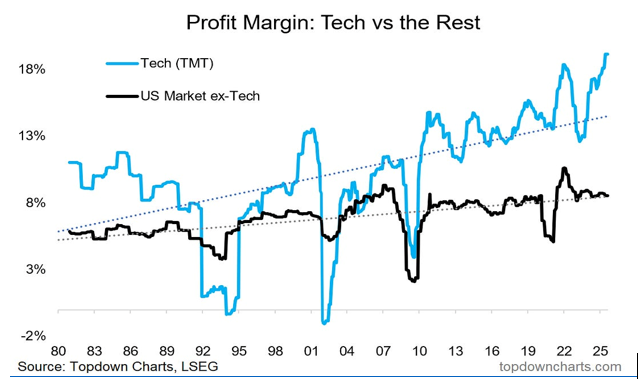
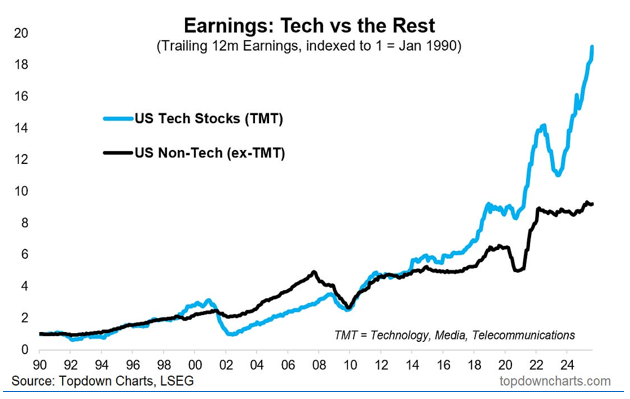
Will the rest of the market catch up? Are those margins and earnings sustainable? While talk of recession is subsiding along with the fear of tariffs’ consequences, which are the uncertain, immense market and geopolitical risks that we may be ignoring, could they turn the tables?
This week is crucial regarding the trading relationship with China, but even more importantly, with regard to the Alaska summit about the war in Ukraine. One risk cannot be ignored: Plan B needs to be in place to make sure that Putin loses if the talks fail.
Similarly, geopolitical considerations couldn’t allow a repeat of a China shock 2.0, where China dominates the tech sector, as the trajectory points out. (China shock 1.0 refers to the ascension of China in the WTO, which enabled Chinese products to flood the markets, elevating deindustrialization, producing record Chinese savings, which, in turn, flooded US liquidity via bond purchases, and which drove rates to very low levels, creating bubbles, imbalances, dislocations, and capital misallocation).
At a very crucial point in history, when things were falling apart in Athens, Solon was given extraordinary powers and was asked to enact new legislation and institutional arrangements. In his wise ways, Solon drafted a new legislation that the Athenians freely adopted and committed not to change for ten years. The legislation was such that it advanced vital reforms, established a legal foundation for order and prosperity, abolished institutionalized injustice by protecting the poor without alienating the wealthy, elevated humane laws and customs, created new political institutions that promoted democracy, and influenced Western legal traditions for centuries to come. To avoid the expected pressures to change the laws, Solon started traveling around the then-known world. Among the places he was invited to visit was Sardis, where Croesus reigned supreme.
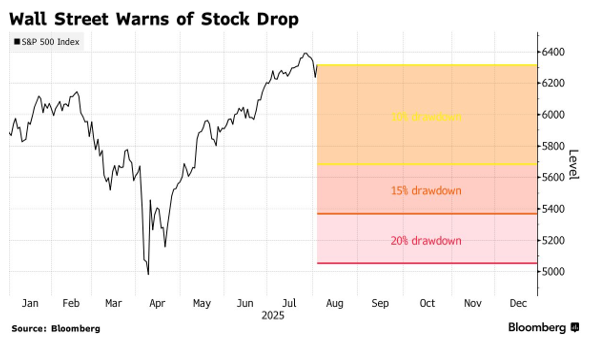
The risk of a market pullback in the short term is rising due to sky-high valuations, according to some Wall Street strategists at Morgan Stanley, Deutsche Bank, and Evercore. The risk of correction is based on rising concerns that inflation will pick up speed between October and February. This is due to abundant liquidity that may be uplifted further if rates are cut. In addition, the settled average tariff level of more than 15% (vs. 2.3% of the past several years) could boost inflationary pressures. Furthermore, the economic growth rate and that of jobs’ creation may subside further by year’s end and in the first half of 2026, so naturally the market would discount that risk. The market has also quantified the rising risk of a downturn by making the insurance/hedging against a drawdown very expensive, as well as by redemptions, which are above normal levels.
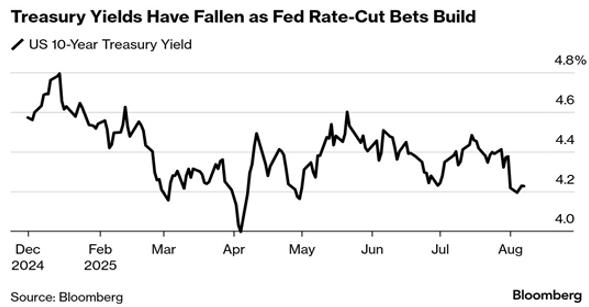
So, as expectations rise for a rate cut in September, the yields on Treasuries are falling (as shown below), which could advance liquidity but also stagflationary risks. The latter can be seen in the trajectory of the dollar.
Croesus was enjoying the ride that the wealth of ancient Lydia (Sardis being the capital) afforded him. Sardis was considered an impenetrable city whose wealth elevated its arrogance and that of its ally/protector (Persia). When Solon visited Sardis at the invitation of its king, Croesus, he was unimpressed and said so to Croesus twice, when asked. Solon, in his wisdom, made it clear to Croesus that he despised his lack of taste and petty ostentation. For Solon, the crucial elements for a good/fortunate/blessed life consisted of honor, integrity, family, country, and sacrifice. By the time that Croesus had lost his temper, he burst out: “So you do not include me among those who are happy at all?” Solon, of course, couldn’t flatter the king, so he humbly replied: “King of the Lydians, the gods have given us Greeks only a moderate share of their blessings, and in the same way our wisdom is also a moderate affair, a cautious habit of mind, …this instinct of ours tells us that human life is subject to innumerable shifts of fortune and forbids us to take pride in the good things of the present, or to admire a man’s prosperity while there is time for it to change. The future bears down upon each one of us with all the hazards of the unknown…to congratulate a man on his happiness while he is still living and contending with all the perils of the mortal state is like proclaiming an athlete the victor and crowning him before the contest is decided, there is no certainty in the verdict and it may be reversed at any moment.”
When Sardis was burned during the Ionian revolt in 498 BC, it brought the wrath of Darius I against the Greeks, only to experience the humiliation of Persia in 490 BC and in 480 BC. There you go then, two hubristic empires that knew the price of today’s happy reports but ignored the value of a long-lasting prosperity.
