
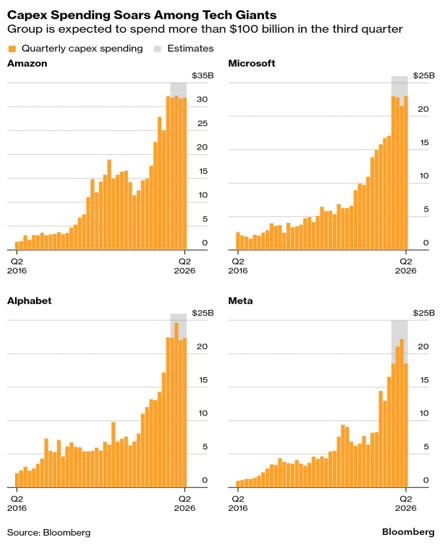
AI has a balance sheet problem: There is a fundamental discrepancy between the projected spending on AI and the corresponding projected revenues. No company can continue spending hundreds of billions of dollars (cumulatively trillions of dollars) and, in return, expect a few billion as projected revenues. Such gaps are known are killer gaps. The Capex budget of these hyper-scalers is a far cry from a realistic expectation of profits, and no model (subscription, advertising, etc.) seems to be closing the gap.
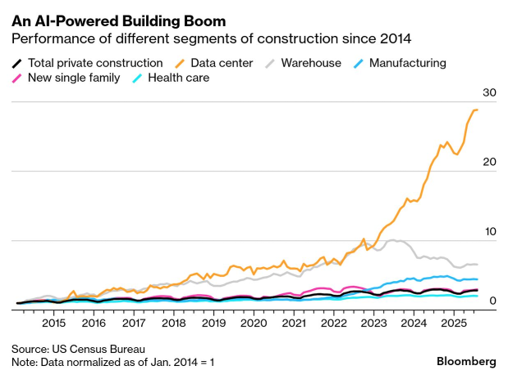
In recent reports, we read that spending on AI (data centers, cloud infrastructure, LLMs, new agentic automation platforms, processors and chips, etc.) is responsible for more than 70% of GDP’s growth and for more than 80% of the market’s gains. That’s astonishing and requires a lot of faith, given the very limited commercial victories at hand as well as those expected by most of the spenders. Delayed and ambiguous returns mark an opaque, large system crowned with a mystical but invisible authority. The herd mentality prevails, according to which we must spend more because others are spending. The monetization verdict can be postponed as long as faith sustains the system, despite the warnings that the gaps are growing.
This is an opaque reality, and as weeks and months go by, the unfolding system becomes opaquer and more powerful. The paradox is that the market’s faith in it becomes stronger as the opacity and AI’s balance sheet paradox increases. It’s like living in Kafka’s novel titled The Trial. In Kafka’s book, the protagonist (Joseph K.) is an ordinary person who is ensnared in a labyrinthine system where authority is opaque. Joseph K. is prosecuted for a crime he knows nothing about, by a court whose abnormal procedures are beyond any rationale. Joseph K. spends the entire novel trying to understand a system that by design cannot be comprehended. What drives him daily is an internal conviction that somewhere in the labyrinth of complexity and bureaucracy, he will discover the cause of his prosecution.
The opaque system becomes a system of belief, where power is sustained by obscurity, authority is derived from incomprehension, and legitimacy is gained by complexity. Incomprehension built on complexity and crowned by obscurity must be something extraordinary. The characters in Kafka’s novel obey the system because they do not want to be outsiders, let alone ostracized. The schizophrenic, self-perpetuating reality of such opacity becomes a source of alienation.
Imagine a world where a faceless bureaucracy controls Joseph K.’s life and the lives of all members of society. There is endless procedural motion but no transparency in the pronounced outcomes. The word “Court” in Kafka’s novel is the modern AI, as the latter performs the functions of the former. You cannot question the modern Court; you can just obey its spending demands. Deferred judgment (the equivalent of monetization of forthcoming productivity gains) becomes Joseph K.’s curse. The more we invest in it, the more we must believe in the forthcoming profits, and like Joseph K., the higher the expectation for a favorable verdict.
Our fear is not so much in the scenario where AI fails to deliver profits, but in the possible scenario where AI writes its own code to construct a new bureaucracy of the mind where opacity becomes the end in itself, and our belief in the inevitability of the verdict is manipulated by techno-oligarchs who themselves do not have a comprehension of the system’s evolution.
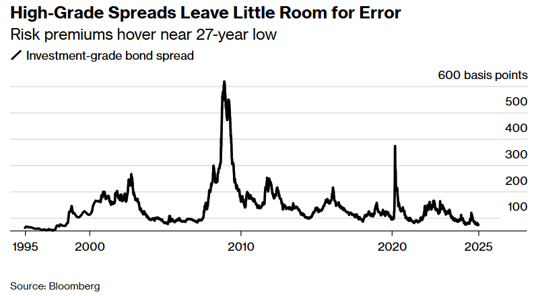
As Bloomberg reported recently, tech firms are striking blockbuster debt deals to pay for their AI ambitions. The growth in those debt deals is well over 70% since last year. The appetite for these bonds is such that spreads have been pushed to their lowest level in the last 27 years (see graphs below), signifying belief in the Kafkaesque system that even over-indebted firms will have the means to pay creditors back.
When a harmonious proportion stands at the center of discovery, then the seeker probably stands at the threshold of the truth. The Renaissance figure who grasped that reality was none other than Leonardo da Vinci. His voluminous notebooks reveal his Aristotelian fascination with invention and observation. However, Leonardo’s Vitruvian Man reveals his Platonic side. Leonardo was steeped in the Pythagorean formulas of harmonious proportion. He understood the creative power of the golden section. Leonardo’s visual allegory of man’s place in the cosmos has the man standing in the center of not one but two geometric figures, the square and the circle. Far from squaring the circle, Leonardo was content to show that the ratios derived from the golden section place the human being at the center of both geometric figures. Leonardo’s man bridges the gap between infinity and matter, between divinity and mortality, and that’s where possibly lies the failure of an opaque system that doesn’t place the human beings at the epicenter of its design.
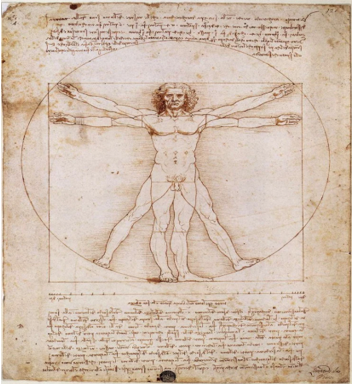
Leonardo’s Vitruvian Man is the metaphor for synthesizing science, art, and proportion, where everything radiates from the human center. In Kafka’s The Trial, Joseph K. is no longer at the center. He, rather, orbits an inexorably invisible system that constantly traps him and displaces him. Just as Joseph K. experiences alienation from a system where bureaucracy becomes disproportionate to justice, in an unbalanced technocratic state innovation expands, but the human element (let alone ethics) either disappears or becomes peripheral. Human relationships no longer define the geometry of progress, but it is instead capital spending and code that displace and distort proportionality among dollars, value, integration, and comprehension. When the circle of ambition outpaces and is not aligned with the square of reality, the imbalances produced have the capacity to disintegrate the system.
Over the next few years, we all must decide if we will adopt the vision of disempowerment and alienation where human beings are lost in the machinery of an opaque Kafkaesque system, or Leonardo’s vision of balance, where human beings are at the center of a forthcoming system in which investment, utility, and design align to produce convergence between purpose, proportion, and beauty.
