
Welcome to the latest edition of the Carbon Market News Roundup, our bi-weekly briefing on the evolving landscape of global carbon markets and climate-related regulation. Our previous issues, along with the rest of our commentaries, may be read here.
Across the EU carbon policy landscape, a common theme is the growing tension between increasingly ambitious climate regulation and the economic, political, and industrial realities of implementation. Ahead of the EU ETS review, divisions have emerged not only between policymakers and industry but within industry itself, as companies that have invested heavily in decarbonization argue against weakening carbon pricing while others seek greater regulatory relief. Similar tensions appear in maritime shipping, where expanding ETS obligations and broader emissions regulations are outpacing the development of affordable renewable fuels and supporting infrastructure. The EU’s Carbon Border Adjustment Mechanism (CBAM) faces comparable structural challenges, with unresolved carbon leakage risks for exports, gaps in downstream product coverage, and concerns over the continued concentration of benefits through free allowances. Meanwhile, developments in the voluntary carbon market reveal that market-based climate solutions remain constrained by fragile demand, unreliable project delivery, and evolving governance frameworks, even as new regional initiatives seek to expand participation and improve integrity.
EU ETS – Regulations Updates & EUA Price Movement
Carbon Market Watch
EPP pushes to soften EU carbon market reforms in bid to shield industry
EuroNews, Marta Pacheco
EU Industry Splits Over Emissions Trading Scheme Overhaul
Oil Price, Tsetana Paraskova
FEATURE: Price or volume? EU weighs options for future ETS Market Stability Reserve
Carbon Pulse, Frederic Simon
The clearest story ahead of the July 15 EU ETS review is that the industrial coalition demanding relief is fracturing from within. That fracture is more analytically revealing than the lobbying pressure itself. On one side stand BASF, ArcelorMittal, ThyssenKrupp and Voestalpine, who sent a joint letter to EU leaders demanding an immediate halt to rising carbon costs, while the EPP, Parliament’s largest group, formally urged Commissioner Hoekstra to extend free allowances beyond 2030 and slow the pace of reductions under the Linear Reduction Factor. On the other side, a group of six European steelmakers (SSAB, Outokumpu, Salzgitter, Saarstahl, Dillinger and SHS) issued a public joint statement arguing that weakening the ETS would penalize first-movers, erode investment certainty, and delay the very transformation the system was designed to accelerate. SSAB’s executive vice president was explicit: companies that never invested in decarbonization could end up at an advantage if the carbon price signal is diluted. The division is not between industry and environmentalists but between companies at different stages of their own transition. This is a genuinely new dynamic that the Commission’s July 15 proposal will have to navigate.
Two other developments sharpen that context. A CE Delft study commissioned by Carbon Market Watch found that extending ETS coverage to all departing aviation flights would raise up to €19 billion annually if arriving flights are also included, while adding less than 1% to an economy return ticket from Frankfurt to Singapore, effectively dismantling the airline industry’s central argument against expansion. This is including long-haul and private jets, which currently escape the system entirely. That untapped revenue potential sits in uncomfortable contrast to the EPP’s simultaneous push to reduce the industrial carbon cost burden. Meanwhile, Carbon Pulse reports that policymakers are divided over the fundamental architecture of the Market Stability Reserve going into the review. The question is whether to keep the existing volume-based triggers that have historically lagged behind market conditions or to introduce price-based triggers that could act as a soft price corridor, providing more responsive supply management without formally setting a price floor. How that design question is resolved will determine whether the reformed ETS acts as the robust carbon pricing tool investors are demanding, or becomes a system that is softened at the cap, extended in its free allocation, and still unable to respond quickly to market stress.
Maritime & Shipping Updates
ECSA: Europe Should Use Carbon Fee Revenue to Support Green Fuels
The Maritime Executive
Ferry Operator Cites EU ETS and Taxes in Plan to Sell Vessels, Stop Routes
The Maritime Executive
Renewable Shipping Fuel Supply at Risk as EU Proposal- Threatens Key Delivery Pathway
International Shipping News
UK expected to extend emissions penalties to smaller vessels
Maritime Journal
The principal challenge facing maritime decarbonization is no longer the introduction of climate regulation, but ensuring that regulatory ambition is matched by sufficient economic and industrial support. The ECSA case emphasizes that European shipping companies already contribute around $10 billion annually through the EU Emissions Trading System (ETS), while European owners account for 44% of the global orderbook for green-fuel capable vessels. However, Europe produces only 10% of global sustainable fuel projects, with less than 5% of European sustainable fuel production allocated to maritime use. ECSA therefore argues that ETS revenues should be reinvested to bridge the fact that renewable marine fuels remain around four times more expensive than conventional bunker fuels and to accelerate clean technology projects. Similarly, warnings appear that the European Commission’s proposed changes to renewable fuel regulations could further weaken investment by limiting key fuel production pathways, particularly those supporting renewable hydrogen and e-fuels. Rather than stimulating supply, the proposal is presented as creating additional uncertainty for producers already facing high costs and restrictive regulatory requirements, thereby threatening the availability of the very fuels required to comply with FuelEU Maritime and ETS obligations.
These policy shortcomings are already translating into commercial and operational impacts. Reports on the ferry operator shows that rising compliance costs from the EU ETS, together with wider taxation, are influencing strategic business decisions, including plans to sell vessels and withdraw routes that have become economically unviable. This illustrates that carbon pricing is no longer a theoretical future cost but an immediate factor affecting fleet deployment and regional connectivity. Meanwhile, there are reports that the UK is preparing to broaden emissions penalties to smaller domestic vessels, signaling that carbon regulation is expanding beyond large international shipping into previously exempt sectors. When compared with the other articles, this demonstrates a clear regulatory trajectory: emissions pricing and environmental obligations are becoming more comprehensive across Europe, while the supporting market for renewable fuels remains underdeveloped. Overall, a consensus across cases is that decarbonization policy must evolve beyond imposing compliance costs and instead prioritize investment in fuel production, infrastructure and technological deployment, otherwise increasingly stringent regulations risk undermining both the competitiveness and operational resilience of the maritime sector.
EU CBAM Updates
CBAM certificate price expected to remain broadly stable in Q2 2026
Steel Orbis
EU ETS: Big corporations benefit, SMEs are left out – Stainless Espresso
Steel News, Gerber Group
EU’s carbon border levy struggles to adjust to exports
EuroMetal
ArcelorMittal Urges EU to Extend CBAM and TRQs to Downstream Steel
Shanghai Metals Market
CBAM and ETS, despite their expanding scope, contain structural gaps that are generating both market distortions and political inequity. The most significant gap is the export problem. CBAM as currently designed protects EU producers from cheap carbon-intensive imports, but does nothing for EU companies exporting the same goods into markets with no equivalent carbon price. As Eurofer’s director-general put it, without a fix there is a real risk of production and emissions simply migrating outside Europe rather than being reduced. The Commission has promised a permanent solution in its 15 July ETS review, and a temporary decarbonization fund worth roughly €300 million annually has been proposed as a stopgap. However, that measure has been dismissed as a sticking plaster on a wooden leg, since member states are reluctant to cede control of the CBAM revenues that would fund it. Meanwhile, ArcelorMittal has gone further, warning that the entire downstream steel value chain sits outside both CBAM and tariff-rate quota coverage. Effectively this is creating a bypass route for carbon-intensive imports that undercuts the policy’s purpose from below.
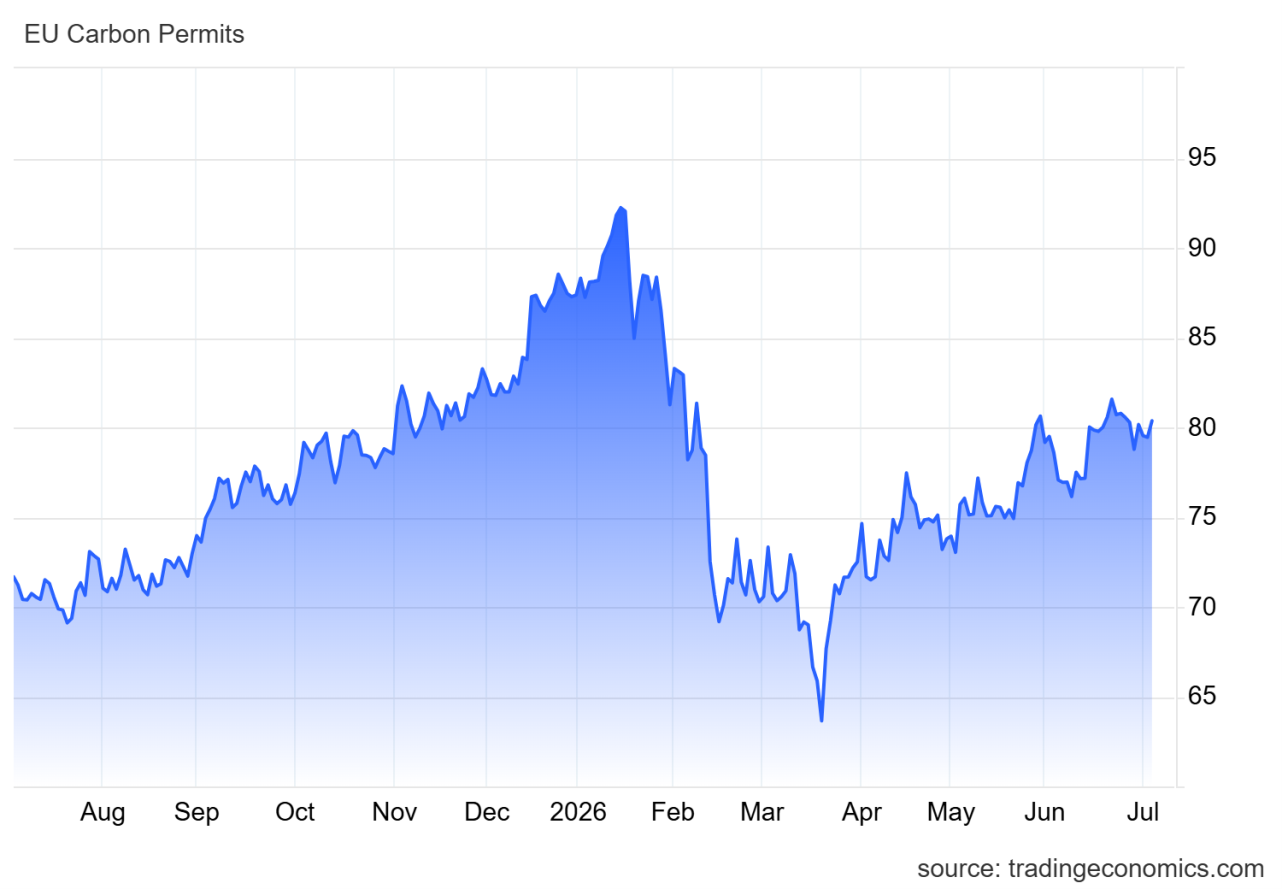
On a more macro-market level, the same 40 major corporations now lobbying loudly for ETS relief (ArcelorMittal, ThyssenKrupp, BASF) have cumulatively received nearly €464 billion in free ETS certificates since 2005. This is a subsidy that small and medium-sized enterprises never accessed even though they quietly absorb the same rising carbon cost environment without the lobbying firepower to get heard. CBAM certificate prices, meanwhile, are expected to hold broadly stable around €75/ton in Q2 2026, according to CO2 IQ, with EUA auction prices anchored between €70 and €80. This is a relative calm that masks the turbulence ahead, since the Commission’s mid-July ETS reform package is widely expected to inject significant volatility into Q3. The structural picture that emerges is of a carbon pricing architecture that is simultaneously too porous to prevent leakage and too concentrated in its benefits to command broad political legitimacy.
Voluntary Carbon Market News
It’s not about Microsoft. Voluntary carbon markets alone can’t scale carbon removal.
Steel Orbis
Sustainability leaders to explore future of climate finance and carbon markets
Arab News
Carbon fund pulls support from African nature carbon project over viability concerns
Carbon Pulse, Dimana Doneva
Singapore Government and the ICVCM deepen partnership to advance high integrity carbon markets
National Climate Change Secretariat Singapore
Microsoft’s carbon removal pause together with the African carbon project failure expose the voluntary carbon market’s most persistent structural weakness: fragility of demand and fragility of supply. The VCM, however well-intentioned, cannot alone drive carbon removal to the gigaton scale the climate requires. The Microsoft pause, being the clearest demonstration yet, shows what happens when a market is anchored by a single dominant buyer pressured by the surging energy demands of AI. The result is a whole sector wobbling. The parallel story of a major carbon fund withdrawing support from an African nature-based project that failed to secure validation or generate a single credit since its 2022 launch underscores that the supply side is equally fragile. Ambitious projects in the Global South, precisely where the VCM’s development finance rationale is strongest, remain highly vulnerable to viability failures that leave intended beneficiaries with nothing.
Against this backdrop, the governance and geographic expansion stories take on added weight. Singapore and the ICVCM formalized a cooperation agreement during London Climate Action Week to advance high-integrity carbon market standards across Asia, with Singapore’s Ambassador for Climate Action framing the challenge as one of building trust and transparency before scale. Meanwhile, Saudi Arabia’s Tadawul Group and the Regional Voluntary Carbon Market Company announced a November forum and the first-ever issuance of Saudi-origin carbon credits, with over 30 projects and 30 companies already expressing participation intent. Singapore is focused on governance architecture and interoperability, working to ensure that the credits flowing through Asian markets actually meet rigorous standards; Saudi Arabia is focused on market entry and supply creation, moving quickly to establish itself as a carbon credit originator. Both are necessary, but the Microsoft’s and the carbon African project case are reminders that expanding the market’s geography and institutional footprint means little if the underlying demand remains brittle and project delivery unreliable.
To explore insights and tools driving carbon compliance and market visit the FACS website here!
