
Welcome to the latest edition of the Carbon Market News Roundup, our bi-weekly briefing on the evolving landscape of global carbon markets and climate-related regulation. Our previous issues, along with the rest of our commentaries, may be read here.
This issue examines the state of carbon markets during a moment of stress and contested direction. Across all four areas, ambitious carbon pricing systems are being pulled between the demands of climate credibility on one side and political, commercial, and jurisdictional pressures on the other. Industrial lobbies are pushing back against tighter benchmarks, shipping regulators are scrambling to coordinate across borders, farmers are calling for CBAM carve-outs, and voluntary carbon markets are grappling with long-standing integrity failures. The central question running through this issue is whether the architecture of carbon pricing and the voluntary carbon markets are now strong enough to withstand the compounding forces of geopolitical disruption, competitiveness anxiety, and enforcement complexity, or whether they will be gradually hollowed out.
EU ETS – Regulations Updates & EUA Price Movement
4 EU countries slam planned ETS benchmark updates
Siobhan Hall, Montel News
European Commission
Dilution doesn’t fix pollution: ETS2 must work for people and climate
Emma Wikström, Carbon Market Watch
No ETS benchmark freeze: Brussels refuses more free CO2 permits for industry
Nikolaus J. Kurmayer, Euractiv
The EU ETS is under significant strain from multiple directions simultaneously. On the industrial side, six member states: Bulgaria, Czech Republic, Greece, Poland, Romania and Slovakia are all pushing Brussels to freeze free CO2 permit allocations at current levels, resisting the Commission’s planned benchmark tightening. Brussels has so far refused. On the ETS2 front, covering buildings and road transport, the Commission proposed a reform of its Market Stability Reserve that risks flooding the system with roughly half a billion extra allowances, threatening EU climate targets. Civil society groups warn that weakening carbon pricing will not help ordinary people cope with energy costs.
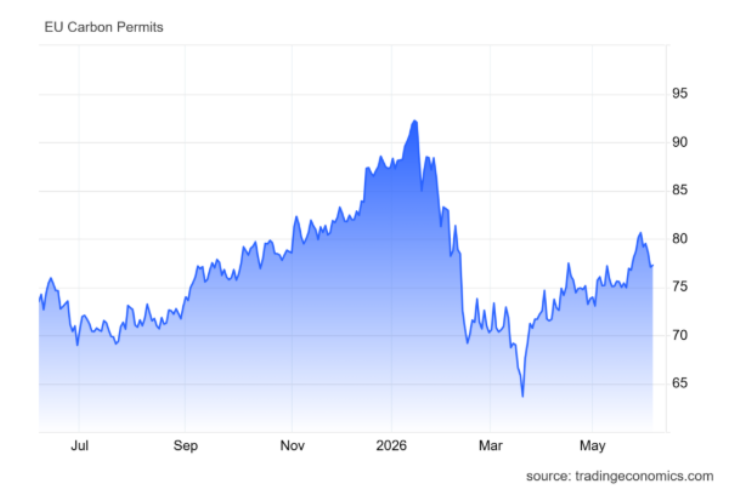
Meanwhile, enforcement is tightening. The Commission referred Spain and Poland to the EU Court of Justice for failing to transpose the revised ETS directives into national law, seeking financial sanctions. The overarching trend is a deepening tension between industrial competitiveness pressures and the EU’s legally binding climate commitments. This indicates that the legitimacy of such carbon pricing mechanisms, albeit one as big as that of the EU, increasingly depends on enforceability.
Maritime & Shipping Updates
UK Carbon Market Expansion To Shipping Could Generate £1 Billion Annually: ICCT
Responsible Us Bureau
Shipping will not pay twice for greenhouse gas emissions, EU commissioner tells Greek shipping
Craig Eason, Tradewinds
Green Corridors Open Routes To Fossil-free Shipping
Technical University of Denmark
ESPO: EU-ETS creates both carbon and commercial “leakage”
The Editorial Team, Safety4Sea
Momentum for carbon pricing beyond the EU gathers, according to an ICCT analysis, which finds that expanding the UK Emissions Trading Scheme to shipping could raise nearly £1 billion annually. Yet the EU’s own maritime ETS is already under strain. The European Sea Ports Organization warns that the regional scope of the EU-ETS is driving both carbon and commercial “leakage” with ships rerouting to avoid EU ports, while non-EU ports rapidly expand capacity at Europe’s expense. At the same time, researchers argue that carbon taxation must be significantly increased before shipping companies face a real commercial incentive to switch to zero-emission fuels.
The policy response from Brussels is to reassure rather than retreat. EU Commissioner Tzitzikostas told delegates at Posidonia 2026 that shipping companies will not be required to pay twice under both the EU ETS and the IMO’s emerging global framework, and that ETS revenues should be reinvested directly into the sector’s clean-fuel transition. The broader picture is one of a sector caught between regulators racing to price carbon and an industry warning that poorly coordinated, regionally fragmented rules risk pushing emissions and trade flows out of reach rather than eliminating them. The race is now between tighter pricing signals and the global coordination needed to make them effective.
EU CBAM Updates
European ministers call for stepping up of urgent measures in face of fertiliser crisis
Europe Daily Bulletin No. 13874, Agence Europe
Irish govt backs proposed EU CBAM off switch during market shocks
Francess McDonnell, Agriland
From CBAM to tariffs: How industry leaders are preparing for aluminium’s changing policy landscape
Trisha Hazra, AlCircle
EU carbon tariff could influence climate policies beyond its borders: Study
Puja Das, DownToEarth
On the CBAM front, there is a deepening tension. Designed as both a climate tool and a trade shield, CBAM is simultaneously delivering geopolitical leverage and generating domestic political backlash. A Potsdam Institute study finds that CBAM could boost global emissions reductions by 73% compared with EU climate policy alone, as trading partners like Canada, South Korea and Japan adopt their own carbon pricing to avoid the levy. Aluminum industry leaders echo this shift, noting that policy developments are now just as influential as supply and demand, with the competitive landscape moving away from cost optimization toward verified carbon performance.
Yet domestically, CBAM is under siege. EU agriculture ministers from countries including Lithuania, Poland and Latvia raised concerns about CBAM’s indirect impact on fertilizer production costs. Latvia openly called for its suspension of fertilizers, while the Irish government backed a proposed safeguard mechanism that would temporarily remove fertilizer products from CBAM rules in the event of serious market disruption. The geopolitical pressures driving up fertilizer prices are thus converting CBAM into a political liability for farmers. The central analytical tension is clear. The very market shocks that make CBAM most relevant as a strategic tool are also the moments that make it most politically vulnerable.
Voluntary Carbon Market News
Europe lays the foundations for a robust carbon removals and carbon farming market
Directorate-General for Climate Action, European Commission
Why Big Carbon Offsets Often Fail
Rachel Rose Jackson, CounterPunch
Africa’s carbon market opportunity comes under the spotlight
Engineering News
Integrating North American carbon credit markets: Prospects and recommendations
Derik Broekhoff, Sanjay Patnaik, and Aidan Conley, Brookings
The overarching debate in voluntary carbon markets is increasingly whether they can deliver real, verifiable emissions reductions or whether they are prone to failure and fragmentation. A Corporate Accountability analysis of the world’s largest carbon offset projects found widespread structural failures, with over-crediting and non-permanence persisting as systemic risks across multiple registries, sectors and project types. Communities in low-income countries are disproportionately bearing the burdens of failed projects. Africa’s growing engagement with voluntary carbon markets is attracting attention as a potential vehicle for climate finance, yet questions remain around market integrity, governance, transparency and the equitable distribution of benefits.
The institutional response on both sides of the Atlantic is to build more rigorous architecture rather than abandon the concept. The EU’s first Carbon Removal and Carbon Farming Days gathered over 500 stakeholders to advance the CRCF Regulation into its operational phase. Certification schemes now are able to apply for EU recognition and the EU Buyers’ Club emerging as a mechanism to aggregate corporate demand and de-risk investments. A Brookings Institution report argues that North American carbon credit markets are unnecessarily fragmented in ways that make them less efficient and reliable than they could be, calling on US policymakers to develop common infrastructure, standards, and governance mechanisms across voluntary and compliance markets. The market’s ambition is expanding geographically and institutionally, but its legitimacy deficit remains the central obstacle to it scaling.
To explore insights and tools driving carbon compliance and market visit the FACS website here!
