
Welcome to the latest edition of the Carbon Market News Roundup, our bi-weekly briefing on the evolving landscape of global carbon markets and climate-related regulation. Our previous issues, along with the rest of our commentaries, may be read here.
This fortnight’s carbon-market landscape is defined by a common tension. Policymakers are seeking to accelerate decarbonization while containing its effects on industrial competitiveness, trade and investment. EU ETS reform signals a softer tightening path and weaker near-term EUA upside, while maritime regulation exposes the costs of fragmented carbon pricing across jurisdictions. CBAM extends this dynamic into trade policy, increasingly linking carbon intensity with market access and geoeconomic competition. Meanwhile, voluntary carbon markets are becoming more state-shaped, as governments seek to mobilize climate finance while retaining control over carbon assets and standards. Together, these developments point toward a more interconnected but increasingly fragmented global carbon architecture.
EU ETS – Regulations Updates & EUA Price Movement
EU climate policy update: Emission trading reform and electrification push
Nordea, Marco Kisic
EU ETS reforms could add 1.9 bln additional allowances to market by 2040, estimates think tank
Carbon Pulse, Roy Manuell
Negative impact of EU ETS seen on port connectivity
Seatrade Maritime News, Nick Savvides
Analysts lower EU carbon price forecasts for 2026, 2027 on market reform proposals
Reuters, Susanna Twidale
The thread running through this fortnight’s ETS news is a policy pivot toward industrial relief that markets are still digesting. The European Commission’s July reform package softens the trajectory. The Linear Reduction Factor drops to 3.7% for 2031-35 and 1.7% thereafter, free allocation is extended toward 2038, and international/removal credits get folded in, backed by a €100bn Industrial Decarbonization Bank. Nordea frames this alongside a parallel Electrification Action Plan as a bid to protect competitiveness, even at some cost to long-term regulatory certainty. A think tank’s estimate that the reforms could add nearly €6 billion worth of free carbon allowances over the 2026-30 period, plus roughly 1.9 billion additional allowances by 2040, points to a structurally looser market than previously planned. That looser stance is already showing real-economy friction. Spain’s Puertos del Estado links ETS-driven shipping cost avoidance to falling EU port connectivity, as carriers reroute calls to Egypt and the UK. And Reuter’s reports analysts have cut 2026 and 2027 EUA price forecasts to €79.97 and €89.13 respectively, directly citing the reform proposals as the cause.
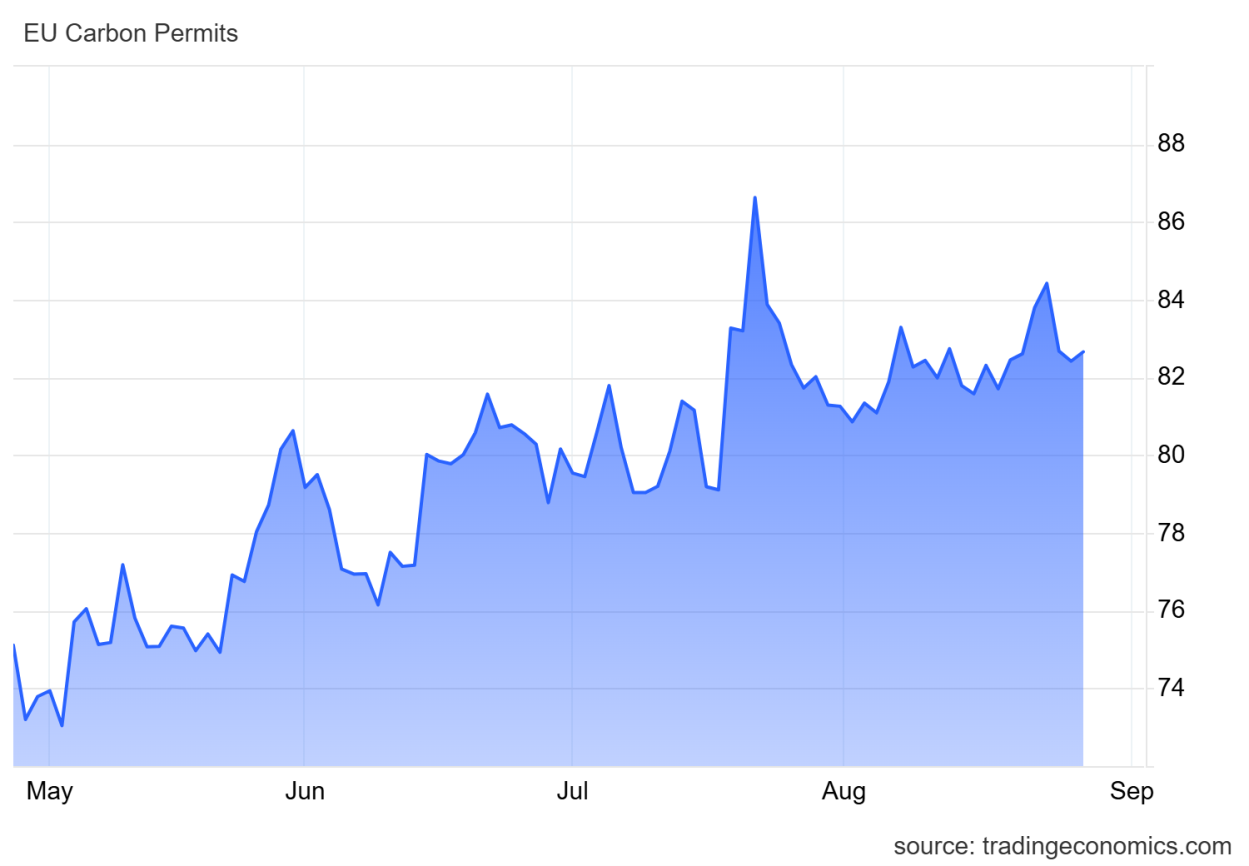
Against that backdrop, EUA prices confirm the story. EUAs drifted in a choppy €76-82 range through June and most of July as the market awaited details, then spiked sharply to roughly €87 around July 22 in what one advisory firm called a “relief rally”. The initial read that reduced tail-risk (no abrupt cap collapse) was bullish. That spike proved unsustainable. As the surplus-heavy specifics sank in, prices corrected back into the low-to-mid €80s through early August, broadly tracking the analyst downgrades. The net effect is a market re-pricing slower, but still positive, long-term tightening. This provides some relief for industry, but less of an upside for holders.
Maritime & Shipping Updates
Cyprus shipping firms await crucial IMO decision on global carbon pricing
Cyprus Mail, Souzana Psara
Decarbonising the shipping industry will require coordinated action, says EY-Parthenon
Sustainability Online, Editor
National carbon pricing regimes expand as shipping awaits a global framework
European Maritime Finance
FuelEU Maritime: early lessons from the first year of compliance
Skuld, Matias Bøe Olsen
In the maritime world, regulatory proliferation ahead of resolution is the name of the game. The IMO’s Net-Zero Framework talks remain deadlocked between four competing visions — from Tuvalu’s steep $300/ton Tier 1 price and mandatory fund payments to Liberia’s tradable-surplus, price-light model — leaving Cyprus- and Greece-based owners unable to commit capital to newbuilds or retrofits until a compliance price materializes. Into that vacuum, national and regional schemes keep expanding rather than waiting. The UK ETS now captures in-port emissions from vessels above 5,000 GT, layering onto the EU ETS and FuelEU Maritime, and raising real risk of double-charging the same ton of CO2 across jurisdictions with no reconciliation mechanism yet in place.
Underneath the pricing debate sits a harder physical constraint. EY-Parthenon’s research frames decarbonization as fundamentally a supply-chain coordination problem. Projected demand for low- and zero-carbon fuels could outstrip supply growth several times over this decade, meaning price signals alone cannot substitute for parallel investment in fuel production, bunkering infrastructure and shipyard capacity.
FuelEU’s first compliance year offers a useful data point in this debate. With 92% of vessels choosing pooling over penalties, and surplus trading settling near €208/ton against a €640 penalty, the scheme shows a market-based mechanism can function at scale. This is potentially a template IMO negotiators could borrow, even as the wider system remains stitched together from incompatible regional patches rather than one coherent global price.
EU CBAM Updates
EU ETS review could ease CBAM costs for Turkish exporters
SteelOrbis, Elif Kefeli
UK working with other countries to set its CBAM rules
Carbon Pulse, Sara Stefanini
Indian steel’s CBAM hit softer than expected: Sandbag
Argus, Amruta Khandekar
EU carbon border levy draws fresh scrutiny over trade impact
Traders Union, Ciaran Ryan
On the CBAM front, carbon pricing is increasingly becoming a determinant of market access, competitiveness and industrial geography. The proposed EU ETS revision illustrates the macroeconomic tension at the heart of this transition. By slowing allowance-supply reductions and potentially extending free allocations to 2038, Brussels could moderate EU carbon-price growth and, consequently, reduce the near-term CBAM cost burden for exporters such as Turkey. Since CBAM certificate prices are linked to EU ETS prices, the reform would effectively smooth the pace at which the EU externalizes its carbon costs to trading partners. The Indian steel case demonstrates a second, more structural effect. CBAM is already encouraging exporters to optimize where different production routes are allocated. Sandbag estimates that Indian steel exposure could fall from €762 million to €407 million if lower-emission output is preferentially directed toward the EU. This suggests that CBAM may reshape trade flows and production allocation even before substantial new decarbonization investment occurs.
At the geoeconomic level, the UK’s parallel development of a border carbon tax with international institutions involved in designing its rules, signals that CBAM-type measures may proliferate beyond the EU. This creates a potential fragmentation risk where exporters could face multiple carbon-border regimes, methodologies and compliance costs. Meanwhile, scrutiny over CBAM’s trade effects highlights the central policy dilemma. Although framed as climate policy rather than protectionism, its commercial effect can resemble a tariff on carbon-intensive imports. The emerging trend is carbon becoming a new instrument of industrial policy and geoeconomic competition. Implications extend into trade diversion, supply-chain restructuring, competitiveness and future negotiations over climate-related trade rules, making CBAM a key shatter point in geoeconomics
Voluntary Carbon Market News
Türkiye, Ghana and Luxembourg join Coalition to Grow Carbon Markets
Anadolu Ajansi: Energy Terminal, Handan Kazancı
Kenya Sets Carbon Credit Limit On Exports, Expert Wary Of Guidelines
Forbes Africa, Freddie Hiney
Trump Administration Reverses Carbon Offset Regulations, CRS Says
Legis1, Mackenzie Prince and Joanne Levine
BAFS
Recent developments in voluntary carbon markets (VCMs) suggest a transition from a fragmented offset market toward a more explicitly state-shaped system for mobilising climate finance, controlling carbon assets and establishing internationally credible market infrastructure. The expansion of the Coalition to Grow Carbon Markets, now involving 14 governments including Türkiye, Ghana and Luxembourg, reflects growing recognition that voluntary demand alone may be insufficient to generate the scale of finance required for decarbonization. Kenya offers a contrasting but complementary model. Nairobi is treating carbon credits as strategic national assets capable of attracting investment and generating development finance. The accompanying emphasis on predictability and institutional coherence demonstrates that producer countries increasingly want greater control over who captures the value created by their carbon resources.
The US trajectory illustrates the opposite policy risk. The retreat from federal oversight under the Trump administration, documented by the Congressional Research Service, reinforces uncertainty around integrity, verification and the role of offsets in climate policy. This regulatory divergence could increase fragmentation between national VCM frameworks. Thailand’s emphasis on high-quality standards and international competitiveness similarly shows how emerging markets are seeking to turn VCMs into structured economic infrastructure rather than simply offset platforms.
To explore insights and tools driving carbon compliance and market visit the FACS website here!
