
Welcome to the latest edition of the Carbon Market News Roundup, our bi-weekly briefing on the evolving landscape of global carbon markets and climate-related regulation. Our previous issues, along with the rest of our commentaries, may be read here.
Carbon markets are entering a defining stretch of 2026, and the story emerging across our beat this fortnight is one of divergence. As Brussels debates whether to loosen its flagship Emissions Trading System just as it toughens its carbon border tax, and as shipping’s carbon-fee revenues pile up without funding the fuel transition they were meant to drive, the credibility gap between climate-policy ambition and real-world decarbonization keeps widening. Yet even as Europe wrestles with competitiveness pressure and compliance loopholes, Southeast Asia is building towards a more durable voluntary carbon market. Across the board a lesson shines through; carbon pricing is proving very good at generating revenue and reshaping behavior, and considerably harder to convert into the clean investment it was designed to unlock.
EU ETS – Regulations Updates & EUA Price Movement
EU Weighs Slower Emissions Cuts And More Free Permits As It Reworks Carbon Market Rules
Carbon Herald, Theodora Stankova
The EU Emissions Trading System at a juncture – What is at stake for the EU?
E3G, Pepe Escrig, Domien Vangenechten, Manon Dufour
The 3 letters Brussels won’t be able to shut up about
Politico, Zia Weise
GreenAir, Christopher Surgenor
The EU ETS review, due July 17, has become a fight over whether Europe’s core carbon-pricing tool stays a strict decarbonization signal or gets loosened to protect industrial competitiveness. Reporting indicates the Commission is weighing extending the ETS timeline into the 2040s, expanding free permits (including a further ~6 billion Euros tied to CBAM), and lowering the annual emissions-reduction factor. This is framed as relief for industry facing fossil-fuel exposure and global competition. Analysis frames this as a genuinely contested political choice rather than a technical tweak. Whether ETS revenues fund strategic transition investment or stay flexible for member states, and whether looser rules undermine the system’s credibility as a climate tool are the fundamental questions. Aviation adds a parallel test case. Studies find that extending the ETS to international departing flights could raise roughly 9 billion Euros annually with limited carbon-leakage risk, yet airlines and aviation diplomats are pushing back, preferring the weaker global CORSIA scheme. The EU carbon market is visibly under strain, torn between deepening its reach and revenue generation versus diluting stringency to appease industrial and political pressure, with revenue governance and time-pressured negotiations as the recurring flashpoints.
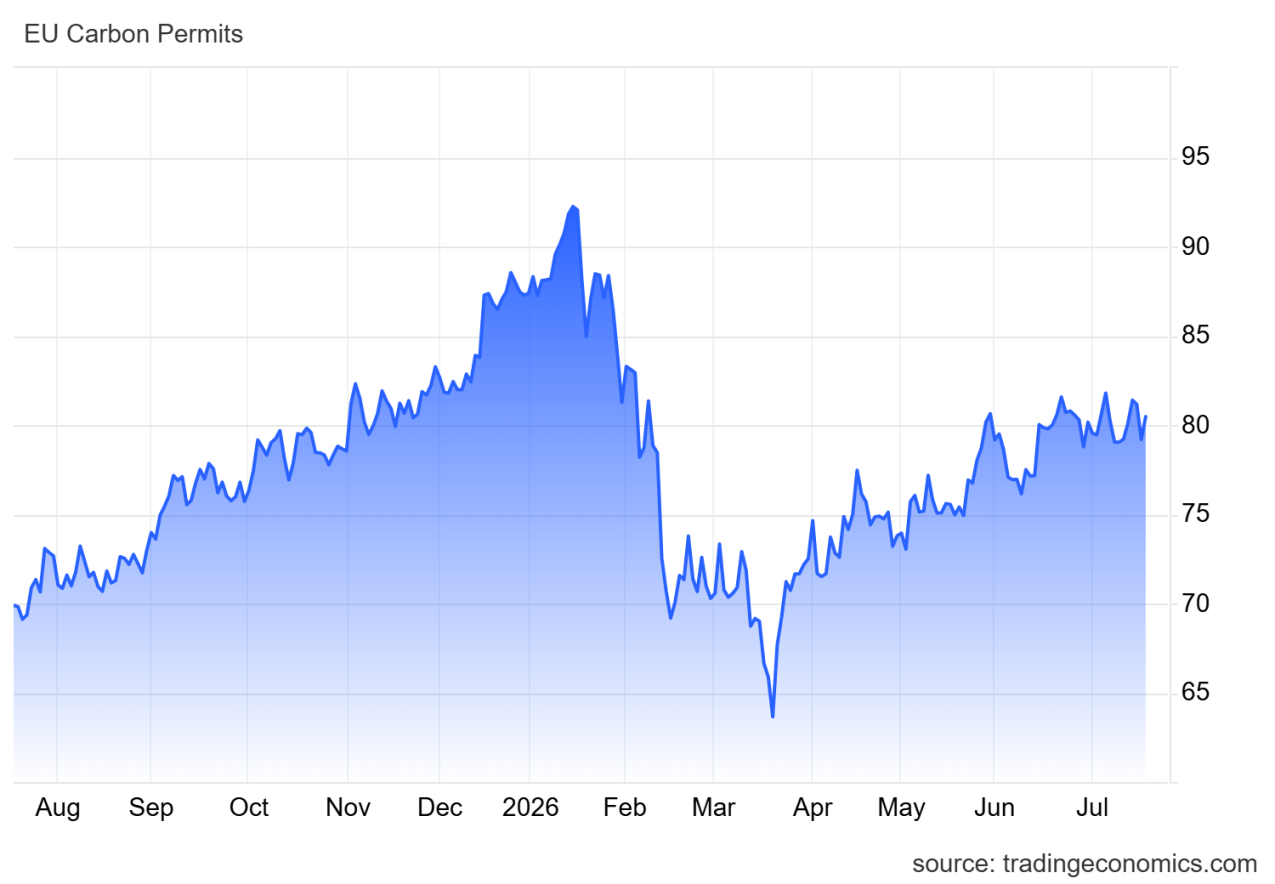
Over the past two weeks, EU Allowance prices have traded choppily in the high-€70s to low-€80s, climbing from around €78 to a local peak near €82 before easing back toward €80 as of mid-July. This is a narrower, more volatile range than the steady climb seen from summer through year-end 2025 or the sharp collapse in February-March 2026. This recent volatility lines up closely with the run-up to the July 17 European Commission’s ETS revision. Traders appear to be pricing in genuine uncertainty about the proposal’s contents. Reports that the Commission may extend the scheme’s timeline into the 2040s, loosen the annual reduction factor, and hand out more free permits point toward looser near-term supply, are a bearish signal that could explain the pullback from the early-July peak. At the same time, prospects of expanded coverage in aviation represent a potential source of new demand, which may be tempering the downside and keeping prices within range rather than falling outright ahead of the announcement.
Maritime & Shipping Updates
Shipping: Emissions revenues not invested in “green” transition
Naftemporiki
EU Shipping Carbon-Fee Loophole Becomes a Port-Competition Fight
EUToday, Correspondents
INSIGHT: FuelEU’s First Year Shows Cheap Complianec May Come at a Cost
Ship and Bunker, Phillipos Ioulianou
Shipowners turn to dirty fossil fuels and nuclear power as green hopes sail away
Financial Times, Alice Hancock
European maritime climate policy is proving highly effective at raising money and reshaping commercial behavior, but less effective at forcing fuel transition. A new ECSA study shows shipping generating up to 9 billion Euros annually in revenues for the European Union and its member states under a carbon price scenario of 100 Euros per ton of CO2. However, only a limited number of member states have earmarked a specific share of their EU ETS revenues for the shipping sector, even though investment needs for shipping’s energy transition in Europe alone are estimated at around 40 billion Euros annually. Rather than funding cleaner fuel, the money is being absorbed elsewhere. Operators are redefining voyage routing through nearby non-EU transshipment hubs to reduce their carbon liabilities, and under FuelEU, surplus compliance-unit prices have fallen faster than anticipated. This makes it increasingly affordable for ship-owners to buy their way into compliance rather than invest in lower-carbon fuels.
One analysis warning this risks the regulation becoming “a low-cost accounting exercise” rather than a real driver of fuel uptake. A parallel report on ship owners reportedly leaning back toward conventional fossil fuels and nuclear power, as green-fuel options remain scarce and expensive, fits the same story. Together, these cases suggest carbon-pricing and compliance-market architecture is currently better at extracting revenue and shaping routing and trading decisions than at closing the price gap between dirty and clean fuels. Conclusively, this is leaving actual decarbonization investment lagging well behind regulatory and market activity.
EU CBAM Updates
EU Lawmakers Vote to Expand List of Products Under CBAM Carbon Import Tax
ESG Today, Mark Segal
MEPs strengthen the EU’s carbon border adjustment mechanism and close loopholes
European Parliament, Press Release
CBAM Expansion Poised to Impact Global Supply Chains
JD Supra, Akin Gump Strauss Hauer & Feld LLP
CBAM Certificate Platform: Brussels’ Next Bureaucracy Trap – Stainless Espresso
Steel News, Gerber Group
Parliament’s Environment Committee has backed extending CBAM well beyond basic materials like steel, aluminum, cement and fertilizers to roughly 180 downstream products (fasteners, wire, springs, machinery, vehicle components and household goods etc.) while tightening anti-circumvention rules on “slightly modified” goods, online imports, and resource shuffling through third countries, and setting up a temporary decarbonization fund to cushion EU exporters and now fertilizer producers as well. Legal analysis frames this as a structural shift. CBAM is moving from a limited border instrument into a mechanism that reaches deep into international supply chains, forcing importers to trace embedded carbon far beyond the point of first sale. Yet even as the policy’s scope widens, industry-facing commentary highlights a parallel administrative strain. A draft system for CBAM certificate purchases and repurchases is criticized as fragmented, irreversible once submitted, and poorly suited to SMEs lacking compliance infrastructure, with a public consultation timed awkwardly over the summer break.
Overall the mechanism is gaining political momentum and legislative teeth. The Parliament is closing loopholes, deepening coverage, and building in transitional support while simultaneously generating real anxiety among traders and smaller importers that the compliance burden, procedural rigidity, and uneven enforcement may fall hardest on exactly the actors least equipped to absorb it. Larger integrated producers appear comparatively insulated but they too are bracing and intervening to mitigate future uncertainty proceeding from broad-sweeping reforms.
Voluntary Carbon Market News
Vietnam Earns $56.5M From Forest Carbon Credits Paid by The World Bank
Carbon Credits, Jennifer L
Verra to Issue First Credits Under Indonesia’s New Carbon Market Regulations
Verra
Yahoo Finance, PR Newswire
New World Bank Group Support for Thailand to Scale Low-Carbon Cities and Carbon Markets
World Bank
Southeast Asia is becoming a proving ground for a maturing, institutionally-backed carbon market that is increasingly defined by sovereign infrastructure and quality assurance. Vietnam collected $56.5 million from the World Bank after cutting 10.3 million metric tons of carbon dioxide through forest protection and better land management, a jurisdictional payment structured to route more than 70% directly to forest owners, local communities, households, and organizations. Simultaneously Vietnam pilots a national emissions trading system and carbon exchange. At the same time, Indonesia’s newly reformed domestic carbon regulations have unlocked issuance for three major Verra-registered forestry projects. The two systems are linked through an API connection enabling seamless data sharing between the Verra Registry and Indonesia’s national registry system which is a deliberate fusion of independent verification with sovereign oversight.
Thailand, meanwhile, is building the financing plumbing for such an ecosystem as well. This is about a $200 million World Bank-backed platform which combines innovative financing with carbon market infrastructure, and pairs an export-import bank and a commercial bank to aggregate credits. Market forecasts reinforce why this build-out matters commercially. Mordor Intelligence projects the voluntary carbon market growing from USD 2.83 billion in 2026 to USD 7.06 billion by 2031. Together, these accounts describe a shift from scattered voluntary offsetting toward government-anchored, bank-intermediated carbon infrastructure, positioning forest-rich, fast-developing Southeast Asian economies as both major credit suppliers and test-beds for how national registries, multilateral finance, and private standards bodies can interlock at scale.
To explore insights and tools driving carbon compliance and market visit the FACS website here!
