
Welcome to the latest edition of the Carbon Market News Roundup, our bi-weekly briefing on the evolving landscape of global carbon markets and climate-related regulation. Our previous issues, along with the rest of our commentaries, may be read here.
This issue of FACS Carbon Newsletter is all about tension. Battle is being waged between industrialists and investors in the EU ETS front. The Commission has drawn a white peace, with the EUA market catching a break at around €80. On the CBAM front; consolidation. Chinese encroachment tactics are advancing and threatening the European advantage over its titanic trading partner. In the seas, the shipping sector is trying to push for more but is failing to keep a steady pace. As for the Voluntary Carbon Markets; a youthful quest to reinvent itself and stay alive is underway after a true crisis with in credibility. Gigantic investments by Big Tech companies and radical methodological rethinking in progress aim to mend the damage. The throughline across all four sections follows a climate architecture under real strain. Along most fronts it is bending, but, so far, it is not breaking.
EU ETS – Regulations Updates & EUA Price Movement
Steel and chemicals giants demand freeze to EU’s flagship climate policy
Ben Makuch, Politico Europe
Finlay Johnston, Carbon Pulse
EU countries back controversial ETS benchmark update after concessions
Ben Makuch, E&E News
Investor coalition calls on EU leaders to maintain ‘robust and predictable’ ETS
Editor, Sustainability Online
The EU ETS benchmark fight is reaching a tense resolution. Industry pressure has been colliding against investor demands for stability in the European carbon markets. Steelmakers ArcelorMittal, ThyssenKrupp and Voestalpine, along with chemicals giant BASF, sent a letter to European Council President demanding an immediate halt to rising ETS costs. They argued that the policy no longer reflects global realities and is putting acute pressure on Europe’s manufacturing base. Despite this, EU member states ultimately backed the Commission’s updated benchmarks in a compromise vote. Brussels pledged to review its benchmark methodology and provide more free allowances in its broader ETS review due in mid-July. An uneasy peace, but a peace nonetheless has emerged.
On the other hand, financial markets are pushing back against further dilution of the system. A coalition of investors collectively representing more than €13.1 trillion in assets called on European leaders to maintain a “robust and predictable” ETS. Their argument was that the system must remain the bedrock of Europe’s climate and investment framework. Overall, the EU ETS seems caught between two organized, well-resourced constituencies. On the one hand are European heavy industry and its deindustrialization concerns. On the other hand are investors and their concerns over long-term certainty that their capital depends on. The Commission’s mid-July review is where those forces will meet each other on the battlefield again.
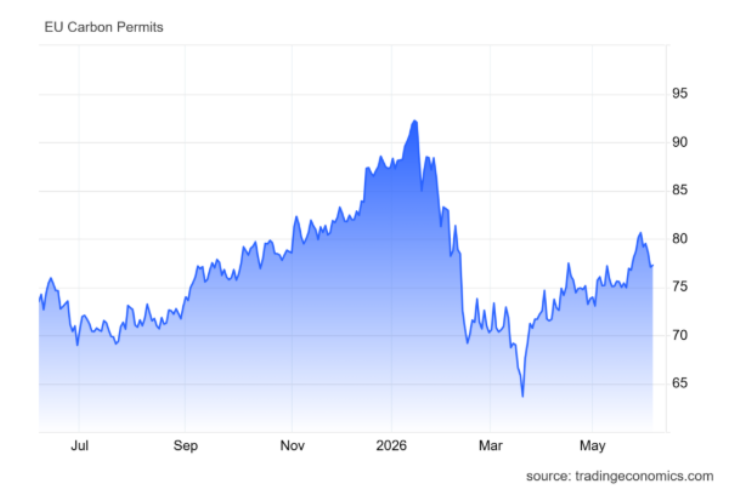
EUA prices confirm this tug-of-war dynamic. Prices having been reluctant to higher climb after the April recovery. Nevertheless, the current status quo around €80 by June is a sign of confidence in the resolution of the standoff between industry and investors. As the Commission negotiated its compromise with member states and signaled the mid-July review rather than capitulating to industry’s demands, the market regained confidence that the system’s structural tightening remains intact. Policy credibility once again gains primacy over price direction. Every dip and rally roughly shadows the moments when the ETS’s robust and predictable character looked either threatened or safe. This is what the investor coalition is fighting to preserve; stability and predictability. On the other hand, industrial concerns over competitiveness and deindustrialization cannot be denied and are very real for both producers and downstream manufacturers facing highly unstable geopolitical conditions alike.
Maritime & Shipping Updates
Major ship operators show small progress on emissions targets: report
Max Lin, S&P Global
Bryony Collins, Carbon Pulse
EU Backs Maritime Industrial Strategy to Strengthen Shipping, Security and Decarbonisation
ESG News Editorial Team, ESG News Survey
The UK ETS expands to maritime from 1 July 2026
DNV, DNV
The maritime sector is moving from voluntary aspirations towards a more binding regulatory reality. Nevertheless, there are mixed signals on whether the pace of progress matches the scale of new obligations. The 2026 Sea Cargo Charter Annual Disclosure Report found that the 32 signatories, who together handle 14% of global seaborne wet and dry bulk trades, missed the International Maritime Organization’s minimum emissions trajectory by 11.6% in 2025. However, this was still a slight improvement on the 12.2% misalignment in 2024. Biofuels emerged as the most mature alternative fuel pathway. A companion report from Carbon Pulse similarly found that the majority of charterers and ship-owners reduced their emissions intensity last year. Steady voluntary progress exists, even as the industry awaits a binding global framework.
Regulators, meanwhile, are moving to lock in firmer mechanisms regardless of voluntary momentum. EU member states formally endorsed conclusions on a maritime industrial strategy that frames shipbuilding and shipping as strategic assets for competitiveness, security, and decarbonization. EU member states have also called for greater investment in clean propulsion and reaffirmed that EU ETS revenues should be directed toward a greener shipping sector. In parallel, the UK Emissions Trading Scheme will expand to cover maritime activities from 1 July 2026, with DNV outlining the compliance mechanisms ship-owners must follow. These include Emissions Monitoring Plans and independent verifications of annual emissions reports. The general trend shows an industry still leaning on voluntary disclosure even as regulators in both the EU and the UK are increasing pressure.
EU CBAM Updates
EU industrial autonomy needs CBAM extension, higher prices inevitable: Kallanish ESM26
Christian Koehl, Eurometal
EU Member States Agree to Expand CBAM Carbon Import Tax to Downstream Products
Mark Segal, ESG Today
The New Carbon Order: China’s Response to Europe’s CBAM
Illaria Mazzocco and Ray Cai, Center for Strategic and International Studies
European aluminium lobby calls for EU to fix CBAM loopholes, warns of threat to industry
Roy Manuell, Carbon Pulse
The EU is moving decisively to widen CBAM. The European Council announced an agreement among member states on changes to CBAM that would expand its scope to downstream products, going further than the European Commission’s original proposal by adding metal-intensive industrial, construction, machinery and electrical-equipment products such as forklifts, conveyor equipment and electric motor components. This is done in order to avoid a shift in production to countries with weaker climate policies. Industry voices broadly welcome this direction but argue it doesn’t go far enough. At Kallanish Europe Steel Markets 2026, speakers argued that CBAM must be extended further to capture steel-based manufactured products. They warned that fragmented small and medium-sized producers are being overlooked over the politically well-connected steel mills and automakers. They argued that higher prices for consumers are merited if it means protecting the industries. Europe’s aluminium lobby raised a parallel alarm, warning EU finance ministers that the current CBAM proposal contains critical shortcomings that could still fail to prevent carbon leakage in the sector.
The external dimension of this expansion is just as important as the internal one. CSIS analysis finds that China has been building the institutional architecture needed to navigate the EU’s carbon tariff regime. At least 30 provincial-level carbon accounting platforms, along with China’s own emissions trading system are direct responses to CBAM’s pressure. This is done even as Chinese officials continue to publicly criticize the mechanism as protectionist. CBAM is obviously becoming both a key part of the EU’s industrial landscape, and a force reshaping trade partnership with titans like China. The question is whether Brussels can tighten CBAM without alienating domestic downstream manufacturers and global trade partners.
Voluntary Carbon Market News
Verra opens carbon credit pathway for e-fuels in shipping
SplashTech
Big Tech is Putting Big Money Behind Marine Carbon Removal
The Maritime Executive
Can a new methodology save the carbon market?
Abhishyant Kidangoor, Mongabay
BizClik Partners with Amazon for Carbon Offsets
Georgia Collins, Procurement Magazine
The voluntary carbon market seems to be actively reinventing itself in response to its own credibility crisis. New methodologies, new buyers, and new money are all coming in, aimed at rebuilding trust. Verra released VM0053, the shipping industry’s first dedicated methodology for generating carbon credits from low-carbon marine fuels like green hydrogen, green ammonia and e-methanol. It is designed to help close the cost gap between conventional bunker fuel and cleaner alternatives for both newbuilds and vessels already in service. In parallel, carbon market pioneer Daniel Morrell launched Balance, a new type of credit that prioritizes biodiversity protection and community income generation ahead of carbon removal itself. This is aimed at responding directly to the voluntary market’s long-standing transparency and greenwashing problems by requiring that biodiversity outcomes be verified before payment and mandating that a minimum of 40% of funding reach local communities.
Capital is following these credibility-focused innovations. Big Tech and e-commerce giants are stepping in as anchor buyers and financiers. Anthropic, Google, Stripe, Salesforce and other technology firms announced a $915 million investment in Frontier Climate. This is a venture funding carbon-capture startups including several ocean alkalinity enhancement projects that aim to turn dissolved CO2 into stable minerals at scale. Meanwhile, Amazon expanded its carbon credit service to qualified UK companies, with its Chief Sustainability Officer acknowledging that the voluntary carbon market has been challenged by transparency and credibility issues. Media company BizClik became an early adopter, citing confidence in Amazon’s vetting standards.
To explore insights and tools driving carbon compliance and market visit the FACS website here!
