
Global Market News
Global Equities Gain
Global equities made significant gains this week as hopes for an end to the conflict with Iran rose (though shaky). The S&P 500 and Nasdaq increased 3.56% and 4.68%, respectively, while the Dow Jones gained 3.04%. The US 10-year Treasury note dipped slightly to close the week at 4.31%. Meanwhile, the price of a barrel of West Texas Intermediate crude oil dropped sharply, closing Friday at $95.63. Volatility, as measured by the CBOE Volatility Index, decreased more than 20% over the week, closing at 19.23.
Energy Costs Push Inflation Higher
U.S. inflation soared in March, with headline CPI rising 0.9% on the month and 3.3% from a year earlier—the hottest annual reading in two years—driven largely by a surge in gasoline and broader energy costs following disruptions tied to the Iran war. Core inflation remained more subdued at 0.2% month‑over‑month and 2.6% year‑over‑year, slightly below expectations. The spike in fuel prices, including an 18.9% jump in gasoline and a 44.2% rise in fuel oil, fed through to transportation services and contributed to weaker real wages and gloomier consumer sentiment. While New York Fed President John Williams said he expects only a modest, temporary boost to core inflation and still anticipates underlying pressures easing later this year, economists noted that the oil shock could continue to filter into food and goods prices in the months ahead, leaving the Federal Reserve navigating a difficult balance between cooling inflation and supporting a softening labor market.
International Developments
Iran War Enters Fragile Ceasefire Ahead of Talks This Weekend
Efforts to stabilize the Middle East conflict remain fragile as a U.S.-brokered extension of the Israel–Lebanon ceasefire has been pushed out by three weeks, even as fighting persists on the ground with continued Israeli strikes on Hezbollah positions and retaliatory rocket and drone exchanges underscoring the truce’s instability. The extension, which excludes Hezbollah from direct negotiations, is closely tied to broader U.S.–Iran diplomacy, with Tehran insisting that a sustained pause in Lebanon and the lifting of U.S. naval pressure are prerequisites for resuming talks. While President Donald Trump has indefinitely extended the Iran ceasefire to allow more time for negotiations, progress has stalled, with Iran rejecting the extension as insufficient and maintaining its control over the Strait of Hormuz, where attacks on shipping and U.S. countermeasures continue to disrupt global trade flows. Diplomatic efforts are ongoing, with Iranian Foreign Minister Abbas Araghchi traveling to Pakistan to revive talks after a planned second round failed to materialize, but tensions remain elevated as both sides escalate military posturing, including expanded U.S. naval deployments and continued maritime confrontations, highlighting the gap between ceasefire agreements on paper and the reality of continued conflict and economic disruption.
Germany’s New Defense Strategy
Germany has unveiled a sweeping new defense strategy aimed at transforming the Bundeswehr into Europe’s strongest conventional military as it responds to what officials describe as a growing threat from Russia and a shifting transatlantic balance. This is the first such official strategy document in the post-WWII era. Defense Minister Boris Pistorius emphasized that while the United States remains central to NATO, Berlin must take on greater responsibility as Washington increasingly focuses on the Indo-Pacific, driving a push for a more “European” alliance. The strategy outlines a phased military buildup through 2039, beginning with rapid readiness improvements by 2029, followed by expanded capabilities by 2035, and culminating in technological superiority driven by innovation, automation, and AI. Germany aims to scale its total force to roughly 460,000 personnel, including 200,000 reservists, while shifting doctrine toward flexible, effects-based warfare rather than fixed force structures. The plan builds on post-2022 rearmament efforts, including a €100 billion defense fund and procurement reforms, and reflects a broader strategic pivot toward sustained deterrence, rapid mobilization, and long-term military self-reliance within NATO.
EU Approves Loans to Ukraine
The European Union has approved a €90 billion financial package and a new round of sanctions against Russia, marking a significant step in sustaining Ukraine’s war effort after months of internal political deadlock. The breakthrough came after Hungary lifted its veto following the resumption of Russian oil flows through the Druzhba pipeline to Hungary and Slovakia, easing a key dispute that had stalled both aid and sanctions. The package, backed by leaders including Ursula von der Leyen and António Costa, is expected to cover roughly two-thirds of Ukraine’s financial needs over the next two years, with funds directed toward both military support and essential government services, helping Kyiv avoid severe budget cuts. Ukrainian President Volodymyr Zelenskyy welcomed the move as a critical lifeline, while the sanctions package targets Russia’s energy revenues and financial networks, including its shadow oil fleet.
US Social & Political Developments
US Navy Chief Steps Down
The abrupt dismissal of John Phelan underscores escalating internal tensions within the Pentagon as the Trump administration pushes an aggressive overhaul of U.S. naval strategy and shipbuilding. Phelan was forced out after repeated clashes with Pete Hegseth and senior leadership over the pace and direction of efforts to revive domestic shipbuilding under the administration’s “Golden Fleet” initiative, as well as broader management disputes and coordination breakdowns. His departure comes amid a wider pattern of high-level turnover and internal infighting at the Defense Department, alongside an ongoing purge of senior military leadership, raising concerns about institutional stability during a period of heightened operational demand tied to the Iran conflict. While Phelan’s exit is not expected to impact ongoing naval operations, including the Strait of Hormuz blockade, it signals intensifying political control over defense priorities, particularly around shipbuilding and industrial policy, with Undersecretary Hung Cao stepping in as acting Navy secretary as the administration seeks to accelerate its maritime buildup agenda.
White House Accuses China of Industrial Scale Theft of AI Technology
The United States is escalating its tech rivalry with China after the White House accused Chinese linked actors of conducting “industrial scale” efforts to extract intellectual property from leading American AI systems, raising tensions ahead of a planned summit between Donald Trump and Xi Jinping. According to a memo from the Office of Science and Technology Policy, foreign entities have used thousands of proxy accounts and jailbreaking techniques to “distill” advanced U.S. AI models, effectively replicating their capabilities at lower cost while bypassing built in safeguards, posing both commercial and national security risks. The administration signaled it will coordinate with U.S. companies and consider punitive measures, while the allegations add new uncertainty to existing debates over technology exports, including whether firms like Nvidia will be permitted to ship advanced chips to China. Beijing has denied the claims, calling them unfounded and urging greater cooperation, but the dispute underscores a deepening competition over AI leadership that is likely to remain a central fault line in U.S.-China relations.
Corporate/Sector News
Panama Shipping Prices Reach Record Highs
As of this month, shipping lane auction prices in the Panama Canal have surged to record highs, with some vessels paying up to $4 million to skip transit queues. This spike is primarily driven by companies rerouting cargo to avoid Middle East shipping lanes, specifically the Strait of Hormuz, which remains effectively closed due to ongoing conflict. One LNG carrier recently paid a record $4 million auction fee in addition to standard transit tolls to secure a slot. For the commonly used Panamax locks, the average auction price hit $837,500, roughly a tenfold increase since the conflict began. Buyers in Asia are increasingly sourcing oil and gas from the U.S. Gulf Coast via the Panama Canal to replace Middle Eastern supplies. Despite record fees, many operators consider the Panama Canal a safer and more predictable alternative than the Red Sea or Strait of Hormuz, where “missiles and drones” continue to threaten commerce. Vessels without pre-booked reservations now face an average wait of four to five days, further incentivizing high auction bids for “line-jumping.”
Layoffs Hit Meta, Microsoft, and Nike
This month, Meta has announced plans to lay off roughly 10% of its global workforce, impacting approximately 8,000 employees. The layoffs are scheduled to go into effect on May 20th. In addition to the job cuts, the company is scrapping plans to hire for 6,000 open positions. Meta’s Chief People Officer, Janelle Gale, stated in an internal memo that the cuts are aimed at improving efficiency and offsetting massive investments in artificial intelligence. Around the same time, Microsoft announced its first-ever voluntary employee buyout program. This one-time retirement offer targets approximately 7% of its U.S. workforce, roughly 8,750 employees, as the company also shifts its focus and resources toward AI. Further, Nike announced on April 23rd that it is laying off approximately 1,400 employees, representing just under 2% of its global workforce. This latest round of job cuts is part of the company’s “Win Now” turnaround strategy intended to modernize manufacturing and streamline its technology division. The reductions mostly affect technology roles within Nike’s global operations team. Nike plans to consolidate its tech operations into two main hubs: its headquarters at the Philip H. Knight Campus in Beaverton, Oregon, and the Nike India Technology Center. This is the second major round of cuts in 2026, following several adjustments over the past few years as the company deals with a prolonged sales slump.
Spirit Airlines Bailout
The Trump administration is reportedly in advanced discussions to provide Spirit Airlines with a $500 million federal bailout to prevent the carrier from liquidating. The proposed deal would likely be structured as a government-backed loan that could eventually grant the U.S. government up to a 90% ownership stake in the airline A lawyer for Spirit confirmed that the airline is in “advanced discussions” with federal officials as of this month. The Trump administration has offered a term sheet that includes $500 million in financing in exchange for warrants equal to 90% of Spirit’s equity. President Trump has publicly stated he is considering buying the airline “at the right price,” suggesting the government could later sell it for a profit once oil prices decline. Spirit faces an immediate need for capital, requiring access to roughly $240 million by the end of next week to continue operations. The administration has cited the preservation of approximately 14,000 to 25,000 jobs as a primary reason for intervention.
Recommended Reads
Hormuz Crisis Delivers a Taiwan Strait Wake-Up Call
The Race for the Next UN Chief Kicks Off
Anthropic’s New AI Model Sets of Global Alarms
Why Gasoline is So Much Cheaper in the US Than Overseas
Drought is Squeezing Half the US It Isn’t a Pretty Forecast for Food Prices
This Week from BlackSummit
The BlackSummit Team
CROSSROADS: North America, Europe, China, India & Japan
The BlackSummit Team
CROSSROADS: Middle East, Asia, Latin America, Sub-Saharan Africa
The BlackSummit Team
Image of the Week
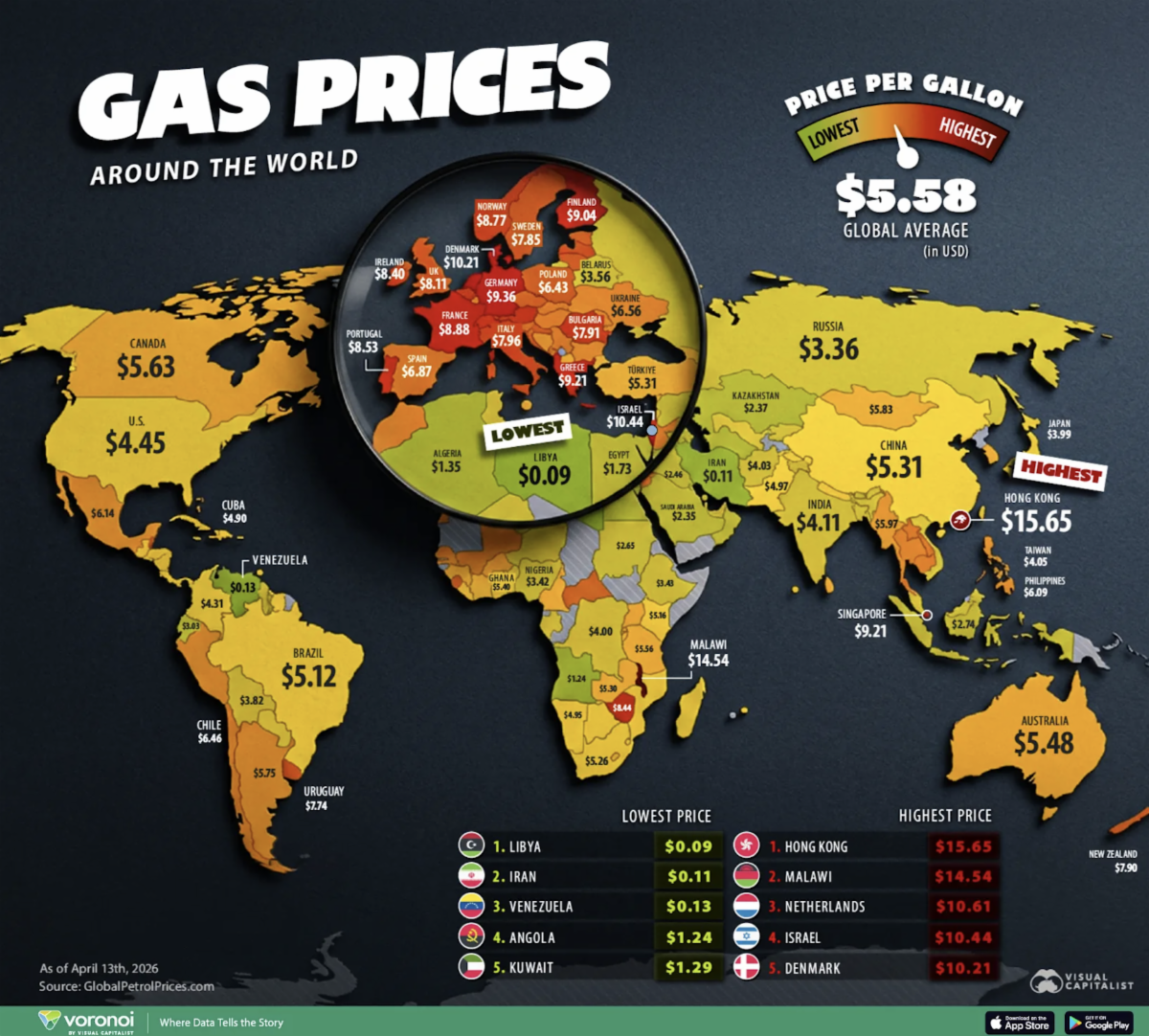
Visual Capitalist
Video of the Week
Inflation Fears Drive Consumer Sentiment to Record Low
Bloomberg
