
Welcome to our monthly newsletter which covers key developments in major non-US markets. With this newsletter, we highlight corporate, debt, and monetary policy news in European, Asian, and Latin American markets. We end this piece with a spotlight on commodities.
European Markets
Corporate and Business News
- Pernod Ricard’s confirmed merger talks with Brown‑Forman put European consumer staples back on the M&A radar. The potential tie‑up would create a global spirits champion with enhanced pricing leverage, cost synergies across distribution and procurement, and greater resilience as volume growth plateaus in mature markets.
- LVMH’s conflict‑hit sales update, followed by weak Hermès and Gucci numbers, deepens the de‑rating across European luxury. The company highlighted that conditions deteriorated sharply in March, particularly in Gulf markets, where mall traffic fell 30–70% depending on location, and spending by Middle Eastern tourists in Europe dropped meaningfully.
- Intertek rejects EQT’s 7.9 billion GBP approach and explores a break‑up, reigniting takeover interest in undervalued UK mid‑caps. Management’s willingness to consider asset sales points to significant embedded value within the business, particularly in higher‑margin assurance and testing divisions that could attract strategic buyers.
- Bouygues, Iliad, and Orange join forces in a 20.35 billion EUR bid for SFR, setting up a defining test of telecom consolidation in France. The proposed deal aims to restore pricing discipline and fund next‑generation network investment, but faces intense scrutiny given France’s historically strict stance on market concentration.
- Alstom scraps key cash‑flow targets and cuts margin ambitions, reviving balance‑sheet concerns across European industrials. The reset reflects weaker project execution, delayed customer payments and higher financing costs, all of which challenge leverage trajectories in an already stretched sector.
Debt and Monetary Policy News
- ECB rate-hike expectations returned forcefully as euro-area inflation jumped back above target on the energy shock, with headline inflation rising to 2.5% in March, up sharply from 1.9% in February, pushing front-end yields higher and reversing earlier easing assumptions. Markets now question whether disinflation progress can be sustained if energy volatility feeds through more durably into core prices.
- Frankfurt stayed hawkish but not panicked. Policymakers debated tighter policy, yet meeting accounts and subsequent guidance argued against an immediate move, shifting focus toward a later hiking window. This nuanced stance kept rate pricing sensitive to incoming data rather than locked into a near-term tightening path.
- Gilt markets remained under pressure as Bank of England officials split between growth caution and inflation primacy, keeping UK rate expectations volatile and testing post‑LDI market resilience. The lack of a unified policy signal continues to amplify moves at the long end of the curve.
- Peripheral sovereign risk re-emerged, with Italy underperforming on energy vulnerability, fiscal slippage, and political noise, while higher yields broadly tightened Europe’s fiscal room. The widening spread dynamic serves as a reminder that debt sustainability concerns resurface quickly in a higher-for-longer rate environment.
Asian Markets
Corporate and Business News
- Air Liquide announced it would invest $236 million in Japan to support next‑generation AI chip production. The investment will expand advanced gas and materials infrastructure critical for cutting‑edge semiconductor manufacturing, underscoring Japan’s push to rebuild a domestic chip supply chain.
- Nissan Motor plans to streamline its global automobile lineup by shedding low‑performing models and deploying artificial‑intelligence driving technology across 90% of its fleet over the long term, the company said. The strategy reflects Nissan’s effort to restore competitiveness and profitability while keeping pace with rivals’ rapid advances in EVs and autonomous features.
- Japan approves an additional $4 billion for chipmaker Rapidus. The funding bolsters the government‑backed effort to commercialise advanced‑node semiconductor production domestically and reduce reliance on foreign manufacturers.
- Microsoft will invest $10 billion in Japan for AI and cyber‑defence expansion. The commitment will scale cloud infrastructure, AI research, and security capabilities, reinforcing Japan’s role as a regional technology hub amid rising digital‑security risks.
- China’s Victory Giant is expected to price its Hong Kong share offering at the top of a range at HK$209.88 per share, raising HK$17.5 billion ($2.2 billion), after receiving strong demand from investors. The strong bookbuild signals renewed appetite for large Chinese listings in Hong Kong despite ongoing regulatory and geopolitical uncertainty.
- Chinese chipmaker Yangtze Memory Technologies aims to build two more factories in addition to one that will be completed this year, which will more than double its production capacity when all three are up and running. The expansion highlights Beijing’s determination to accelerate semiconductor self‑sufficiency despite export controls and technology restrictions.
- Elliott Investment Management said it has taken a stake in Daikin and thinks the manufacturer of air conditioners should improve margins and shareholder returns and review non‑core assets. The activist intervention raises the prospect of cost discipline, portfolio simplification, and more aggressive capital returns at a company long viewed as operationally strong but financially conservative.
Debt and Monetary Policy News
- Japan’s wholesale inflation jumps as the Bank of Japan vows vigilance to stagflation risk. Japan’s Corporate Goods Price Index (CGPI) rose 2.6% year‑on‑year in March, up from a revised 2.1% in February, and above market expectations of 2.4%. Rising input costs signal renewed upstream price pressures that could squeeze corporate margins and consumer purchasing power if not accompanied by stronger wage growth.
- China’s factory‑gate prices rose for the first time in more than three years in March, in an early sign that the war in Iran is feeding cost pressures into the world’s second‑largest economy. The reversal marks a potential turning point after a prolonged bout of deflation driven by weak demand and excess capacity.
- Chinese banks likely extended significantly more new loans in March than in February, driven by improved credit demand and a seasonal rebound. The pickup suggests policy easing is gaining traction, though analysts remain cautious about loan quality and the sustainability of demand.
- Major global investment banks now expect China to keep official interest rates steady this year, scaling back earlier rate‑cut calls, as the impact from the Middle East conflict appears limited, even as Beijing maintains a loose policy stance. Stable rates would allow authorities to preserve policy ammunition while relying more on targeted fiscal measures and liquidity support to stabilise growth.
Latin American Markets
Corporate and Business News
- Chevron signed two key agreements to expand operations at Venezuela’s vast Orinoco Belt, including an asset swap adding an extra heavy crude area to its main project while returning an offshore gas field and a small crude area, executives and officials said at an event. The deal deepens Chevron’s exposure to long‑life oil reserves while aligning with U.S. licence constraints and Venezuela’s push to revitalise output through joint ventures.
- Tecto Data Centers, backed by BTG Pactual’s funds, is set to invest $2 billion through 2028, including the construction of five data centers in Brazil, adding to a wave of new data centers in Latin America’s No. 1 economy.
- Hong Kong‑based conglomerate CK Hutchison’s Panama business said it would seek arbitration over Maersk’s takeover of two strategic ports near the Panama Canal, which are at the center of a legal battle between Beijing and Washington.
- Shell is in advanced talks with Venezuela for more gas areas. Additional gas access would support Shell’s LNG ambitions in the Caribbean while offering Venezuela a route to monetise reserves with lower sanctions risk than crude exports.
- Brazilian cross‑border payments company Ebanx said it is expanding global operations, with a focus on Southeast Asia, strengthening its footprint outside Latin America. The move targets fast‑growing digital commerce corridors in markets such as Indonesia and Vietnam, where demand for alternative payment methods mirrors Ebanx’s original Latin American growth playbook.
- Brazilian asset manager Quadra Capital is nearing the acquisition of 15 billion reais ($2.99 billion) of assets from state‑owned Banco de Brasília (BRB) that were previously held by liquidated lender Banco Master. The transaction would accelerate Quadra’s scale‑up in credit and structured assets while helping BRB clean up legacy exposures inherited from the bank resolution process.
- Brazilian steelmaker CSN is set to start receiving binding offers for its cement unit in just a few weeks, the company’s chief financial officer said. A sale would support CSN’s deleveraging agenda and sharpen its focus on core steel and mining operations amid still‑elevated capital intensity.
Debt and Monetary Policy News
- Argentina reached a staff‑level agreement with the International Monetary Fund on the second review of its $20 billion program, unlocking a $1 billion disbursement, subject to approval by its Executive Board. The deal provides short‑term funding relief while keeping pressure on authorities to sustain fiscal consolidation, FX liberalisation, and inflation‑fighting measures.
- Mexico inflation spikes in March, fueling debate within a divided central bank. Mexico’s headline inflation rose to 4.59% year‑on‑year in March, up from 4.02% in February, marking a year‑and‑a‑half high and its strongest reading since October 2024. The upside surprise complicates Banxico’s easing plans, sharpening divisions between policymakers prioritising growth risks and those focused on anchoring inflation expectations.
- Brazil eyes strict budget curbs and limits on tax breaks in 2027 while counting 39% of court‑ordered debt inside its fiscal target. Together, the measures point to a tougher headline fiscal stance aimed at reinforcing debt sustainability ahead of an election cycle, but reliance on accounting adjustments to ease near‑term pressure risks political pushback and renewed investor scrutiny over fiscal transparency and framework credibility.
- The World Bank now forecasts Latin America and the Caribbean to grow by 2.1% in 2026, down from its previous 2.5% projection made in October. The downgrade reflects a combination of weaker global demand, persistently high borrowing costs, geopolitical disruptions, and structurally weak investment, with private consumption still the main growth driver but insufficient to generate stronger momentum.
Commodities Spotlight
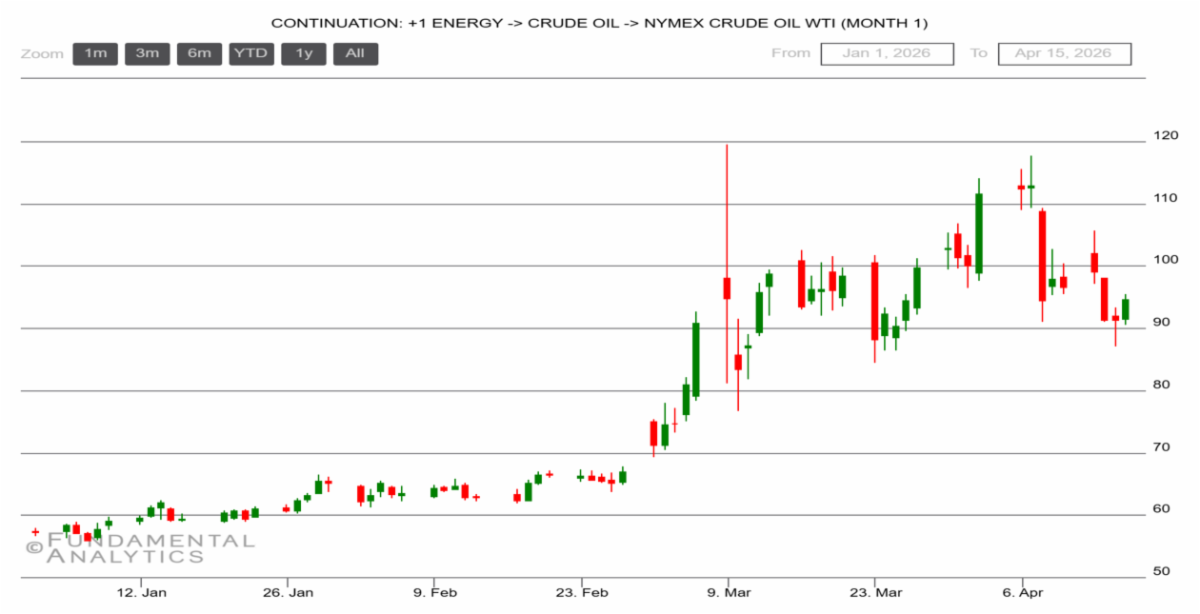
WTI crude oil experience amplified volatility on US-Iran conflict
Source: Fundamental Analytics
NYMEX WTI crude oil futures traded at war-distorted highs before retreating sharply, as the Iran conflict and repeated disruption to Hormuz traffic overwhelmed otherwise mixed U.S. fundamentals. U.S. crude stockpiles built to near multi-year highs, helped by softer refinery runs, while exports stayed firm and net imports fell toward record lows, cushioning domestic balances. Later, ceasefire progress and confirmation that the Strait had reopened deflated part of the geopolitical risk premium, though regional outages and depleted global inventories kept oil historically elevated.
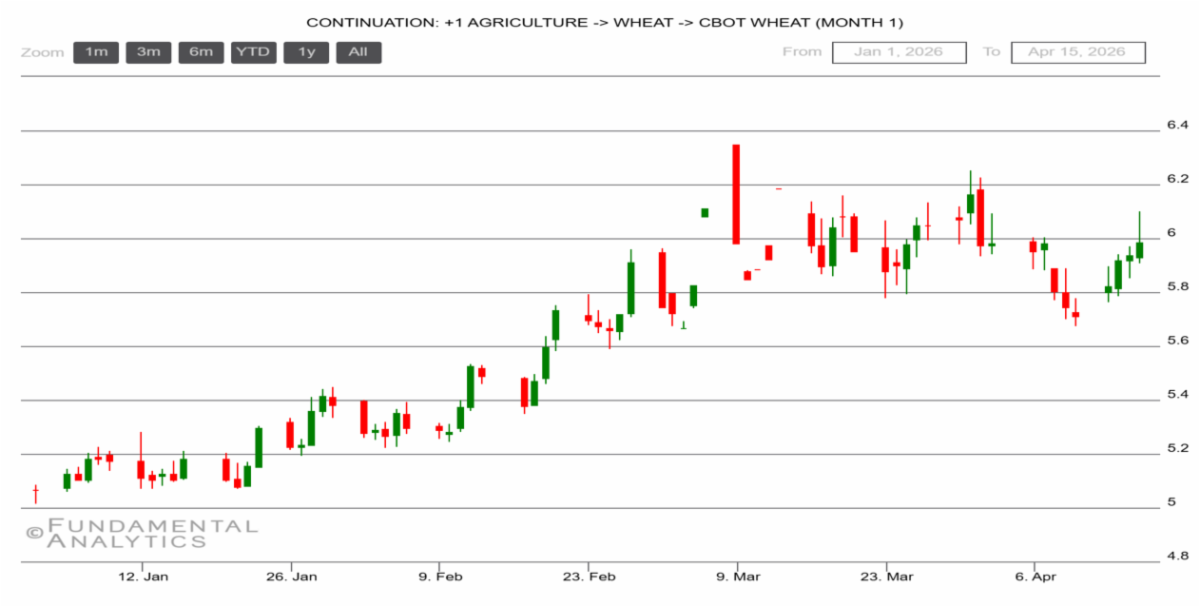
Wheat futures trade below $6 mark on better-than-expected supply
Source: Fundamental Analytics
CBOT wheat futures traded choppily and finished only modestly lower overall. Early support from Middle East-related fertilizer and freight concerns faded as the USDA raised U.S. wheat supplies and ending stocks, while global markets stayed well supplied, and export competition from the Black Sea and EU remained intense. Late in the period, renewed dryness in the U.S. Plains rebuilt some weather premium, but not enough to fully offset the broader weight of ample inventories and cautious import demand.
