
Global Market News
Global Equities Decline
Global equities continued to decline this week as an end to the war with Iran remains unclear. The S&P 500 and Nasdaq decreased 2.12% and 3.23%, respectively, while the Dow Jones dropped 0.90%. The US 10-year Treasury note climbed nearly 5 basis points to close the week at 4.43%. Meanwhile, the price of a barrel of West Texas Intermediate crude oil increased to end the week just shy of $100, closing Friday at $99.64. Volatility, as measured by the CBOE Volatility Index, rose more than 26%, closing at 31.05.
Energy Supply Shock Clouds Global Inflation Outlook
The Organization for Economic Cooperation and Development (OECD) has projected that annual inflation across the Group of Twenty (G20) economies will be about 1.2 percentage points higher this year than it expected in December. That outlook reflects persistent cost pressures, particularly from energy markets. Adding to these concerns, International Energy Agency head Fatih Birol warned that the Iran war is creating a larger oil supply shock than those of the 1970s, with around 11 million barrels per day currently lost versus five million then, and cautioned that global leaders may be underestimating the severity of the crisis. Such a disruption risks further driving up energy prices, reinforcing the inflationary pressures highlighted in the OECD’s forecast.
International Developments
Rising Military Escalation and Energy Risks in the Middle East
The conflict in the Middle East is escalating militarily while alleged diplomatic efforts have been deadlocked. The US is deploying roughly 2,000 paratroopers from the 82nd Airborne Division. Total US troop deployments to the region now total roughly 7,000, with potential missions including the seizing of Iran’s key oil export hub at Kharg Island or the forcible reopening of the Strait of Hormuz. Potential for Special Forces operations have also been discussing the extraction of Iran’s enriched Uranium. The US is reportedly considering sending an additional 10,000 combat troops in the coming days. At this time, diplomatic efforts remain stalled as Iran rejected the US’s 15-point peace proposal which included sanctions relief, limits to nuclear and missile programs. In response, Iran demanded sovereignty over the Strait of Hormuz, reparations, and security guarantees while continuing attacks across the region. The war has already resulted in almost 2,000 deaths in Iran, more than 1,000 in Lebanon, 19 in Israel and 13 US military members, with dozens more deaths across the Middle East in Saudi Arabia, the UAE, and other countries that have been hit by strikes. President Trump has said he will delay further strikes on Iranian energy infrastructure until April 6 to allow for potential negotiations, though both sides remain far apart. Allies in Europe are beginning to coordinate efforts to secure shipping lanes, highlighting the growing global concern over energy flows.
Ukraine Pipeline Attack Reduces Russia’s Export Capacity
Ukraine is intensifying its long-range strike campaign on Russian energy infrastructure to offset weakening international pressure on Moscow after the US issued a 30-day waiver allowing continued purchases of sanctioned Russian oil. Ukrainian drone strikes have hit key Baltic export hubs at Ust Luga and Primorsk, reportedly disrupting up to 40% of Russia’s oil export capacity or roughly 2 million barrels per day. This is one of the most severe supply shocks in Russia’s modern history, directly targeting state revenues as oil prices surged from $70 to $108 by March 26. Prior to Ukraine’s strikes, Russia had escalated its military campaign, launching a record 948 drones and 34 missiles in a 24-hour window, conducting 600 ground assaults across eastern Ukraine. Despite this pressure, Ukrainian defenses remain intact, aided by a rapidly scaled drone and air defense capability that is intercepting roughly 91% of incoming drones. Kyiv is expanding its strikes deep into Russia, including attacks up to 900km from its borders, signaling a strategy focused on degrading Russia’s war financing and logistics as the conflict grinds on without any meaningful diplomatic progress.
EU and Australia Strike Free Trade Deal with Critical Mineral Access
The European Union and Australia have reached a long‑awaited free trade agreement that includes a strategic partnership on critical minerals, concluding nearly eight years of negotiations. Under the deal, the EU will gain tariff‑free or near‑tariff‑free access to key Australian minerals such as lithium, manganese, and aluminum, which are essential for electric vehicles, batteries, and clean‑energy technologies, while Australia will remove tariffs on more than 99% of EU exports. European Commission President Ursula von der Leyen emphasized that the agreement is intended to reduce over‑dependence on single suppliers, particularly China, and to strengthen supply‑chain resilience amid growing geopolitical risks.
US Social & Political Developments
Senate Approves DHS Funding Bill
Efforts to end the 42‑day partial government shutdown remain unresolved after the House and Senate advanced competing Department of Homeland Security funding plans late Friday. The Senate had unanimously passed a bill that would reopen most of DHS—including the TSA—while excluding Immigration and Customs Enforcement and parts of Customs and Border Protection, a move Democrats hailed as a win despite failing to secure broader enforcement reforms. The House, however, rejected that approach and instead passed a 60‑day funding measure by a 213–203 vote that would restore funding to the entire department, including ICE, sending the issue back to the Senate, which has already left for a two‑week recess. With House Speaker Mike Johnson refusing to bring the Senate bill to a vote and Senate Democrats calling the House proposal “dead on arrival,” the shutdown that began February 14 appears set to continue despite mounting disruptions to air travel and federal operations. Amid mounting disruption at airports nationwide, President Trump signed an executive action authorizing emergency pay for TSA employees, citing severe security risks and saying agents should begin receiving paychecks as early as Monday.
Trump-Xi Meeting Postponed
President Donald Trump is set to visit Beijing on May 14–15 for his first trip to China in eight years, rescheduled from an earlier date due to the ongoing Iran war, in a move aimed at stabilizing U.S.–China relations amid heightened geopolitical and economic tensions. The meeting with President Xi Jinping—followed by a planned reciprocal visit to Washington later in the year—comes as both sides seek limited cooperation on trade, including potential agreements on agriculture and aviation, while continuing to clash over key issues such as Taiwan, where expanded U.S. arms sales have drawn sharp criticism from Beijing. The talks also unfold against the backdrop of global energy instability, as Trump has unsuccessfully sought China’s support in countering Iran’s threats to the Strait of Hormuz, through which a significant share of global oil flows, while China continues importing roughly 12 million barrels of oil per day.
Corporate/Sector News
Companies and Governments Enact Emergency Policies Amidst Iran Energy Crisis
The Iran war is triggering widespread global energy disruptions with significant economic spillover, as oil supply constraints tied to instability around the Strait of Hormuz push prices higher and strain both developed and emerging economies. U.S. gasoline prices have risen by about $1 over the past month to $3.98 per gallon, while companies like United Airlines warn fares could increase up to 20% due to elevated jet fuel costs, and firms such as BASF are raising prices by as much as 30%, reflecting broader inflationary pressures. Governments worldwide are responding with emergency measures to secure supply and protect consumers, including fuel rationing in countries like Slovenia and Sri Lanka, export restrictions in China, India, and Serbia, subsidy expansions such as Malaysia’s increase to 2 billion ringgit, and tax cuts or financial support across Europe and Asia. Some nations are also boosting domestic production or shifting energy strategies, such as South Korea increasing nuclear output and India prioritizing LPG for 333 million households.
LA Jury Finds Meta and Google Liable in Landmark Case on Social Media Addiction
A California jury has delivered a landmark ruling finding Meta and Google (via YouTube) negligent for designing addictive social media platforms that contributed to a young woman’s depression, anxiety, and body dysmorphia, awarding $6 million in damages, with Meta responsible for about 70% of the total. The case is significant not for the relatively small financial penalty for trillion-dollar companies, but because it establishes a new legal precedent treating social media platforms as potentially defective products based on their design features such as infinite scroll, autoplay, and algorithmic recommendations, rather than focusing on user generated content, thereby bypassing traditional protections under Section 230. The verdict, alongside a separate $375 million ruling against Meta in New Mexico for failing to protect minors, could influence roughly 2,000 similar pending lawsuits and marks a potential turning point akin to early litigation against Big Tobacco, raising the likelihood of stricter regulation, product design changes, and increased legal accountability for tech companies as concerns over youth mental health and social media usage continue to grow globally.
SpaceX Eyes Record Breaking IPO
Elon Musk’s SpaceX is preparing for what could become the largest IPO in history, with plans to file as soon as this week and potentially raise over $75 billion at a valuation that could exceed $1.5 to $1.75 trillion, far surpassing the $29.4 billion record set by Saudi Aramco in 2019. The offering is expected to be driven largely by strong growth in its Starlink satellite internet business, which generated an estimated $16 billion in revenue and $7.5 billion in EBITDA in 2025, while also incorporating more speculative ambitions such as space-based data centers and lunar infrastructure. In a departure from traditional IPO structures, SpaceX is considering allocating up to 30% of shares to retail investors—well above the typical 5–10%—leveraging Musk’s large and loyal investor base to support demand and reduce post-listing volatility. The company is also taking an unusually hands-on approach in assigning specific roles to banks for targeted investor segments globally, though complexities remain, including limited financial transparency and the recent integration of Musk’s AI firm xAI, making the IPO both highly anticipated and potentially challenging for investors to fully evaluate.
Recommended Reads
Israel Thought it Could Spur Rebellion Inside Iran. That Hasn’t Happened
The Banner Year for International Stocks Has Stalled Before it Even Began
The Iran War is Also Now a Semiconductor Problem
The Looming Social Security Crisis
This week from BlackSummit
Crossroads: North America, Europe, China, India & Japan
The BlackSummit Team
Crossroads: Middle East, Asia, Latin America, Sub-Saharan Africa
The BlackSummit Team
The BlackSummit Team
The BlackSummit Team
Image of the Week
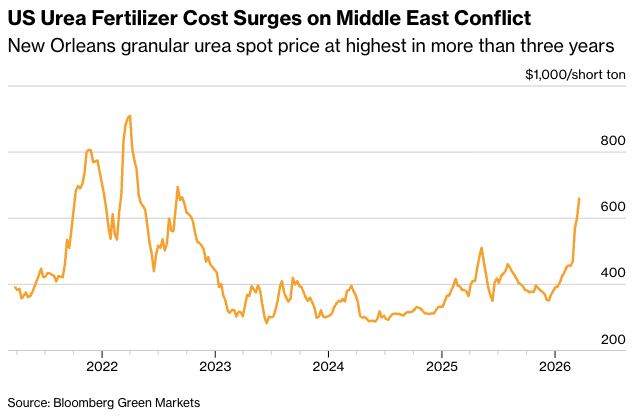
Bloomberg
Video of the Week
Is the Iran War Weakening America’s Armed Forces?
The Economist
