
Before we present our analysis on the unfolding events in the Middle East, let’s state two things and ask a rhetorical question: First, as of the time of this writing (Monday afternoon), the war effects on both equities and bonds are not significant. Second, this fluid situation presents one great opportunity but also a grave danger. The opportunity is that the potential collapse of the Iranian tyrannical regime could change the Middle East for the better and be as important as the collapse of the Soviet Union. The grave danger lies in the possibility of Iran weaponizing the oil infrastructure in the region (briefly touched on below) and using whatever is left from its regional proxies, as well as its own ballistics, to spread terror in the area. Now, before we start addressing a few major concerns, let us ask a rhetorical question: What happened to the Comprehensive Strategic Partnership Treaty that was signed by Iran, Russia, and China less than a month ago?
Let’s now turn our discussion to the seismic events of the weekend. The synchronized attack of the US and Israel on Iran could result in several possible aftereffects, which could be grouped into two possible outcomes: Regime change (the success metric that President Trump chose) or survival of the regime under different leadership. If it is the latter, that would be very unfortunate, as the Iranian tyrannical leadership has been a source of vile and terror internationally and domestically for 47 years now. In addition, the possibility of a more radical regime cannot be excluded. If that were to happen, then retribution from underground radicals organized by that regime cannot be excluded, which, in turn, unfortunately increases the global risks and makes the Middle East “a cup of reeling.” Any prolonged conflict will become a destabilizing factor for geopolitics and geoeconomics. There are three concerns and a few questions arising from the weekend’s events. Let’s first address those three concerns and close this update by raising some questions.
First, what does the day after involve? I believe the paragraph above (regarding the outcomes) addresses that first concern as the situation is fluid and evolving. Second, what will happen to oil prices? Third, how will Iran’s traditional allies such as China and Russia, react?
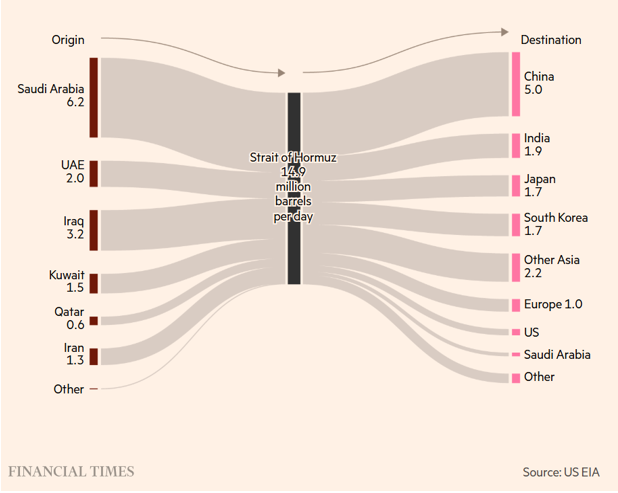
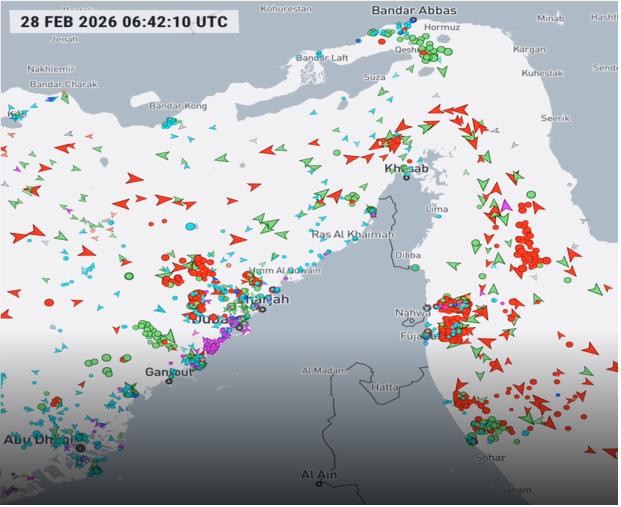
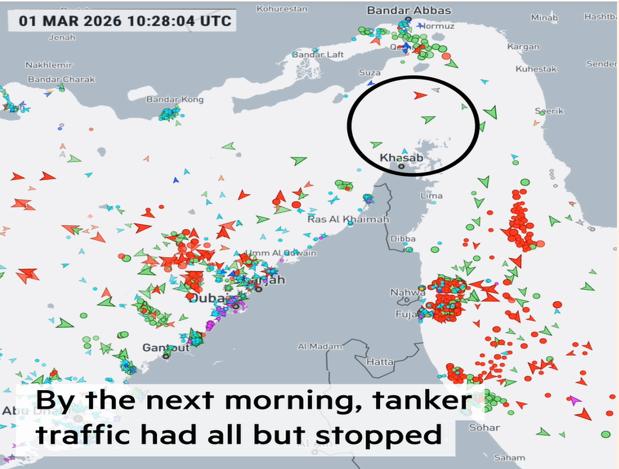
Let’s address the concerns related to oil prices (it should be noted that LNG prices will also be affected). We have seen analyses explaining that oil prices could reach over $100 a barrel. We don’t subscribe to those views. We believe that chances are that oil prices will spike 8-12% (placing the WTI around $74 and the Brent around $81), but when the situation normalizes, there are reasons for prices to settle. The reasons for this kind of medium price spike are as follows: First, OPEC+ already announced higher production quotas (of course, the question is if those higher production levels could reach the destinations given that the Strait of Hormuz – from where 20% of global oil shipments pass – is practically closed, not necessarily by Iran but by the shipping and insurance companies themselves, as shown below.) If the closure lasts up to 10 days, then the impact would not be significant. However, if the closure is prolonged (which we don’t think will be the case), then the chokepoint of Hormuz could drive oil prices to the north of $95 for both WTI and Brent. Even worse, if Iran chooses to weaponize oil by targeting oil infrastructure facilities (refineries, oilfields, and export terminals), then we should not be surprised that such escalation not only drives oil prices well above $120, but also endangers an escalation beyond Middle East grounds.
Second, those countries (such as China and India) that are importing from Iran (baptizing the Iranian oil as Malaysian), have already built their strategic reserves at a very high level.
Third, the US is pretty much self-sufficient in terms of energy thanks to the shale revolution. Mild increases in oil prices should not affect the inflationary pressures by much, if they are contained in terms of time. However, a prolonged conflict will have effects on both inflation and growth and won’t permit any cuts in interest rates in the foreseeable future.
Moving now to the third concern (impact on other countries), three comments are in order: First, the most significant impact could be felt in China, especially if the effects are prolonged. The reason for this is that China depends to some extent on Iranian oil exports. Even more importantly, President Xi may interpret the recent actions (spheres of influence dogma and now the attack on Iran) as his special “get-out-of-jail” card and push forward the invasion of Taiwan, which will open a very significant can of worms in the South Pacific and create earthquakes that we have not seen for the last several decades. Second, thanks to Kyiv’s heroic war efforts of resistance, two authoritative regimes (in Syria and Venezuela) that have killed and imprisoned their citizens have collapsed, as the toothless Russia was unable to support Assad and Maduro. Unfortunately, higher oil prices boost Russia’s reserves and enhance Putin’s hand (even temporarily) in his atrocious and barbaric war in Ukraine. By any measure – no matter how much you stretch it – Russia is not a significant power any longer (the fall of Assad in Syria and Maduro in Venezuela are great witnesses to that.) The concern is that the Iranian war will distract attention from Ukraine and could weaken the EU’s hands (the only ones who truly still support Ukraine), as they will have to deal with the consequences of the Iranian war. Third, traditional allies (especially Europeans who have already been feeling uncomfortable with US policies) will strengthen their resolution of alienation and determination that they need to move alone without acting in cooperation with the US, something that puts more pressure on the international world order.
Before we close with some questions, allow me to say that while we don’t see the outcome as a binary possibility (regime change or not), the situation is very fluid and could truly convert the area again into “a reeling cup.” There could be a military takeover in Iran. There could be a civil war. Someone might be installed as the new leader. A new mullah could emerge who, with the assistance of the ITGC, could spread terror. These are serious times and require serious planning and responsible answers to questions like the ones that follow:
1. Could freedom and democracy emerge in a fragmented society? If the mullahs are out and a liberal order prevails in Iran, the Middle East then becomes an asset play for the US. However, the capital attraction to the region may be significantly wounded.
2. Is there a concrete plan for the day after, along with alternative options in case what is envisioned doesn’t play out? Are the goals spelled out, or do the goalposts keep changing places? And even further, what are the chances of a top-down regime change rather than a boost from the bottom up? And if the historical record supports the latter, what have we done to empower that? If the IRGC were to surrender to whom do they surrender to? Do the people have the means to organize themselves?
3. What kind of message does the attack send to the world and to our US citizens regarding the rule of law and the well-circulated arguments that the international order instituted by the US following WWII is being dismantled in favor of imperial dreams? And if we had obliterated Iran’s nuclear capabilities last June, did Iran present an imminent threat that required immediate action without Congressional approval?
4. The negative effects on China following Venezuela and now Iran are significant. Will they be even more cozy with Putin? Will they bring forward their plans for Taiwan even if Xi doesn’t seem to be trusting his own military commanders?
5. What are the implications for Ukraine and the weak Russian? Could it be that the US turns its attention to places other than Europe?
6. For centuries, the engine of finance is war. However, military power has been subordinated to strategy. Moreover, war has been based on a coherent theory of order, deterrence, or alliance management. Is this the case now? What do we say to those who accuse the developments of spectacle and the command of the news cycle? Could a prolonged conflict be a blessing in the sense of pushing the can of debt implosion down the road?
7. Cui bono from this war, and could it serve not only as a distraction but also be used by authoritative regimes as an excuse for abuse of power?
