
Welcome to the new edition of the Carbon Market News Roundup, our bi-weekly briefing on the evolving landscape of global carbon markets and climate-related regulation. Our previous issues, along with the rest of our commentaries, may be read here.
In this issue, we examine how political pressure and policy signaling are increasingly shaping carbon market dynamics across jurisdictions. EU ETS prices declined sharply as government leaders openly discussed possible intervention and reform, showing the market’s sensitivity to regulatory expectations even in the absence of formal changes. Meanwhile, CBAM’s global trade effects are becoming clearer, with exporters adjusting strategies, policymakers debating design stability, and external regions assessing structural economic impacts. In the maritime sector, decarbonisation investment continues despite uncertainty around global pricing frameworks, even as overlapping regional schemes raise concerns about regulatory fragmentation. At the same time, voluntary carbon markets are entering a phase of institutional restructuring, with stronger oversight initiatives emerging alongside ongoing integrity debates and weak demand for removals, while cross-border carbon management solutions begin to complement traditional offset mechanisms.
EU ETS – Regulations Updates & EUA Price Movement
EU carbon prices slip as leaders suggest intervening in market
By Nora Buli and Kate Abnett, Reuters
EUA price plummets EUR 5 to 5-month low after Merz slams ETS
Cem Bektas, Montel News
The week the EU’s climate foundations started to shake
Zia Weise, Politico
China’s Carbon Market Expands Into Heavy Industry As USA Regresses
Michael Barnard, Clean Technica
European carbon prices declined sharply after several EU leaders, including Germany, Italy, and the Czech Republic, suggested revising or postponing parts of the Emissions Trading System. The benchmark EUA contract dropped to around €72–73/t as markets reacted to political signals, reflecting the sensitivity of the carbon market to perceived intervention risk. The comments were framed in the context of industrial competitiveness concerns, with some policymakers proposing price caps or structural adjustments, while the European Commission defended the system and emphasized that ETS revenues should be more actively used by Member States to support decarbonisation investments. The market reaction showed how policy expectations can immediately influence price formation even before formal legislative changes occur.
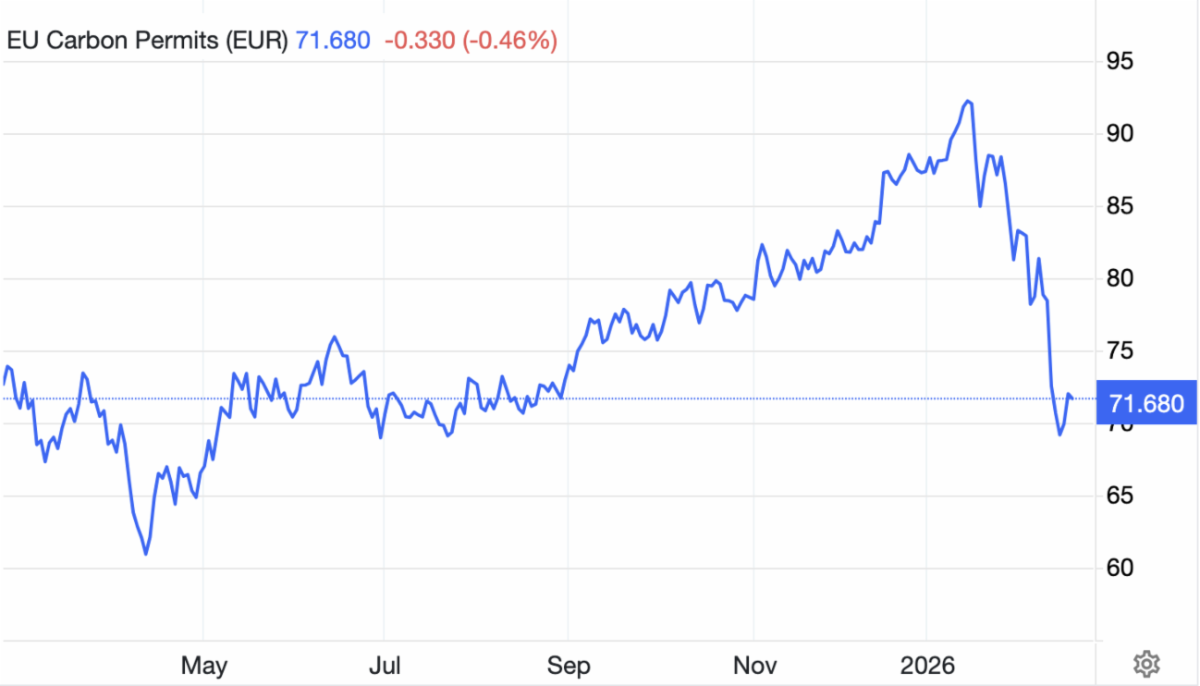
Source: Trading Economics
Subsequent coverage confirmed that the decline was driven primarily by political rhetoric rather than fundamental demand changes, with prices falling roughly €20 amid broader debate over the Green Deal’s economic impact. Industry groups argued that rising carbon costs weaken competitiveness, while other policymakers and market participants warned that intervention risks undermining investment certainty and long-term decarbonisation signals. At the same time, global carbon policy divergence became more visible. While the EU debated tightening or adjusting its mature cap-and-trade framework, China expanded emissions reporting toward wider sector inclusion as part of a gradual carbon market build-out.
Maritime & Shipping Updates
Global shipping industry sticks with green investments, despite carbon price delay
By Enes Tunagur and Jeslyn Lerh, Reuters
Shipping decarbonisation continues despite IMO carbon price postponement
Carbon Pulse
UK shipping industry urges course correction on UK ETS expansion
SAFETY4SEA
Fragmented Carbon Schemes Threaten Maritime Progress, Warns BAR Technologies
Hellenic Shipping News Worldwide
Despite the postponement of a global carbon price under the International Maritime Organization, the shipping industry continues to advance decarbonisation investments, supported by long asset lifetimes and expectations of tightening regulation. Major operators are ordering dual-fuel vessels capable of running on LNG, methanol or ammonia, with lower-emission ships now dominating new building orders and more than $150 billion already committed. Industry assessments similarly indicate that the delay has not materially altered transition strategies, as companies anticipate future regulatory alignment and view alternative fuels and efficiency technologies as commercially necessary over the long term.
At the same time, regulatory uncertainty is increasingly driven by overlapping regional frameworks. The UK’s planned inclusion of domestic maritime in its emissions trading scheme has raised concerns over competitiveness, infrastructure readiness, and cost impacts on ferry-dependent communities, with industry requesting phased implementation and revenue reinvestment. More broadly, sector stakeholders warn that the proliferation of schemes, including EU ETS, FuelEU Maritime, and trade-linked carbon measures, risks fragmenting compliance obligations and complicating investment decisions. Calls are therefore growing for a globally coordinated framework to provide clearer signals, while companies continue deploying fuel-agnostic technologies and efficiency solutions to remain compliant across diverging regulatory regimes.
EU CBAM Updates
India will support steel exports hit by Europe’s carbon tax, federal secretary says
Neha Arora, Reuters
EU’s carbon border fee may be more inflationary than expected, says think tank
Carbon Pulse
Industry lobbies urge MEPs to scrap CBAM’s suspension plan
Montel News
UNECE report assesses implications of EU Carbon Border Adjustment Mechanism on Central Asia
UNECE
India signaled that its steel exports to Europe will continue to face pressure from the EU’s Carbon Border Adjustment Mechanism, despite a newly signed trade agreement that reduced tariffs in other sectors. Indian officials confirmed that the carbon border levy, alongside quotas and other trade constraints, is expected to reduce steel shipments to the EU, prompting potential government support measures and a search for alternative markets. At the same time, a separate analysis warned that CBAM’s cost pass-through could prove more inflationary than initially anticipated, particularly for energy-intensive goods, suggesting that the mechanism’s macroeconomic impact may extend beyond direct trade effects and into broader price dynamics within affected supply chains.
Industry groups within the EU have also intensified their engagement with CBAM design, with hydrogen, aluminum, steel, and fertilizer lobbies urging policymakers not to suspend elements of the mechanism, arguing that regulatory consistency is essential for investment certainty. Beyond the EU, new analysis from UNECE assessed the implications of CBAM for Central Asia, showing both potential trade risks and structural transition opportunities. The report indicates that exporters of emissions-intensive products such as aluminum, cement, steel, electricity, and hydrogen could face significant cost exposure if EU carbon prices rise toward projected long-term levels. However, it also emphasizes that alignment with EU-comparable carbon pricing and strengthened monitoring systems could reduce future CBAM liabilities while accelerating domestic decarbonisation pathways.
Voluntary Carbon Market News
Kenya Establishes National Registry to Bring Oversight to Carbon Credits
Ecofin Agency
Structural failure, weak transparency and falling prices render VCM a “dead body”
Carbon Pulse
Carbon Direct’s 2026 State Of VCM Report Highlights Buyer Hesitancy As A Bottleneck For CDR Scale-Up
Sasha Ranevska, Carbon Herald
Malaysia and Japan plan major cross-border carbon capture project
Anton L. Delgado, ABC News
Kenya launched a national carbon registry to centralize tracking, authorization, and transfer of carbon credits, aiming to prevent double-counting and strengthen market transparency. The reform reflects a broader trend across African countries, introducing state oversight and legal recognition of carbon credits as tradable assets. At the same time, critical assessments of the voluntary carbon market continue, with researchers highlighting structural weaknesses including low transparency, falling prices, and integrity concerns, reinforcing calls for stronger governance frameworks and standardized verification mechanisms.
Market development is also constrained by demand uncertainty. A new industry report found that carbon dioxide removal supply and technology readiness are increasing, yet buyer hesitancy remains the primary bottleneck preventing scale-up, with current purchases far below long-term climate targets. In parallel, international carbon management initiatives are expanding beyond traditional offset markets, illustrated by plans for cross-border carbon capture and storage in Southeast Asia, where captured emissions may be transported and stored abroad.
Recommended Reads
European utilities, cement makers slide on talk of EU emissions trading changes
Danilo Masoni and Samuel Indyk, Reuters
EU carbon pricing tussle has global implications
Financial Times
Trump EPA ends emissions limits for US automakers; state rules, lawsuits could follow
Valerie Volcovici, Reuters
European industry revolts over EU plan to weaken carbon border tax
Politico
The Fed Is Heading for an F on a $7 Trillion Test
Mark Gongloff, Bloomberg
See how climate change is accelerating
John Muyskens and Shannon Osaka, Washington Post
To explore insights and tools driving carbon compliance and markets, visit the FACS website here!
