
Welcome to our monthly newsletter which covers key developments in major non-US markets. With this newsletter, we highlight corporate, debt, and monetary policy news in European, Asian, and Latin American markets. We end this piece with a spotlight on commodities.
European Markets
Corporate and Business News
- Rio Tinto and Glencore explored (and then shelved) a copper-driven mega-combination, underscoring how scarcity value in energy-transition metals is pushing Europe-linked miners toward scale plays and putting strategic pressure on rivals like BHP.
- Deutsche Börse struck a record deal for Allfunds, signalling an exchange-industry pivot away from pure trading volumes toward stickier, fee-based “market infrastructure” revenues and distribution rails.
- ASML pushed past the $500bn valuation threshold as AI-led capex plans from TSMC and peers re-rated the entire equipment cycle, reinforcing Europe’s choke-point advantage in advanced chip supply chains.
- Airbus hit its delivery goal and kept the top spot globally, but ongoing bottlenecks—especially around Pratt & Whitney engines and other supplier constraints—keep the commercial-aircraft market structurally tight and supportive of pricing power.
- Renault reset guidance, reshuffled leadership, and later flagged margin pressure as price competition intensifies, crystallizing the core European autos dilemma: defend volume and EV cadence without surrendering profitability.
- Capgemini agrees to buy WNS in a cash deal to scale “AI-powered operations,” highlighting how European IT services are using M&A to move up the stack from projects to ongoing, outcome-linked delivery.
Debt and Monetary Policy News
- ECB hardened the “higher-for-longer pause” message, keeping key rates unchanged and signaling a high bar for any further moves as the baseline assumes inflation stabilizes around target and growth stays resilient—economists’ polling and the prior meeting accounts reinforce expectations for an extended hold through 2026.
- Euro-area inflation sentiment turned less comfortable as the ECB’s consumer survey shows five-year inflation expectations jumping to a record high, raising the risk that expectations drift becomes the next constraint on easing—even if near-term inflation is subdued.
- The ECB moved to protect bond-market functioning and elevate the euro’s global standing by making its euro liquidity backstop a permanent, worldwide repo facility—designed to prevent forced selling of euro assets during stress and improve monetary-policy transmission.
- The ECB estimates the digital euro would cost EU banks €4–6bn over four years, intensifying the debate over who pays for the infrastructure while the ECB pitches lower merchant fees and reduced reliance on foreign payment rails.
Asian Markets
Corporate and Business News
- Japan’s exports jumped in January, and manufacturers’ confidence improved this month, data showed, offering Tokyo some hope that robust Asian demand will help shore up a stuttering economy as it navigates global and domestic risks. Prime Minister Sanae Takaichi’s tax cuts and spending plans could inject much-needed momentum, analysts say.
- Two-thirds of Japanese firms are concerned about the government’s fiscal discipline as Prime Minister Sanae Takaichi plans a temporary suspension of sales tax on food and steps up investment to spur growth. Takaichi late last month called a snap general election with a vow to suspend an 8% food levy for two years, shaking market confidence in the country’s fiscal health and sending long-dated JGB yields to record highs
- Indonesia’s equity bourse has lost almost 12%, or more than $80 billion in value, since index provider MSCI warned last week that the country risked a downgrade to frontier status due to problems with ownership and trading transparency.
- Emerging Asian currencies weakened and equities moved narrowly in thin holiday curbed trade, with the rupiah under pressure a day ahead of Bank Indonesia’s policy meeting. Volumes were thin across the region with markets in China, South Korea, Taiwan, Malaysia, and Singapore all closed for holidays.
- Japan’s real estate giant Mitsui Fudosan announced it will build a 730‑unit condominium project in Bengaluru, in collaboration with India’s Mahindra Group, marking a significant expansion into India’s residential property market.
- Mining giant BHP announced that copper has become its largest earnings contributor, with profits boosted by sustained demand in Asia even as iron‑ore volumes in China soften.
- SoftBank’s shares extended their multi‑day slide after news that its U.S. subsidiary SB Energy would invest in a $33 billion natural gas mega‑project in Ohio, part of Japan’s broader U.S. investment commitments.
Debt and Monetary Policy News
- The Bank of Japan could raise key interest rates again as early as March and deliver up to three hikes this year in light of persistent inflation and yen weakness. Analysts note that Japan’s nominal growth outlook and clearer fiscal strategy under Prime Minister Sanae Takaichi are reinforcing expectations for a more aggressive tightening cycle.
- New loans from Chinese banks in January rose from the prior month to match the strong performance a year ago as a predictable monetary policy environment supported demand for credit. Banks in China are expected to have issued around 5 trillion yuan ($721.17 billion) in net new yuan loans last month, compared to 910 billion yuan in December.
- China’s Central Bank will step up financial support to boost domestic demand, as industrial overcapacity and lackluster consumption weigh on business confidence and dampen the outlook for growth. The economy is stable but faces challenges such as “supply being strong while demand being weak”, the People’s Bank of China said.
- Japan’s annual bond issuance will likely surge 28% three years from now due to rising debt-financing costs, a finance ministry estimate showed, casting doubt on Prime Minister Sanae Takaichi’s argument that the country can deliver tax cuts without boosting debt. Under the estimate, Japan would need to issue up to 38 trillion yen ($248.32 billion) worth of bonds in the fiscal year starting in April 2029 to fill a hole from expenditures surpassing tax revenues, up from 29.6 trillion yen in fiscal 2026.
- Asian bonds attracted foreign inflows for a fourth straight month in January as an improving growth outlook and robust demand for regional exports boosted investor appetite. Foreign investors bought a net $3.78 billion worth of local bonds in South Korea, Thailand, Malaysia, India, and Indonesia last month, compared with net purchases of about $8.07 billion in December.
Latin American Markets
Corporate and Business News
- Brazil’s Ports and Airports Minister Silvio Costa Filho has asked the Finance Ministry to loosen conditions on loans to airlines backed by the National Civil Aviation Fund (FNAC), a public fund expected to release 4 billion Reais ($764.76 million) starting in 2026.
- Card giant Visa said it would buy payment platforms Prisma and Newpay from private-equity firm Advent International, bolstering its presence in Argentina. The deal links Visa’s global payments network with a scaled local platform, giving the company a stronger footing to bolster digital payments use and modernize infrastructure across Argentina.
- Brazil’s Central Bank ordered the extrajudicial liquidation of Banco Pleno after its financial condition deteriorated, liquidity collapsed, and it violated regulatory rules, following the earlier shutdown of its former affiliate Banco Master. The bank’s controller, ex‑Master partner Augusto Ferreira Lima, had been tied to ongoing fraud investigations, and the failure adds R$4.9 billion in liabilities to Brazil’s deposit guarantee fund.
- Walmart’s Mexico and Central America unit, Walmex, reported a 3.9% drop in fourth-quarter net profit, missing analyst forecasts, as a higher tax rate that was adjusted due to inflation weighed on results. Net profit was 14.6 billion pesos for the last three months of 2025, landing below the 16.68 billion pesos predicted.
- Brazilian state-run oil firm Petrobras posted record exports of 1.2 million barrels per day (bpd) of oil and derivatives in its fourth quarter, surging about 79% from the same period the prior year. The record comes as the firm’s oil production in Brazil rose about 20% in the same period to 2.5 million bpd.
- Mexican telecom company America Movil posted a more than 350% jump in profit for the fourth quarter of 2025, boosted by a swing to foreign exchange gains that helped slash its financing costs.
- Agibank raised $240 million in its New York initial public offering, the second Brazilian fintech to tap U.S. capital markets in recent weeks. The Sao Paulo-based digital bank sold 20 million shares at $12 apiece in its scaled-back IPO, compared with the latest marketed range of $12 to $13 apiece.
Debt and Monetary Policy News
- Uruguay will push ahead with shifting its government debt away from the dollar and seek the broadest trade ties possible as the Latin American nation looks to boost growth. Uruguay’s aim is backed by solid investor demand, with some viewing the country’s currency as “more stable than the dollar” as the greenback weakens and geopolitical risk roils once-stable Western world investments.
- Bolivia is discussing a medium‑ to long‑term Extended Fund Facility with the IMF, which would allow it to borrow between eight and ten times its IMF quota, or roughly $2.6 to $3.3 billion, according to reports.
- Brazil’s annual inflation edged up in January, broadly in line with expectations, while remaining within the official target range. Prices in Latin America’s largest economy rose 4.44% in the 12 months through January, up from 4.26% the previous month, but still support expectations of monetary easing ahead.
- Inflation in Mexico sped up in January, supporting the central bank’s decision last week to hold its interest rate as it sees inflation taking longer to reach the bank’s target. Consumer prices rose 3.79% in the year through January, above December’s rate of 3.69%.
- The IMF said that continued reserve accumulation by Argentina is essential for securing durable access to private credit markets after the central bank has purchased over $2 billion in foreign currency since the start of 2026.
Commodities Spotlight
Energy
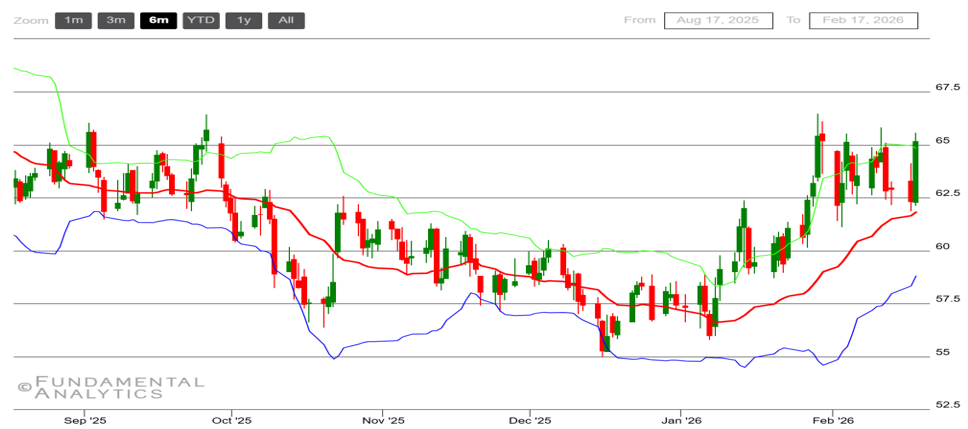
Intensified geopolitical risk gave bullish signal, but oversupply concerns remain
Source: Fundamental Analytics
WTI traded choppy as markets weighed an ample supply narrative against episodic geopolitical risk. A Reuters poll and IEA outlook pointed to 2026 oversupply and modest demand growth, while talk of OPEC+ resuming output increases capped rallies. U.S. data alternated between large stock builds and sharp draws, with production near records. Headlines on U.S.–Iran talks and strike fears swung risk premia.
Agriculture
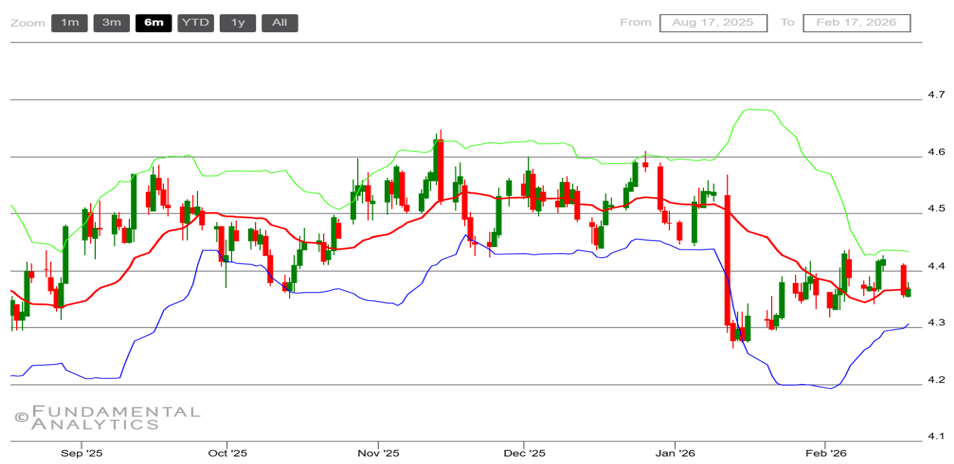
Corn futures retreat to 4 months low as harvest counterbalance bullish movement
Source: Fundamental Analytics
Corn futures oscillated between ample U.S. supply and South American weather risk. A record U.S. harvest and stocks kept rallies contained, even as the USDA lifted export expectations and trimmed ending stocks. Export sales and ethanol grind provided support. Meanwhile, Argentina’s January heat and uneven rains threatened yield potential, injecting a weather premium and sharpening focus on South America’s second-crop outlook.
