
Global Market News
Global Equities Weaken
Global equities declined on the week. The S&P 500 and Nasdaq decreased 1.39% and 2.10%, respectively, while the Dow Jones dropped 1.23%. The US 10-year Treasury note decreased several basis points to close the week at 4.05% amid rising equity volatility and softer inflation data. Meanwhile, the price of a barrel of West Texas Intermediate crude oil dropped to end the week at $60.65. Volatility, as measured by the CBOE Volatility Index, rose nearly 10% over the week, closing Friday at 20.60.
Inflation Cools, Jobs Surprise, and AI Jitters Continue to Shake Markets
Wall Street ended the week lower as investors evaluated new economic data and a steady stream of corporate earnings. January’s Consumer Price Index rose 0.2%, slightly below expectations and slower than December’s pace. Nonfarm payrolls surprised to the upside, increasing by 130,000, which is well above forecasts and December’s revised figure. Corporate earnings from major companies like Coca-Cola, McDonald’s, and T-Mobile contributed to notable stock-specific movements throughout the week. Meanwhile, market sentiment shifted from what strategist Ed Yardeni called “AI-phoria to AI-phobia,” as fears of AI-driven disruption hit first software stocks and then wealth management firms following the debut of an AI tax-planning tool. This environment of rapid repricing could create opportunities for active managers to distinguish AI winners from losers, while smaller and value-oriented stocks—as well as international equities, particularly in emerging markets—continued to outperform large U.S. growth stocks.
International Developments
Election Results Across East Asia: Japan, Thailand, and Bangladesh
Election outcomes across Asia this week signal a broader shift toward strong mandates and coalition-driven stability as governments prepare to confront economic and geopolitical pressures. In Japan, Prime Minister Sanae Takaichi secured a historic supermajority for the Liberal Democratic Party after calling a snap election, strengthening her authority to pursue fiscal spending, industrial policy, and a more security-oriented economic strategy, though risks remain given high public debt and inflation. Meanwhile, Thailand’s Bhumjaithai Party formed a governing coalition with Pheu Thai following a decisive victory, creating a sizable parliamentary majority that could help address economic challenges after recent political turbulence. In Bangladesh, the opposition Bangladesh Nationalist Party returned to power with a landslide victory, positioning leader Tarique Rahman to restore stability, rebuild investor confidence, and revive key industries after months of unrest. Taken together, the results reflect voter preference for decisive leadership and functional governments, while also highlighting the growing importance of political stability in sustaining economic recovery and managing great power competition across the region.
US-Iran Tensions Deepen as Protests and Military Moves Intensify
The United States appears to be reinforcing its military posture in the Middle East even as it pursues diplomacy with Iran, highlighting a strategy that blends deterrence with negotiation. Reports indicate the Pentagon has ordered the USS Gerald R. Ford carrier strike group to join the USS Abraham Lincoln already in the region, a move that would place two aircraft carriers near Iran as Washington pressures Tehran to reach a nuclear agreement. President Donald Trump reiterated his preference for a diplomatic deal following talks with Israeli Prime Minister Benjamin Netanyahu, though he warned that military options remain if negotiations fail. Indirect US-Iran discussions recently resumed in Oman, but key disagreements persist, particularly over Iran’s missile program, which Tehran calls nonnegotiable. Iranian officials have also cautioned against Israeli interference in the talks. The buildup follows last year’s direct hostilities between Israel, the US, and Iran, underscoring the fragile security environment as Washington seeks leverage while keeping open the possibility of a negotiated outcome. This diplomatic backdrop is unfolding as Iran continues to face ongoing, deadly nationwide protests, with human-rights groups reporting thousands of demonstrators killed amid the regime’s most violent crackdown in decades.
Geopolitical Spotlight at the Winter Olympics
Italy’s Winter Olympics have unfolded against a backdrop of heightened security and political tension. Italian authorities said they thwarted a series of cyberattacks of Russian origin targeting foreign ministry facilities, including Italy’s embassy in Washington, as well as Olympic related sites and hotels in Cortina d’Ampezzo. On the ground in Milan, thousands protested the cost, environmental impact, and security footprint of the games, with clashes erupting after a breakaway group confronted police, prompting the use of water cannons and several detentions. Meanwhile, the International Olympic Committee drew international scrutiny after withdrawing the accreditation of Ukrainian skeleton athlete Vladyslav Heraskevych for wearing a helmet honoring athletes killed since Russia’s 2022 invasion, citing rules barring political messaging at competition venues. The episode, coupled with Russia’s broader exclusion from the Games, has underscored the difficulty of separating sport from geopolitics as Milano Cortina 2026 proceeds under tight security and global attention.
US Social & Political Developments
Immigration Drawdown in Minnesota
The Trump administration has announced the conclusion of its large-scale immigration enforcement surge in Minnesota, with border czar Tom Homan confirming a “significant drawdown” of federal agents after weeks of operations targeting what officials described as public safety threats. Some officers will remain to coordinate with local law enforcement, but the reduced presence follows public backlash after two fatal shootings involving federal agents and widespread protests. State and local leaders expressed cautious optimism about the pullback while emphasizing the lasting social and economic strain on affected communities. Trump administration officials framed the move as evidence of successful enforcement and praised cooperation from Democratic leaders, though coordination challenges and a federal investigation into the state’s response remain unresolved.
Congressional Moves: Canada Tariffs and DHS Funding
Congressional tensions over trade and immigration intensified this week as the House voted 219 to 211 to rescind President Trump’s tariffs on Canadian imports, with six Republicans joining Democrats in a largely symbolic rebuke that is unlikely to take effect given the president’s expected veto. The vote nevertheless highlights growing unease among some lawmakers about ceding trade authority to the White House and concerns over the tariffs’ mixed economic impact. Meanwhile, a deep partisan divide over immigration enforcement has pushed the Department of Homeland Security toward a potential shutdown after Senate Democrats blocked a Republican funding bill they argued lacked sufficient guardrails on federal agents. With negotiations stalled and lawmakers departing for recess, the funding lapse could disrupt several federal agencies, though immigration operations are expected to continue, underscoring the broader political standoff shaping US domestic policy ahead of upcoming mid-term elections.
Corporate/Sector News
Trump Revokes EPA Protections
The Trump administration has revoked the Environmental Protection Agency’s 2009 endangerment finding, a scientific determination that greenhouse gases threaten public health and the legal foundation for most federal climate regulations. The move eliminates emissions standards for vehicles and could pave the way for broader rollbacks affecting power plants and other major polluters, with the White House framing the action as a historic deregulatory effort intended to boost energy production and reduce costs. Critics, including environmental groups and former officials, argue the repeal disregards extensive scientific evidence linking greenhouse gases to worsening climate impacts and warn it could increase pollution and health risks. Legal challenges are widely expected, potentially setting up a Supreme Court battle over the EPA’s authority under the Clean Air Act. The decision marks a significant shift in US climate policy and could shape the regulatory landscape for years, as future administrations may face legal and political hurdles in attempting to restore federal oversight.
Washington Post’s Sweeping Layoffs
Jeff Bezos issued his first public statement following mass layoffs at The Washington Post, totaling roughly 30% of the post’s workforce, including 300 journalists. He describes the move as a strategic pivot toward using reader data to shape coverage and business decisions as the paper attempts to adapt to a crowded digital media landscape. Leadership upheaval accompanied the cuts, with CEO Will Lewis stepping down and CFO Jeff D’Onofrio taking over on an interim basis, while executives stressed that understanding audience behavior will be central to future growth. The data-focused approach has drawn criticism from some media figures who fear it could undermine the publication’s originality, adding to ongoing tensions after Bezos previously ended presidential endorsements in the 2024 election. Despite skepticism and internal pushback, Bezos expressed confidence that aligning newsroom priorities with reader interests can position the paper for a more sustainable and competitive next chapter.
Venezuela to Grant More Oil Blocks to Chevron and Repsol
Venezuela’s state-run PDVSA and the Rodriguez administration are poised to grant additional oil exploration and production blocks to Chevron Corp. and Spain’s Repsol SA. Officials in Caracas are expected to award new land for oil production as early as February 2026 to help rebuild the nation’s energy sector. In late January 2026, Venezuela’s National Assembly approved reforms to the main oil law, granting foreign companies greater autonomy to export oil and manage sales proceeds, even as minority partners in joint ventures. The US Treasury Department recently issued expanded licenses allowing Chevron, Repsol, BP, Shell, & Eni to operate more broadly in the country. Under these terms, tax and royalty payments must be deposited into a US-controlled bank account. With these new areas, Chevron expects a production increase of up to 30% within the next 18 to 24 months. The move is part of a broader strategy by the Trump administration to revive Venezuela’s oil sector while reducing the influence of China and Russia in the region.
Recommended Reads
Jimmy Lai’s 20-Year Sentence Follows Beijing’s Playbook on Dissent
The Forgotten Hero Who Helped Eradicate One of Humanity’s Oldest Killers
The Road to Dow 50000 Was Perilous. What’s Next Could be Rockier.
Why China’s Grip on Critical Minerals Is So Hard to Break
The Political Cost of America’s Surging Electricity Bills
This week from BlackSummit
Is This A Rimini Shift? Let’s Discuss Recent Volatility in Precious Metals and the Tech Sector
John E. Charalambakis
The BlackSummit Team
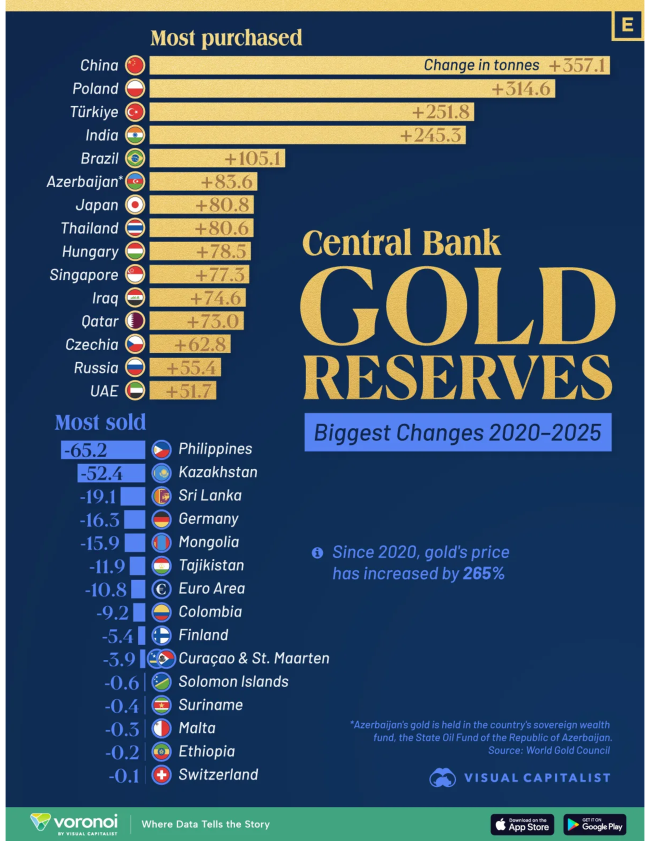
Image of the Week
Video of the Week
How the Debt Problem is Fueling the Gold Market
Source: Bloomberg
