
Global Market News
Global Equities Mixed
Global equities were mixed this week. The S&P 500 and Nasdaq were both down on the week, 0.10% and 1.84% respectively, while the Dow Jones gained 2.50%. The U.S. 10-year Treasury note declined to 4.21%, while the price of a barrel of West Texas Intermediate crude oil dropped to end the week at $63.55. Volatility, as measured by the CBOE Volatility Index, decreased moderately, closing Friday at 17.76.
AI Disruption Fears Shake Software Markets
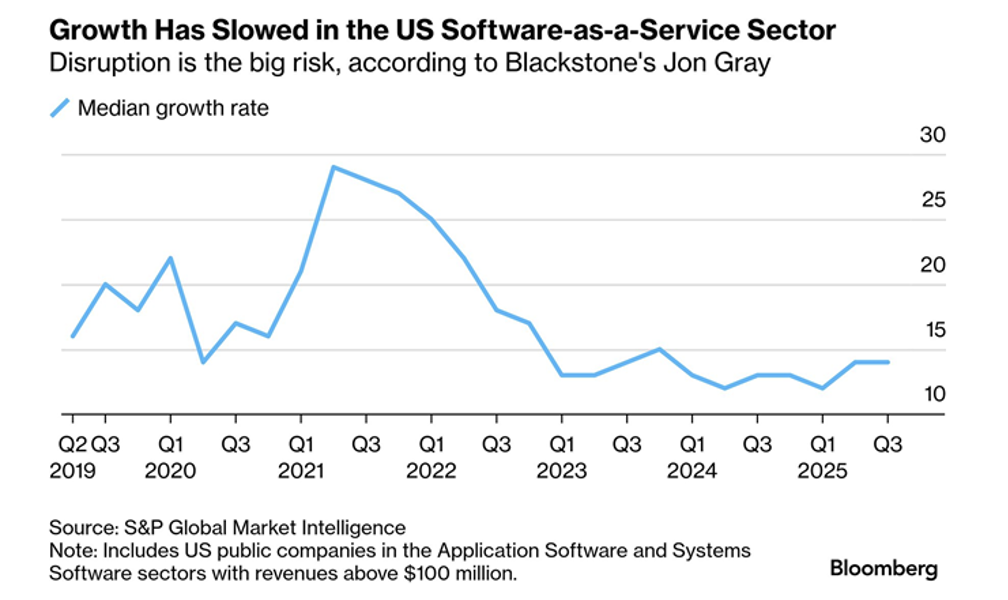
Software stocks fell sharply this week on fears that fast‑advancing AI tools—particularly new capabilities from Anthropic—could erode demand for traditional software and data‑service platforms, wiping out over $800 billion in market value across six sessions. Although shares stabilized somewhat by Thursday, companies like Microsoft, Salesforce, and ServiceNow were still under pressure, and global tech markets showed similarly mixed performance. These concerns were amplified by uncertainty over whether major tech firms’ rapidly rising AI‑driven capex will pay off, with Alphabet alone signaling its capital spending could nearly double. Amid the turbulence and a broader rotation out of tech, value stocks outperformed, pushing the Russell 1000 Value index to a record high on Wednesday.
International Developments
US-Iran Talks in Oman Amid Protest Crackdown and Increased Military Presence
Iran’s government has intensified its crackdown following nationwide protests, carrying out mass arrests, shuttering businesses, and targeting doctors who treated injured demonstrators in what rights groups describe as “collective punishment.” Authorities have acknowledged roughly 3,000 deaths, though estimates suggest the toll could be significantly higher, with up to 40,000 detained. The sweeping repression underscores the regime’s fear of renewed unrest amid a deepening economic crisis and growing external pressure, even as some citizens continue acts of defiance through strikes, student protests, and symbolic public mourning. Tensions with Washington escalated further when a US F-35 fighter jet shot down an Iranian Shahed 139 drone that approached the aircraft carrier Abraham Lincoln with “unclear intent” in the Arabian Sea. The incident occurred alongside a broader US military buildup following the unrest in Iran and was quickly followed by another confrontation in which Iranian boats threatened a U.S.-flagged tanker before being deterred by a Navy escort. Oil prices rose after the drone was downed, highlighting market sensitivity to the risk of a wider confrontation as both sides continue signaling readiness for military action. Despite the volatile backdrop, recent talks in Oman offered a tentative diplomatic opening, marking the first negotiations since last year’s brief military conflict between the two countries.
US-India Trade Deal Reached
The United States and India are moving toward a formal trade agreement expected to be signed in March, marking a significant thaw after months of strained relations. The deal would reduce US tariffs on Indian exports to about 18% from as high as 50%, while India plans to purchase roughly $500 billion in American goods over five years, including major orders for energy, semiconductors, and up to $70-80 billion in Boeing aircraft. In exchange, New Delhi has agreed to scale back purchases of Russian oil and lower tariffs on US imports, though details remain unclear and domestic critics in India have raised concerns about agricultural market access. The agreement follows intensive behind-the-scenes diplomacy aimed at repairing ties after Trump’s tariff hikes and public criticism of India, with both sides recognizing the strategic importance of the partnership. For India, closer economic alignment with Washington supports its long-term development goals and helps counter China, while the US benefits from expanded trade and investment links with one of the world’s fastest-growing major economies.
Second Round of Russia-Ukraine Talks after Large Scale Attack on Ukraine’s Power Grid
Renewed US-brokered peace talks between Russia and Ukraine resumed in Abu Dhabi just days after Russia launched one of its most intense assaults of the year on Ukraine’s power grid, firing roughly 70 missiles and hundreds of drones that triggered widespread outages during subzero temperatures. Ukrainian officials accused Moscow of disregarding diplomatic efforts, noting the strikes came shortly after President Donald Trump said Vladimir Putin had agreed to pause attacks on energy infrastructure. Despite the escalation, negotiators from all three countries described the discussions as constructive, producing a major breakthrough with a prisoner exchange involving more than 300 captured soldiers and an agreement to continue talks, likely in the United States. Kyiv reiterated that any settlement must include robust security guarantees to prevent future aggression, while Moscow signaled “positive movement” but continues to demand territorial concessions, including Ukrainian withdrawal from contested eastern regions.
US Social and Political Developments
Partial Government Shutdown Ends After House Passes Spending Package
A partial government shutdown ended on February 3rd, lasting only four days. The brief lapse in funding concluded when President Trump signed a $1.2 trillion spending package that includes full-year funding for most federal agencies but only a short-term extension for the Department of Homeland Security (DHS). Funding for the Department of Homeland Security was separated from the main package and only extended until February 13, 2026. This allows more time for negotiations regarding the Democratic Party’s demands for restrictions on ICE and Border Patrol, emboldened following multiple deaths during federal enforcement operations. Other government agencies that did not receive full-year funding include the TSA, Coast Guard, Customs and Border Patrol, U.S. Secret Service, CISA, and FEMA. Lawmakers must reach a new agreement on DHS funding by February 13th to avoid another partial shutdown. Democrats are seeking reforms such as body camera requirements and a ban on masks for immigration agents
DHS to Withdraw 700 Agents from Minneapolis
The Trump administration has ordered the withdrawal of about 700 federal immigration officers from Minneapolis, reducing the force by roughly a quarter, in an effort to calm tensions after two U.S. citizens were killed during enforcement operations. Around 2,000 agents will remain, still far above normal levels, but officials say the strategy will shift toward more targeted arrests, greater reliance on local jail transfers, and expanded use of body worn cameras to improve oversight. President Trump acknowledged the incidents were “very sad” and signaled the need for a “softer touch” while maintaining firm enforcement, as public backlash grows and polls show widespread disapproval of ICE tactics. While the Department of Homeland Security argues the changes reflect “smart law enforcement,” Minneapolis Mayor Jacob Frey criticized the continued large federal presence, calling the broader operation harmful to residents and businesses.
Corporate/Sector News
Walmart Reaches $1 Trillion Market Cap
Walmart officially surpassed a $1 trillion market capitalization on February 3rd, becoming the first traditional retailer to reach this historic milestone. The company’s stock closed that day at $127.71, up nearly 3%, bringing its total market value to approximately $1.018 trillion. E-commerce revenue jumped 27% in the most recent quarter, while advertising revenue surged 53%. Additionally, early and extensive investments in artificial intelligence for supply-chain automation have helped the company beat same-store sales estimates for 15 consecutive quarters. Last month, Walmart moved its listing to the Nasdaq 100, further cementing its stance as being “tech-forward.” The retailer reached this milestone just three days into the tenure of new CEO John Furner, who succeeded longtime chief Doug McMillon on January 31, 2026. Furner is expected to accelerate the company’s transformation into a high-tech omnichannel retailer
France Raids Tech Offices of X as SpaceX Acquires xAI
On Tuesday, French authorities raided the Paris offices of Elon Musk’s social media platform X as part of a significant cybercrime investigation. The probe began in January 2025, regarding fraudulent data extraction. However, it was significantly widened to include allegations that X’s AI tool, Grok, was used to generate sexually explicit deepfakes and content denying crimes against humanity; manipulation of data processing & algorithm abuse was also alleged. Elon Musk characterized the raid as a “political attack,” while the company itself, X, denied any wrongdoing, calling the raid “law enforcement theater” designed for “illegitimate political objectives.” In related news, Musk officially announced that SpaceX has acquired xAI, his artificial intelligence startup, in a record-breaking deal that values the combined entity at approximately $1.25 trillion. The merger combines SpaceX’s launch and Starlink satellite capabilities with xAI’s large language models (Grok) to create what Musk calls a “vertically integrated innovation engine.” Musk stated the primary goal is to build space-based AI data centers to overcome Earth-based limitations on power, cooling, and land use.
Group of US Investors Reach Preliminary Deal on Mining Assets in the DRC
A consortium of American investors has secured a deal with the Democratic Republic of Congo (DRC) as the US seeks to secure critical mineral supply chains and counter China’s dominance in the sector. Glencore PLC entered a non-binding agreement to sell a 40% stake in its DRC copper & cobalt operations to the US-backed Orion Critical Mineral Consortium. Valued at approximately $9 billion, the deal includes the Mutanda Mining and Kamoto Copper Company (KCC) assets. Late last year, the DRC brokered a Strategic Partnership Agreement, granting US firms “privileged access” to reserves. As a result, this year state-owned Gécamines announced plans to export 100,000 metric tons of copper directly to the US starting last month, and US-backed venture between Gécamines and Mercuria Energy Group was announced to ship copper cathode to Saudi Arabia and the UAE. Additionally, Ivanhoe Mines is in advanced discussions with Gécamines and Mercuria to supply zinc and other minerals (including copper) to the US from its Kipushi mine.
Recommended Reads
America First Risks Becoming America Alone
U.N. Says It’s in Danger of Financial Collapse Because of Unpaid Dues
How Russian-linked Oil Trade Continues off the EU’s Black Sea Coast
What is Driving Gold’s Relentless Rally?
Emerging Markets Make Roaring Start to 2026 as Dollar Slides
This week from BlackSummit
The BlackSummit Team
The FACS Team
Image of the Week
Video of the Week
Japan is Taking Action to Tackle Smartphone Addiction. Here’s How
Source: World Economic Forum
