
This Advent, we encourage you to support worthy causes that bring hope and healing to those in need by giving to organizations that we as a firm and as individuals support, such as Mercy Ships, Gifts to Children of Ukraine, and initiatives led by Nicholas Kristof. We wish you a blessed holiday season!
Global Market News
Global Equities Mixed
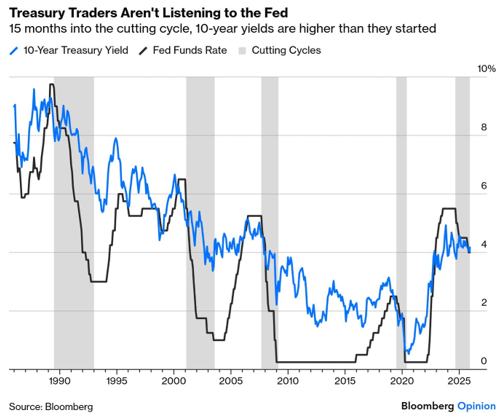
Global equities were mixed this week amid another rate cut from the Fed and concerns over heavy AI spending. The S&P 500 and Nasdaq declined 0.63% and 1.62%, respectively, and the Dow Jones gained 1.05% on the week. The U.S. 10-year Treasury note rose a few basis points to 4.18%, while the price of West Texas Intermediate crude oil dropped back below $60 per barrel, closing Friday at $57.44. Volatility, as measured by the CBOE Volatility Index, was not much changed, ending the week at 15.74.
Mixed Labor Signals Ahead of FOMC Rate Decision
The Fed Cuts Rates
The Federal Reserve cut interest rates by 0.25% to a range of 3.50%–3.75% and signaled that the easing cycle is now on hold, pending further assessment. Three FOMC members dissented, with differing views on whether to cut more or keep rates unchanged, while the Fed also announced monthly purchases of $40 billion in short-term Treasuries through early 2026. Chair Jerome Powell noted that employment figures may be overstated and emphasized that a rate hike is unlikely, citing a cooling economy and inflation mainly driven by tariff passthrough expected to peak in Q1 2026. The Fed raised its 2026 GDP forecast, lowered its inflation outlook, and projected one more rate cut in 2026.
International Developments
EU Indefinitely Freezes Russian Assets Amid Peace Talks
The European Union has indefinitely frozen approximately €210b ($247b) of Russian central bank assets held within the bloc. This move, agreed upon by EU members on December 12, is part of a movement toward using the funds to support Ukraine. The decision was made using a special “economic emergencies” procedure, which required a qualified majority vote rather than unanimous consent. This prevents some of the more Russia-friendly countries, like Hungary and Slovakia, from blocking the measure as previously threatened. Meanwhile, the Trump administration has allegedly set an informal “Christmas deadline” for Ukraine to agree to a peace deal with Russia. The U.S. has denied making it an official stance, though Ukrainian President Volodymyr Zelenskyy has confirmed the U.S. delegation wants clarity on a deal by that time. Ukrainian officials maintain that they have not been given sufficient details on security guarantees and refuse to cede any territory, which is a critical sticking point in negotiations.
U.S. Seizes Oil Tanker Near Venezuela, Announces New Sanctions
The United States seized an oil tanker off the coast of Venezuela on December 10, as part of an ongoing pressure campaign against the Maduro government and efforts to stop the flow of sanctioned oil. The tanker was carrying about 1.8 to 2 million barrels of heavy crude oil, as well as falsely sailing under a Guyanese flag. U.S. officials framed the action as a sanctions enforcement measure and part of broader efforts in Latin America, while the Venezuelan Foreign Minister called the seizure “international piracy.” President Trump has stated the goal is to pressure Nicolás Maduro’s government, which the U.S. has charged with “narcoterrorism.” Earlier in the week, the administration also sanctioned individuals close to Maduro, including three nephews of his wife and a businessman, along with six shipping firms and six Venezuela-flagged vessels tied to the oil sector. These measures aim to cut off financial lifelines to Maduro’s regime and intensify economic pressure.
Thailand Dissolves Parliament Amid Escalation With Cambodia
Thailand’s parliament was officially dissolved on Friday by Prime Minister Anutin Charnvirakul. The dissolution was triggered by a political deadlock and an impending no-confidence vote, paving the way for a general election to be held early next year. Under Thai law, a general election must be held between 45 and 60 days after the dissolution decree is published in the Royal Gazette, which occurred on Friday; a new election will likely take place by late January or February in 2026. This comes as the border conflict between Cambodia & Thailand was reignited earlier this month. Driven by a long-running territorial dispute, recent hostilities have included airstrikes and artillery fire, leading to dozens of casualties and the displacement of hundreds of thousands of people. While U.S. President Donald Trump was able to broker a ceasefire in July of this year, the peace collapsed shortly thereafter as both sides accused the other of ceasefire violations.
US Social & Political Developments
Trump Allows Nvidia to Sell Advanced Chips to China
President Donald Trump recently announced that the U.S. will allow Nvidia to sell its H200 artificial intelligence chips to China. This decision reverses previous restrictions and has sparked significant debate in Washington. Sales are permitted to approved commercial customers vetted by the Department of Commerce, with the condition that the U.S. government receives 25% of the sales revenue. The decision has drawn bipartisan criticism in Congress, with some lawmakers arguing it compromises national security for short-term economic gain and risks ceding the U.S. advantage in AI. Additionally, while the H200 is more powerful than previous restricted chips, the Chinese government had previously discouraged local firms from buying “degraded” U.S. chips due to security concerns, pushing for domestic alternatives.
House Passes $900 Billion Defense Bill
The House of Representatives has passed a nearly $900 billion National Defense Authorization Act (NDAA) for fiscal year 2026, ahead of the year-end deadline. The legislation, which passed with bipartisan support by a vote of 312-112 on Wednesday, now heads to the Senate for approval. The bill authorizes a 3.8% pay raise for service members across the board, as well as “significant acquisition reforms” intended to streamline the way the Pentagon buys weapons and supplies, aiming to cut red tape and accelerate delivery of modern capabilities. Additionally, the legislation mandates more Pentagon consultation with Congress and requires the release of unedited video footage and command orders relating to recent military strikes on suspected drug-smuggling boats. The bill has generally received bipartisan support and is expected to pass the Senate and then be signed into law by President Trump.
Corporate/Sector News
Paramount Jumps In On Bidding War for Warner Bros
Paramount has launched a hostile takeover bid for Warner Bros. Discovery (WBD), initiating a bidding war after Netflix reached an initial agreement to acquire WBD’s studio and streaming assets. Paramount Skydance is offering an all-cash $30 per share for the entirety of Warner Bros. Discovery, valuing the deal at approximately $108.4 billion including debt. The bid is backed by the Ellison family (led by tech billionaire Larry Ellison), RedBird Capital, and Middle Eastern investment funds, and includes WBD’s cable networks like CNN and TNT. Netflix has previously negotiated a deal with the WBD board for the studio and streaming assets only, excluding the cable networks, in a deal valued at $27.75 per share and an enterprise value of $82.7 billion. Both deals face potential antitrust scrutiny. Paramount argues its offer is more likely to pass regulatory approval faster, while Netflix is confident its deal will close, though it is expected to take 12-18 months for review. The involvement of President Trump’s son-in-law, Jared Kushner’s firm, in Paramount’s financing has added a political dimension to the regulatory conversation.
Oracle Plunges Amid Spending Concerns
Oracle shares fell more than 14% this week after the company reported weaker-than-expected quarterly revenues and announced a sharp increase in capital spending to $50 billion this year, largely for data centers to support AI workloads. The company’s aggressive investment strategy, aimed at competing with cloud giants like Amazon, Microsoft, and Google, has raised concerns about soaring debt, which jumped 44% year-on-year to $116.3 billion. While Oracle expects long-term gains from AI infrastructure contracts with clients such as OpenAI, investors worry about upfront costs, financing risks, and the ability of these customers to honor massive commitments. Despite strong bookings and a boost in net income from asset sales, analysts warn of near-term pressure due to the timing mismatch between heavy spending and delayed revenue growth.
China Starts Buying U.S. Soybeans Again, Trump Pledges Support for Farmers
President Trump announced a $12 billion aid package on December 8, funded by tariff revenues, to support U.S. farmers affected by the trade war with China. Under the plan, up to $11 billion will go toward one-time “bridge payments” for row-crop farmers, with the remainder allocated for specialty crops. The announcement coincided with easing Chinese purchases of U.S. soybeans, though volumes remain below promised levels. China has resumed buying U.S. soybeans in recent weeks, but the pace is slower than expected, leaving uncertainty about future demand. Treasury Secretary Scott Bessent and Agriculture Secretary Brooke Rollins stated that the aid aims to stabilize farm income and help farmers plan for the next planting season.
Recommended Reads
China’s $1tn wake-up call: Record surplus threatens to fuel trade tensions
How a Nuclear-Fossil Fuel Alliance Is Winning the Fight for Energy Dominance
Trump Has Long Disdained Europe’s Elites. Now, It’s Official.
This week from BlackSummit
BlackSummit Team
BlackSummit Team
Image of the Week
Video of the Week
How Warren Buffett Changed Investing Forever
Source: Bloomberg
