
When Plato received John D. Rockefeller’s invitation for dinner, he insisted on an average type of restaurant. “Affordability is key,” he insisted, “and I pay my own way.” It happened that my table was behind theirs.
Plato asked rhetorically: “Mr. Rockefeller, have you seen this graph, and how would you interpret the fact that stocks (mainly the top 10 tech-oriented companies) continue their upswing while consumer sentiment is slumping?”
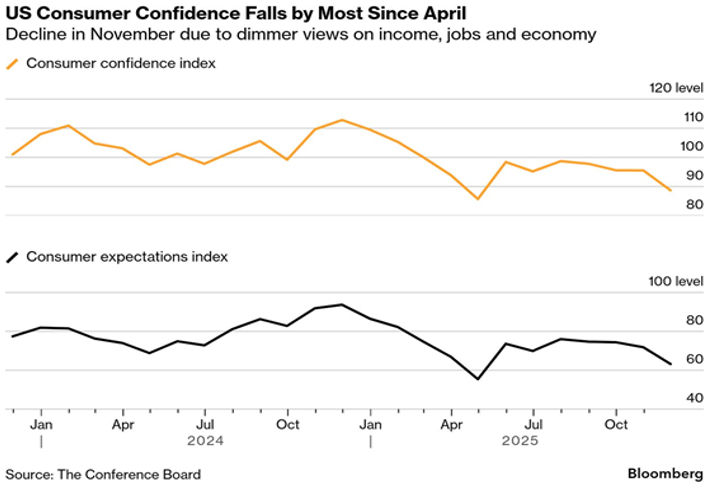
Before Rockefeller had a chance to address Plato’s question, Plato asked again: “And as the person who epitomizes the oil industry, what do you think of the fact that crude prices are nearing their 4.5-year lows?”
“My dearest teacher, if not mistaken, there is an AI subliminal message in your questions. I still remember the early days in Titusville, Pennsylvania, when land values were skyrocketing. I witnessed pieces of land sold for $25,000, and three months later resold for $1.5 million. The oil Dorado could convert a metropolis into a ghost town as its wells went dry. Those who carted the oil out of the fields to be refined were the masters of the region.”
“I knew that you would get my AI implication, but the paradoxes do not stop there, as you know. The dollar is down almost 10% since the beginning of the year, gold is up 60%, and silver is up over 90%. Let me kindly remind you of the dialogue in Phaedrus where human beings are compared to charioteers driving the two horses of human nature: our soul of reason and our irrational animal passions. The charioteer’s mastery is found when he gives the lead to one and reins the other. The execution of such a task leads to a virtuous life as justice, discipline, and knowledge end up becoming the needed companions before the soul withdraws again within the vault of its eternal destiny.”
“My dearest teacher, I recall well your sentence in the Republic, where you stated clearly that there will be no end to the troubles of states, until philosophers become the kings in this world, but tell me honestly, as you always did, would you rather be a king or a kingmaker, especially in our world?”
“Mr. Rockefeller, let’s agree that I am not here to answer questions. I‘d rather question the answers provided to me. You mentioned before the busting of towns when oil wells dried up, implying that the money was not in the oil per se, but rather in refining and transportation, and if not mistaken, your conflict with Thomas Scott of the Pennsylvania Railroad is legendary, as both of you tried to control oil shipments and pipelines. Nowadays, the money can still be found in pipelines, as well as in shipping (was wondering of all those shipping magnates who are making billions transporting Russian oil), and of course in trading. Data centers are becoming bunkering and trading stations. However, I am wondering that as the world evolves at rapid speed and trust is eroding, which of my writings would you consider the most relevant in our world nowadays?”
“Oh, I was hoping you would ask that, dearest teacher. The Timaeus would be the most relevant one,” Rockefeller replied without hesitation.
“Is that because I chose an Italian to portray the radical new thinking as I was approaching the end of my life? Or is it because I envision the genesis of the world by a God so different than the Olympians, where the Forms and models of perfection out of which God has fashioned the visible world, are numbers taught to us by Pythagoras, the most influential of all Pre-Socratic philosophers?”
“I like numbers, dearest teacher,” Rockefeller replied, and he added, “When I see major divergence in numbers, I will invent, as you pointed out, a strategy to bankrupt my business opponents. Strategy without numbers resembles a Greek dish without olive oil.”
“Well then, philosophically we disagree, as my goodbye for tonight will remind you, but for now the numbers I see may point to some forthcoming troubles, namely late-cycle excesses and currency troubles. Just look at the figures below:
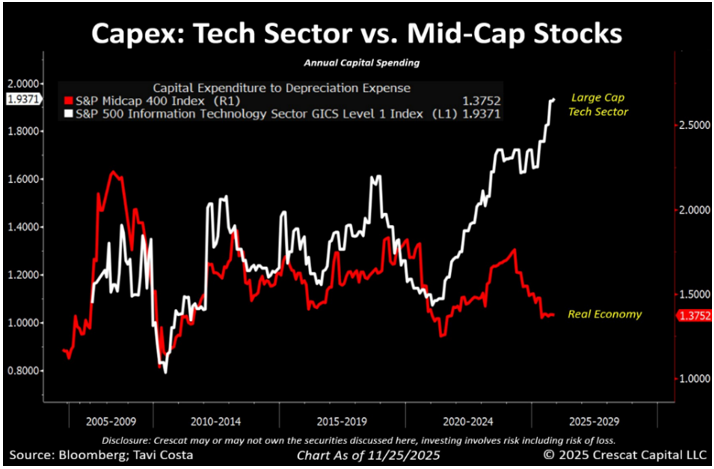
Do you recall the vendors’ telecom financing of the late 1990s/early 2000s and the boom/bust story of capital expenditures of that era? Recall, I have no answers, just questions to the accounting numbers provided to me.
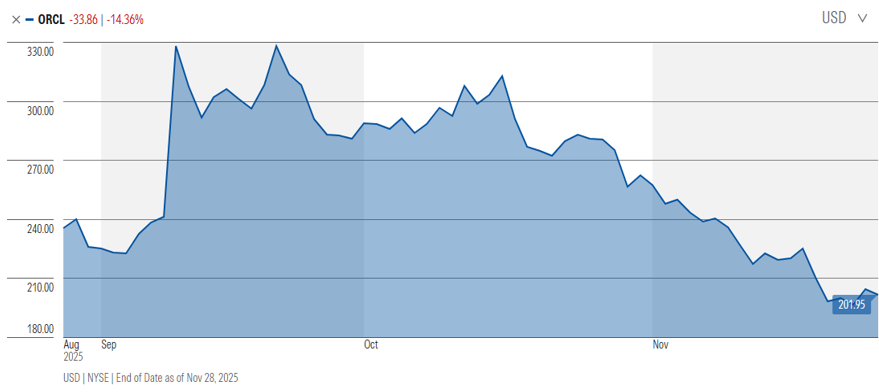
I am also certain that you recall all the fanfare about Oracle’s one-day stock rise of more than 37% last September, as the figure above shows. What happened to that, and why is Oracle’s stock price lower today than three months ago? What happened to that fanfare, and as an admirer of numbers, do you think that Oracle’s debt might be the cause that made investors wake up to the nightmares of debt accumulation?”
“My dearest teacher, unchecked debt is a curse, as is unchecked power, and I learned well the lessons of the latter. You know well of the alleged ‘tainted donations’, and that I have been marked as the epitome of corporate unchecked power. However, it was shrewdness, a trusted team, cost containment, use of leverage as needed, and strategy that led Standard Oil to its apogee of power. From 15 competitors in New York, 12 in Philadelphia, 22 in Pittsburgh, and 27 in the Oil Regions, we ended up being the only ones standing at the end. That’s what numbers taught me as a grains trader.”
“Mr. Rockefeller, I respect your mastery of numbers, but tell me, please, about Japan nowadays and what the implications of a carry trade unwinding might bring to an unstable world? As I see it, Japanese yields are rising at a time when Japan has been playing the role of a major US financier. Ignoring for the moment Japan’s debt which is mostly internal, the rising Japanese yields (due to the local expansionary fiscal policy) could become the launching pad of debt monetization in the US, as the Japanese money well is drying up, like those oil wells in Titusville.
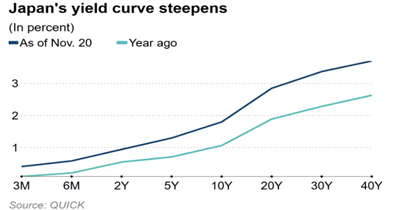
Japanese money props up mortgages, and as US rates drop while Japanese rates are rising, Japanese pensions are pulling more than a trillion dollars out of Treasuries, as hedging US debt becomes unprofitable. As the carry trade (borrow internally at low costs and invest the proceeds into US Treasuries) becomes unprofitable, leveraged funds are at risk, which could start reversing the downward trend of US rates at a time when a dovish Fed is being pushed to be born. Pushing short-term rates while long-term rates reverse course could become the praxis that a currency turmoil is looking for, as buyers are walking away while suppliers work on the printing machine.”
“My dearest teacher, I admire your wisdom about numbers. So, what are numbers for you, teacher?” John D. Rockefeller asked, only to hear the teacher say:
“Didn’t I promise you, Mr. Rockefeller, that my goodnight for today will be an explanation as to why your interpretation of numbers is wrong? Numbers are the venue that God is using to convey reality to us. As Pythagoras taught us: ‘Figures as archetypes, not figures for profit.’ The Pythagorean theorem and program was to prove that math and geometry are the starting points of Being itself. Pythagoras started with the number one (literally a pebble in the sand). One (the Monad as he called it), forms the starting point for all numbers and geometry, while two pebbles (the Dyad) generate the line and spatial expansion, literally the baseline of all subsequent forms. Putting one and two together gives us three. The Triad serves as the three points of the triangle. Pythagoras’ first geometric surface gave us the Pythagorean theorem, the basis of the square and every other geometric figure. From the fourth pebble (what Pythagoras called the Tetrad), we move to a harmonious completion, reminding us of the four intervals in the musical scale, or of the four seasons in the year. From there, we move on to the pyramid, which is known as geometry’s first solid form, and from there, the numbers and their ratios move to the realm of three-dimensional reality. Trust me, Mr. Rockefeller, I needed my own trip to Italy to learn from Archypas the permanent mathematical and geometric order of nature and humans.”
“I don’t know what to say, dearest teacher,” Rockefeller whispered.
“Goodnight, Mr. Rockefeller”.
