
Global Market News
Global Equities Rise
Global equities made gains this week amid an extended U.S.-China trade détente and mostly good U.S. tech earnings. The S&P 500 and Nasdaq rose 0.71% and 2.24%, respectively, and the Dow Jones increased 0.75% on the week. The U.S. 10-year Treasury note rose several basis points to 4.09%, while the price of West Texas Intermediate crude oil declined on the week to $60.89 per barrel. Volatility, as measured by the CBOE Volatility Index, rose over the week, closing Friday at 17.44.
Fed Cuts Rates, Odds of December Cut Cool
At Wednesday’s FOMC meeting, the Fed cut rates by a quarter-point, bringing the target rate range to 3.75% – 4%. The committee also announced it will stop reducing its balance sheet starting December 1st, indicating an end to its policy of quantitative tightening (QT). However, Fed Chair Jerome Powell surprised markets by cautioning that a December rate cut isn’t guaranteed, citing “strongly differing views” within the committee and limited economic data due to the government shutdown. As a result, market expectations for a December cut dropped sharply, and bond yields rose.
International Developments
U.S. Strikes Trade Truce with China as Asia’s Economic Alliances Shift
U.S. President Donald Trump concluded his Asia tour with a series of high-profile trade moves that signal a temporary cooling of tensions in the global economy but also underscore shifting alignments across the region. In Busan, South Korea, Trump and Chinese President Xi Jinping agreed to a one-year extension of the U.S.–China tariff truce, halving fentanyl-related tariffs and suspending new export restrictions on Chinese firms while Beijing postponed tighter controls on rare earth exports. The limited deal restores agricultural and rare earth trade flows and grants Trump domestic political wins, but analysts view it as a pause rather than a breakthrough. On the same trip, Washington finalized a trade pact with South Korea, lowering U.S. import tariffs to 15% and securing up to $170 billion in Korean investments, much of it targeted at reviving America’s shipbuilding industry under Trump’s “Make American Shipbuilding Great Again” initiative. Meanwhile, China deepened its own regional footprint, signing the ASEAN–China Free Trade Area 3.0 agreement, expanding tariff reductions and market access for over two billion consumers. Framed by Premier Li Qiang as an antidote to “protectionism and coercion,” the deal reinforces Beijing’s growing influence in Southeast Asia even as U.S.–China competition continues to define the regional trade order.
Israeli Strikes Rattle Fragile Gaza Ceasefire
Israel’s overnight airstrikes across Gaza this week marked the deadliest breach of the fragile U.S.-brokered ceasefire since it took effect earlier this month, killing at least 104 Palestinians – including 66 women and children – and wounding more than 250. The strikes followed the killing of an Israeli soldier in Rafah, which Prime Minister Benjamin Netanyahu called a “red line” violation by Hamas, though the group denied responsibility and accused Israel of trying to sabotage the truce. The Israeli military said it targeted “dozens of terrorists and infrastructure sites,” claiming to have killed 25 Hamas commanders, while Gaza’s health authorities reported entire families buried under the rubble of homes and tent camps. President Trump, who helped broker the ceasefire, defended Israel’s right to “hit back” but insisted the truce remained intact, calling Hamas “a small part of the overall peace.” The escalation drew condemnation from U.N. officials and renewed mediation efforts from Qatar and Egypt, as both sides traded accusations over delays in returning hostage remains — a core term of the ceasefire. Despite Israel’s announcement that the truce had been “reinstated,” the strikes underscored how volatile the agreement remains.
Sudan Civil War Escalates as RSF Captures El-Fasher, Cementing Control of Darfur Amid Mass Killings
After a 500-day siege, Sudan’s Rapid Support Forces (RSF) seized the strategic city of El-Fasher, the last major government-held stronghold in Darfur, completing their control of the war-torn region and prompting fears of a renewed genocide. Humanitarian groups report that more than 1,500 civilians were killed in recent days as RSF fighters stormed hospitals and refugee camps, with satellite imagery showing mass graves and widespread destruction. The World Health Organization confirmed hundreds of patients were executed at the Saudi Maternity Hospital, while the Sudan Doctors Network described the assault as “a true genocide.” RSF leader Mohamed Hamdan Dagalo (Hemedti) acknowledged “violations” and pledged an internal investigation, though similar promises in past massacres went unfulfilled. The United Nations and African Union have demanded accountability and safe passage for civilians, as regional powers from Egypt to Qatar condemned the atrocities. Analysts warn that El-Fasher’s fall entrenches Sudan’s partition, leaving the RSF dominant in the west and the army confined to Khartoum and the Red Sea corridor, while amplifying scrutiny of alleged UAE support for the paramilitary force. The capture marks a grim milestone in Sudan’s civil war, with Darfur once again at the epicenter of ethnic cleansing and impunity.
US Social & Political Developments
U.S. Escalates Caribbean Boat Strikes and Sanctions Colombian President
The Trump administration has expanded its campaign of lethal boat strikes across the Caribbean and Pacific, drawing condemnation from the United Nations, regional governments, and members of Congress who say the attacks violate international law. Since September, U.S. forces have destroyed at least ten vessels and killed over sixty people, which President Donald Trump has defended as necessary to combat “narco-terrorism.” The backlash intensified after Colombian President Gustavo Petro condemned the attacks as “murder,” warning they targeted poor fishermen and low-level traffickers rather than major cartels. Trump responded by labeling Petro a “thug” and imposing sweeping personal sanctions on him, his family, and senior officials for “failing demonstrably” to curb drug production. Analysts say the move marks the sharpest rupture in U.S.-Colombia relations in decades. While Defense Secretary Pete Hegseth insists the strikes are part of a justified “armed conflict” against drug syndicates, critics argue the administration’s unilateral campaign risks alienating allies, destabilizing the region, and further blurring the line between law enforcement and warfare.
Shutdown Drags on as SNAP Benefits Face Legal Lifeline
The federal government shutdown entered its fifth week with no signs of compromise, leaving 1.4 million federal workers furloughed or unpaid and threatening critical social programs. The deadlock has become the second-longest in U.S. history, shuttering services from national parks to research labs while delaying pay for troops and air traffic controllers. The crisis deepened this week when the administration moved to suspend payments from the Supplemental Nutrition Assistance Program (SNAP) on November 1st, which feeds more than 42 million Americans. Two federal judges in Rhode Island and Boston intervened, ordering the government to use $6 billion in emergency funds to avert the first-ever lapse in SNAP benefits, warning that “irreparable harm” would otherwise follow. Retailers, food banks, and state agencies remain braced for disruption, with grocery chains warning of lost sales and Feeding America anticipating record demand. The Trump administration, which has proposed $187 billion in SNAP cuts over the next decade, insists a shutdown is “not an emergency,” even as millions of families face uncertainty ahead of the holidays.
Corporate/Sector News
U.S. Expands Partnerships in Strategic Sectors
Washington announced a pair of landmark public-private partnerships this week underscoring its twin bets on artificial intelligence and nuclear energy as foundations of American competitiveness. The Department of Energy and AMD unveiled a $1 billion collaboration to build two next-generation supercomputers at Oak Ridge National Laboratory—the Lux AI and Discovery systems—designed to advance high-performance computing, accelerate fusion and materials research, and secure U.S. leadership in AI infrastructure. Lux, deploying in 2026, will serve as the nation’s first “AI Factory” for scientific innovation, while Discovery, arriving in 2028, will extend the exascale computing frontier achieved by Frontier. The partnership marks a shift to faster, co-funded deployment models, blending federal and private capital to expand sovereign AI capabilities. Meanwhile, in the energy sector, Cameco Corp. and Brookfield Asset Management announced an $80 billion partnership with the U.S. government to build new Westinghouse nuclear reactors across the country—a deal that includes federal financing and participation rights. Officials framed the agreement as a cornerstone of America’s critical-infrastructure and energy-security strategy, signaling renewed federal commitment to both nuclear generation and cross-border supply-chain diversification.
AI Market Shakes up as OpenAI Eyes $1 Trillion IPO
AI-powerhouse OpenAI is reportedly preparing an IPO that could value the company at up to $1 trillion, with a filing potentially as early as the second half of 2026, making it one of the largest public offerings in history. Meanwhile, the broader tech sector is seeing divergent fortunes: Meta Platforms shares plunged more than 11% and Microsoft fell roughly 2.8% after disappointing earnings, as investors expressed concern over the high cost of AI development and weak near-term returns. In contrast, Amazon defied the trend by posting better-than-expected results, pushing tech-heavy indexes higher and underscoring the uneven impact of AI adoption across companies. The headlines suggest a bifurcated landscape: AI pure-plays like OpenAI commanding sky-high future valuations while legacy tech players are being pressured to show that massive AI investments translate into profits now.
Layoff Surge Signals Strain
Several major U.S. companies announced large-scale workforce reductions this week, highlighting fresh pressure across tech, retail, and logistics sectors amid shifting economic and strategic landscapes. Amazon confirmed a cut of approximately 14,000 corporate jobs, with most affected roles in engineering, recruiting, and management as the company shifts toward greater AI and automation integration. Next, Target Corporation announced it will eliminate around 1,800 headquarters-level positions, roughly 8 % of its global corporate staff, as incoming CEO Michael Fiddelke moves to streamline operations and refresh the retailer’s strategy. Meanwhile, logistics giant United Parcel Service (UPS) has already cut about 48,000 jobs year-to-date and shuttered 93 facilities in 2025 as it restructures away from its historic volume business with Amazon and focuses on cost savings.
Recommended Reads
The World Feels Weird Now. Here’s How to Invest
What to Know About Trump’s Latest Tariffs
Americans blame Trump and GOP more than Democrats for shutdown, poll finds
UPS Jumps After Sweeping Job Cuts Push Profit Above Estimates
America’s Retreat From Aid Is Devastating Somalia’s Health System
This Week from BlackSummit
Leonardo on Opaque Systems, Questionable Returns, and the Kafkaesque Paradox
John E. Charalambakis
BlackSummit Team
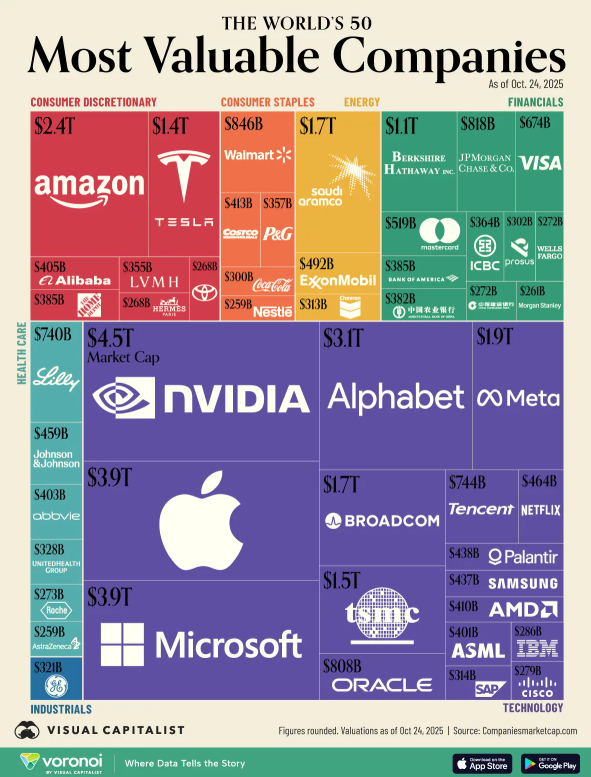
Image of the Week
Video of the Week
The graduate ‘jobpocalypse’: Where have all the entry-level jobs gone?
Financial Times
