
Welcome to our monthly newsletter which covers key developments in major non-US markets. With this newsletter, we highlight corporate, debt, and monetary policy news in European, Asian, and Latin American markets. We end this piece with a spotlight on commodities.
European Markets
Corporate and Business News
- Renault issues profit warning and names finance chief Duncan Minto interim CEO. Shares sank as much as 18 %—their worst session since 2020—after the group cut its full‑year operating‑margin target to 6.5 % (from “at least 7 %”) and flagged a €900 m working‑capital hit, reviving concerns about pricing power in an increasingly competitive European EV market.
- BCG study finds Europe’s power‑grid upgrade plans face a €250 bn funding gap. Operators must triple capex to 345 bn over 2025‑29 to keep pace with electrification, AI‑driven demand, and renewables, highlighting a looming bottleneck for the energy transition.
- Shell warns of weaker Q2 earnings after soft LNG trading and US chemicals outages. Profit estimates were cut by up to $2 bn; management hinted at further portfolio moves in European chemicals as margin volatility persists.
- BP sells 300 Dutch service stations (plus 15 EV hubs) to Catom. The disposal advances BP’s $20 bn divestment plan and underlines a strategic pivot back toward higher‑return hydrocarbons after setbacks in renewables.
- Consensus now sees STOXX 600 Q2 earnings falling 0.7 % year-over-year. The one‑week forecast swing from a slight gain reflects tariff uncertainty and soft demand, marking what could become the weakest quarter in over a year.
- Germany’s Ifo business‑climate index, a highly-regarded early indicator of economic developments, rises to 88.4, its sixth consecutive gain. Early signs of a cyclical turn for Europe’s largest economy emerge as fiscal stimulus and lower rates buoy expectations, though current‑conditions readings remain fragile.
Debt and Monetary Policy News
- The European Central Bank (ECB) braces for a “steady‑hand” pause as inflation lands exactly on target. Euro‑area CPI was reported at 2.0% in June, giving the Governing Council room to sit tight after eight consecutive cuts.
- Berlin’s borrowing surge is driving Bund yields to multi‑year highs. Germany’s debt agency added €19 bn to its Q3 funding needs to finance defense and infrastructure, and the 30‑year Bund yield climbed to 3.26 %, its highest level since 2023.
- Growing confidence in euro-zone stability has led central banks to shift toward euro-zone assets. By mid‑July, official institutions had taken 20% of all syndicated sovereign supply, up from 16 % last year, as Asian and Middle‑Eastern banks diversify away from Treasuries.
- The Bank of England (BoE) has sketched a post-quantitative easing liquidity map. Executive Director Nathanael Benjamin said the BoE will target an “ample” reserve level, neither scarce nor excessive, while continuing £100 bn‑per‑year quantitative tightening.
Asian Markets
Corporate and Business News
- China’s cabinet pledged to regulate what it called “irrational” competition in the country’s electric vehicle industry, vowing to strengthen cost investigation and price monitoring, according to state broadcaster CCTV. The cabinet meeting, presided by Chinese Premier Li Qiang, was held as a two-year price war in the world’s largest auto market only intensifies.
- China’s new home prices fell at the fastest monthly pace in eight months in June, highlighting the struggle to revive demand despite repeated policy measures and growing calls for additional support. The 0.3% month-on-month drop extended a weak trend that has persisted since May 2023. Prices fell 0.2% on the month in May.
- Canadian retailer Alimentation Couche-Tard withdrew its $46-billion takeover offer for Japan’s Seven & i Holdings, blaming a lack of constructive engagement by the Japanese retailer.
- Citigroup plans to raise its investment banking headcount in Japan by 10% to 15% over the next year and make new hires in Australia, as part of its strategy to bolster growth in the Asia Pacific. Rising interest in cross-border mergers and acquisitions in Japan has resulted in Citi seeing a 140% rise in its investment banking fees in the country to $92 million as of July 10th.
- In May 2025, Japan’s core machinery orders fell by 0.6% from the previous month, a smaller decline than expected, signaling some stabilization after a sharp drop in April. Manufacturing orders continued to weaken, while non-manufacturing sectors like real estate and finance showed strong gains.
- Japan’s Nissan Motor has raised $4.52 billion in U.S. dollar- and euro-denominated senior unsecured bonds, with the proceeds intended to refinance existing debt.
Debt and Monetary Policy News
- China’s economy slowed less than expected in the second quarter in a show of resilience against U.S. tariffs, though analysts warn that weak demand at home and rising global trade risks will ramp up pressure on Beijing to roll out more stimulus. China’s economy grew by 5.2% year-over-year in the second quarter of 2025, slowing slightly from 5.4% in Q1, but still beating expectations of 5.1%.
- China is widely expected to leave its benchmark lending rates unchanged, as signs of economic resilience reduced the urgency for further monetary easing.
- The yen softened on Friday heading into Sunday’s upper house election in which Japan’s ruling party looks vulnerable, while, more broadly, the U.S. dollar was set for a second straight weekly gain against major peers. The dollar rose 0.14% against the yen on Friday at 148.8, heading for a weekly rise of nearly 1% on the Japanese currency, more than its gains against the euro, pound, or Swiss franc.
- Japan’s core inflation slowed in June but stayed above the central bank’s 2% target, highlighting lingering price pressures that back market expectations for further interest rate rises.
- The Bank of Japan finished selling off its holdings of stocks bought from 2002 to 2010 in a rare program to avert disruption to the banking system from the sharply falling prices of equities, central bank data showed.
Latin American Markets
Corporate and Business News
- Trump imposed 50% tariffs on Brazil. In a letter, Trump linked the tariffs to Brazil’s treatment of former President Jair Bolsonaro, who is on trial over charges of plotting a coup to stop President Lula from taking office in 2023. Lula responded, saying new tariffs would be met with reciprocal measures.
- Argentina has filed an emergency appeal in the U.S. to halt a court-ordered transfer of its 51% stake in YPF, the country’s largest energy company, as part of a $16.1 billion judgment awarded to former shareholders Petersen Energia and Eton Park Capital Management.
- Mexican retailers are expected to post solid second-quarter 2025 results, boosted by favorable calendar effects, though global economic risks and sticky inflation present challenges for brands in the year’s second half.
- Brazil’s economic activity unexpectedly fell in May, central bank data showed, dragged down by a sharp drop in the farm sector along with declines in tax revenue and industrial output. The IBC-Br index, a leading indicator of GDP, fell 0.7% in May from April on a seasonally adjusted basis.
- Nestle announced environmental restoration projects in partnership with re.green (an environmental restoration company focused on large-scale tropical forest recovery) and chocolatier Barry Callebaut in Brazil, seeking to plant millions of trees in areas where it sources key ingredients.
- Foreign direct investment in Latin America grew by 7.1% in 2024 to $188.96 billion, but new investment interest has stagnated, the Economic Commission for Latin America and the Caribbean said.
- Cash-strapped Cuba’s grueling crisis shows no signs of improvement, Cuban Economy Minister Joaquin Alonso said, announcing growth fell 1.1% last year on top of a 10% decline since 2019.
Debt and Monetary Policy News
- Brazil’s monthly inflation slowed for the fourth time in a row in June, but the annual rate ticked up and remained well above the official goal, prompting the central bank to release a letter to justify missing the target. The consumer price index rose 0.24% in June, down from the 0.26% increase reported in the previous month.
- Brazil’s finance ministry raised its forecast for economic growth this year, while projecting a slight slowdown in 2026 in face of the central bank’s tight monetary policy. The ministry’s economic policy secretariat now expects Brazil’s gross domestic product to grow 2.5% in 2025, up from the 2.4% estimated in May. For 2026, the forecast was revised down to 2.4% from 2.5%.
- The Brazilian government secured $1.8 billion in revenue from the first round of tax debt renegotiations with major companies this year. As part of the initiative, which is included in a broader effort to reduce Brazil’s fiscal deficit to zero by 2025, the government is finalizing technical details to launch another three public notices to renegotiate tax debts.
- Colombia’s government is weighing a tax reform proposal that, if passed, would help raise $6.48 billion to fund its 2026 budget. Most of the funds would be raised through tax increases.
- Argentina’s economic activity likely expanded 5.8% year-on-year in May, marking its eighth-consecutive month of growth, with an average forecast for 5.9% growth in Latin America’s third-largest economy, with estimates ranging from a low of 3.5% to a high of 7.8%
- Peru’s economy is projected to have expanded just under 3% in the second quarter of 2025, central bank chief economist Adrian Armas said, adding that this remained in line with the bank’s forecasts of 3.1% growth by the end of the year.
Commodities Spotlight
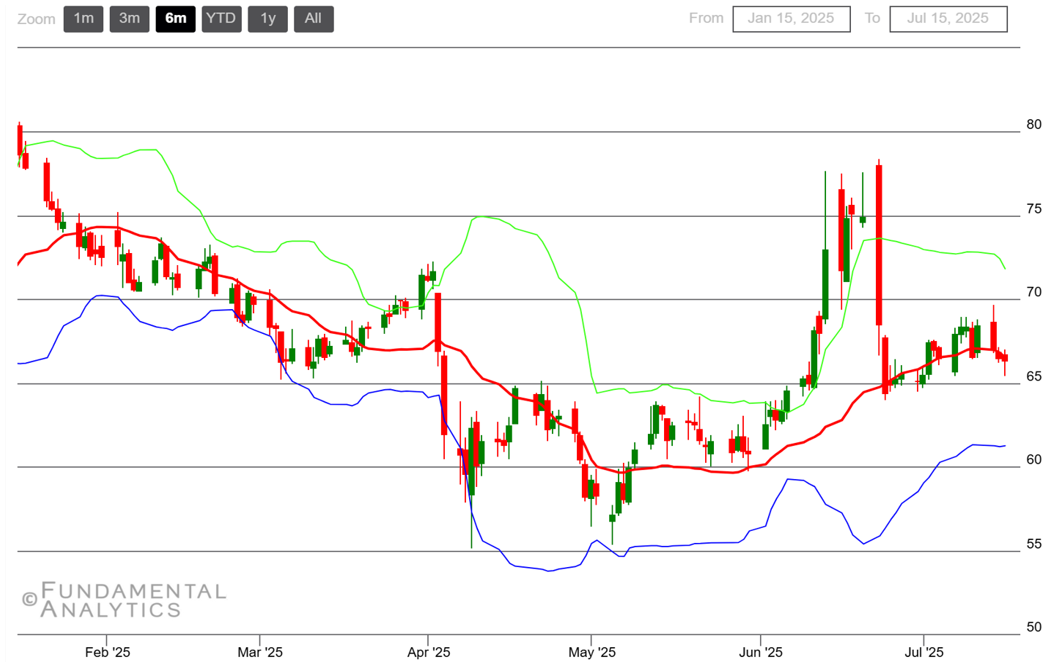
WTI futures experienced volatility but reverted quickly
Source: Fundamental Analytics
Geopolitical tensions briefly lifted oil prices, but the premium proved short-lived. Following Iran’s June 23rd missile strike on the Al Udeid U.S. base, traders quickly realized Hormuz shipping was unaffected, leading to a swift correction—WTI dropped 7% in one session. OPEC+ then accelerated its supply rebound, limiting further rallies. With Saudi and UAE output set to reach 10 million barrels per day (mbd) and 3.4 mbd, respectively, discretionary spare capacity above 3 mbd reemerged, forming a visible price ceiling unless global demand significantly outpaces these additions. U.S. fundamentals sent mixed signals: the EIA reported a 7.1 million barrel inventory build for the week ending July 4th, likely due to seasonal refinery downtime and untracked barrels, while the Baker Hughes rig count fell for an eleventh straight week to 424, its lowest level since September 2021. Meanwhile, demand signals continued to strengthen, with U.S. gasoline consumption rising 6% over the Independence Day holiday and China’s June refinery throughput climbing 8.5% year-over-year. Supporting this trend, an EIA report revealed a 3.9 million barrel draw in crude inventories, reinforcing signs of growing consumption.
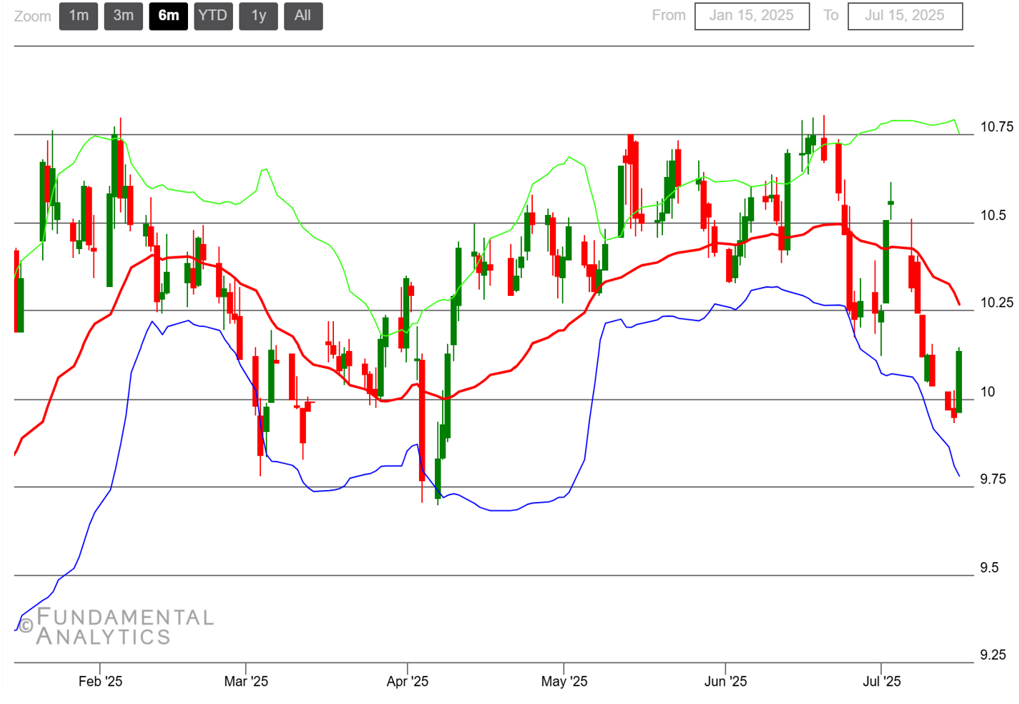
Soybean futures remain close to $10 mark
Source: Fundamental Analytics
U.S. crop conditions remained stable in early July, with USDA ratings holding near 66% “good to excellent,” reinforcing expectations for a strong harvest and applying downward pressure on prices. In Brazil, the 2025/26 planting area expanded by approximately 1.2%, with projected output reaching 176 million tons (MT), adding to global oversupply concerns. A USDA-reported 120 kilotonnes (kt) export sale in mid-July spurred speculation of Chinese buying, offering some price support. Domestic soybean crushing continued to grow, fueled by record demand for soybean oil in biofuel production, lifting projected soybean oil use to 15.5 billion pounds in 2025/26 and helping to anchor soybean prices. Despite this, global feedstock demand remains tepid: China’s June imports totaled 12 MT, yet oversupply fears persist with soybean meal reportedly accumulating at terminals. With bearish fundamentals dominating, soybeans are expected to stay range-bound between $10.00 and $10.50 per bushel unless export activity or gluten demand—particularly from China—shows sustained strength.
