
I looked to my left, and Aeschylus was pointing to the following graph while asking what the implications would be as Japanese rates are rising. Could the upswing in the Japanese interest rates imply a market dislocation as traders sell US assets to buy Japanese bonds and cease their carry trade practices (where they borrow cheaply in Japan to buy US bonds and other assets)? And could that be part of the Aeschylean market oxidation?
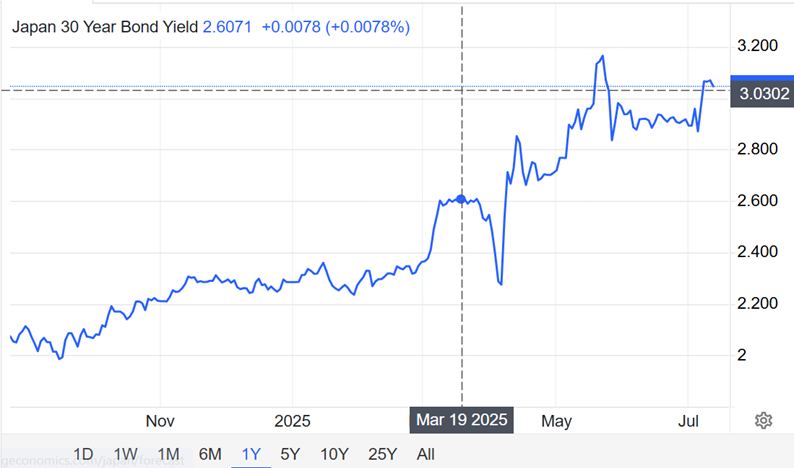
Source: Trading Economics
Then, I looked at my right and Euripides interjected by pointing to the following graph about margin trading during overpriced markets and asking a similar question as to whether such record trading on margin is part of the Euripidean market oxidation.
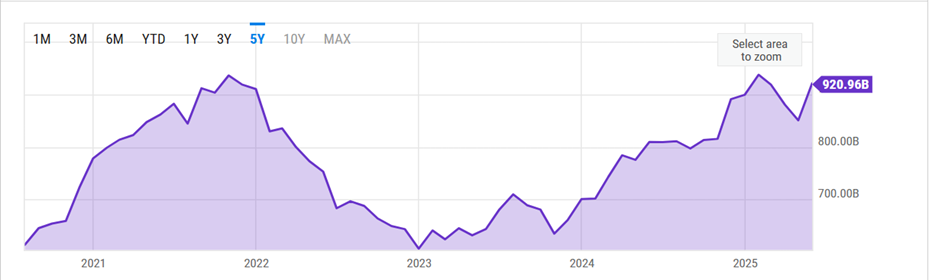
Source: YCharts & FINRA
Sofocles (the third of the three great Greek tragedians) served in important public posts ranging from State-Treasurer, General, Commissioner (following the Syracusan expedition), priest, and envoy to other Greek states. However, despite these important posts we know him as the great tragedian of realism and foresight with an excellent understanding of human nature. In two of his plays (Ajax and Philoctetes) Sofocles’ themes of tragedy revolve around weapons, and nowadays, stablecoins are presented as the ultimate weapon of stability and preservation of the dollar as the world’s reserve currency. But could that weapon be a reflection of market oxidation?
Sofocles’ play Ajax was written in the 440s BCE. When Achilles was killed (towards the end of the Trojan War), Ajax claimed his weapons and armor being not just the bravest fighter, but also the image of resilience and the bulwark in the Greek army. However, the ever-cunning Odysseus was awarded the armor and Ajax vowed revenge against Odysseus and those who supported such award.
Nowadays – and especially since the discussions about the Genius legislative Act started – stablecoins are presented as the anchor of resilience in the cryptocurrency markets. Akin to Ajax steadfastness, stablecoins are presented as the medium of stability and value, deriving (hypothetically) their “strength” from the underlying assets (Treasury Bills/TBs) and the denominated currency (USD). The idea is that the rise of the stablecoins will strengthen the dollar (extending its reach and life) as the international reserve currency of the world.
The goddess Athena angered against Ajax and afflicted him with madness where Ajax hallucinated seeing the cattle as his enemy. When Ajax recovered from his hallucinations, he wanted to commit suicide out of shame. Ajax was found dead, and Sofocles’ confronted his audience with one of his favorite themes: Ajax was ruined out of ignorance regarding his limitations. Ajax excessive strength brings to him the inescapable fatal blow and destroyed him. Sofocles treated madness as the oxidation/transitory phase to self-inflicted catastrophe. Ajax ignored the gods and the stablecoins are designed to circumvent the central banks and the rules they have established in preserving a monetary order. Ajax had been a hero, but the new cryptocurrency market has no room for these kinds of heroes.
The complex mechanisms to maintain the peg of stablecoins are tied up to systematic incoherence when are tested under conditions of stress, that can force massive sales of the underlying assets (TBs), reducing their values, and forcing rates higher, becoming a source of instability, and ultimately leading to an un-pegging from the USD. Despite his immense strength, Ajax’s wrong judgement call (about Achilles’ armor) brought his downfall. Ajax tragic story of brutal realism ignored fundamentals in a similar manner that the much promising stablecoins ignore monetary rules and fundamentals.
Sofocles had a charisma to deal with tragic heroes. In his play Philoctetes, he dealt with the one who was left behind by the Greek army at the island of Lemnos on its way to Troy. Philoctetes had control of another hero’s weapons: He possessed the bow and arrows of Heracles. The Greeks were told by a seer that Troy would fall only when Neoptolemus (Achilles’ son) and Philoctetes (with Heracles bow and arrows) jointly fight in the expedition. Once again, the ever-cunning Odysseus obtained Philoctetes’ weapons by a trick, wanting to leave Philoctetes behind. Following an intervention by Heracles with orders from Zeus, Odysseus and Philoctetes proceeded to Troy to fulfill the seer’s prognosis of Troy’s fall using Heracles’ weapons.
The Philoctetes may have been the most complex of all Sofocles’ tragedies. Watching those tragedies, the Athenian audience could reflect upon the degradations of their own war-convulsed world. The play shows human beings going through their motions and attempts to plan a future upon the basis of inadequate knowledge, manipulation, cunning, and an atmosphere of suspicion, deception, and violence. Philoctetes is torn between his longing to rejoin his comrades and his bitterness at having been cast away from them and by them. Neoptolemus struggles between a noble goal (winning the war and fulfilling a prognosis), and ignoble means (tricking a wounded hero), while witnessing the death of his ideals at the hands of Odysseus’ amoral dishonesty.
Stories of deception related to cryptos are well-known. Similarly, stories of stablecoins whose backup assets were an amalgam of deception, fiction, and complex algorithmic manipulation are equally well-known. Stablecoins are supposed to be indispensable (like Philoctetes’ weapons) for the broader crypto market, providing the bridge between fiat – but widely acceptable currency like the USD – and cryptos. They are supposed to become the ultimate medium of exchange and store of value, providing safety during volatile times. They are fashioned as the bow and arrow of Philoctetes to replace the monetary order of central banks and promote transparent decentralization of finance.
The line between asset-backed stablecoins and algorithmic ones seems to be thin, and that’s where the dangers and the uncertainties lie (besides the other weaknesses discussed above). There is little (if any) doubt that in a digitized world, the digitization of the currency is a one-way street. The problem lies in the trust that Philoctetes should place after being deceived and misled twice (first being abandoned, and second being tricked to get his weapons). Circumventing the trust placed in the central banks is an attempt to change the world monetary order, maybe without the consent of those behind that order, which reminds us of Ajax and his defiance of the order established by the Olympians. Digital currencies can be indispensable. How they come about, by whom, and how trust is established could be the key for them to become the tools of growth and stability, otherwise fragility, disorder, and significant pain could be inflicted, while ephemeral zero-sum games are being played out.
Sofocles’ play Oedipus Rex presents to us the ultimate searcher for the truth. Oedipus departs from the king’s court and home in Corinth to avoid fulfilling the oracle that had him slaying his father and marrying his mother. He went to Thebes but on his way – during a dispute – killed a man. Arriving in Thebes he solved the riddle of the Sphinx (that no one else could solve) and became the ruler of the city, per ordinance issued by the then ruler (Creon was who the queen’s brother). A few years later, Thebes was under a severe plague. Oedipus is convinced that the cause was the murder of his predecessor, King Laius, who was struck down at a crossroads. Searching for the truth behind King Laius’ death, he discovers that the man he killed at the crossroads coming to Thebes was none other than King Laius and shortly thereafter he discovers that he had fulfilled the oracle of killing his father and marrying his mother (Jocasta) with whom he had four children. Learning of the fulfillment of the oracle, Jocasta hangs herself, and Oedipus puts out his own eyes, bids farewell to his two daughters (Antigone and Ismene) and is led away out of the city.
The tragedy of Oedipus is that in his mastery of overcoming insuperable obstacles, he moves with gradual but terrible inevitability from ignorant misconceived assurance to recognition and knowledge that leads to despair. According to Aristotle, this play represented the model of what a tragic drama ought to be. The courageous, resolute, determined, iron-willed, and hot-tempered Oedipus’ hubris (amartia according to Aristotle) becomes the cause of reversal and ultimate ruin.
There are uncomfortable truths behind anything fiat. Hidden flaws may allow the system to function, and we might be blind to those facts and hidden flaws, however, fiat systems tend to degrade and even cheat with illiquid assets, insufficient reserves, which like Oedipus’ true identity, could be a ticking financial bomb. The revelation of the inconvenient truth becomes the epicenter of catastrophic events. Fiat systems that are based on liabilities and not on assets with intrinsic value are blind to system’s stresses as well as to Tiresias warnings (Tiresias was warning Oedipus not to push the envelope), and the attempts to avoid the ultimate realization of the truth ultimately leads to the truth. In the case of stablecoins, it could potentially lead to de-pegging of the illusion represented by fiat assets from the reality that is grounded on true hard assets.
Oedipus at Colonus was Sofocles last play and was performed in 401 BCE after his death. The story is a sequel to Oedipus Rex. After Oedipus blinded himself, he departed Thebes and after years wandering from place to place as a ragged beggar, he arrives at Colonus (near Athens), led by his daughter Antigone. The people at Colonus are horror-struck after learning who he is and order him to leave. Oedipus appeals to the Athenian hospitality and King Theseus extends asylum to him, despite people’s objections and the demands of Creon (Jocasta’s brother and ruler of Thebes following Oedipus) to hand Oedipus and Antigone to him. As the play progresses, we learn that thunderclaps inform Oedipus that his hour has come. So, as he is attended by Antigone, Ismene, and Theseus’ family, he leads the way to the place where he will depart from the land of the living. Halfway there and as he bids Antigone and Ismene farewell, he is taken by the gods. Sofocles’ last testament is the most mysterious of his plays. Oedipus is far from a saint, but his tragic suffering shows a nobility of character that has moved him from utter isolation to an ultimate divine acceptance.
For some time now, cryptos are seeking legitimacy from being exiled from traditional finance. No doubt they have been affiliated with illicit activities, scams, hacks, and seen by traditional finance as being polluted (like Oedipus was seen). Cryptos are seeking their own Colonus, and the Genius Bill is seen by many as the vindication of a mature and wise Oedipus whose final resting becomes a source of blessings for the land. The tokenization of any assets is seen as the new monetary authority based on new technology (blockchain), and the principle of decentralization and transparency. The adoption and integration of cryptos by the global financial system is perceived as vindication and a source of growth and strength. The Genius Bill can be seen as the legitimization venue for cryptos in a similar manner to Oedipus’ final earthly experience and the divine blessing he experienced at the end of his life.
As we are looking into the stablecoin picture nowadays, we can see foreign countries with unstable monetary systems benefiting from the stablecoins, by providing a dollar proxy and facilitating faster, cheaper international money transfers, bypassing traditional banking. As the volume rises above $1 trillion (currently stands at about $800 billion while dominating 80% of crypto transactions), and as more international players (besides Visa, Stripe, and Uber) adopt them, the danger of financial dislocations will be rising too. As demand for stablecoins rises, so will the supply of dollars which will lead to its cheapening and devaluation. The impact on the interest rates is doubtful, as debts are rising and the value of the dollar declines, which by itself may undermine the dollar’s supremacy.
The whole financial system might be under the gun of moral hazard as issuers of stablecoins could profit from illiquid assets and insufficient reserves that could lead to a run on stablecoins. As dollars are moving from banks to stablecoins, financial disintermediation can create a doom loop, especially as hundreds of billions of dollars migrate from bank deposits to stablecoins. If that were to happen, then the bond and stock markets are susceptible to turmoil at a time when the upbringing of the new system uproots the financial stability role of the Fed (with the latter being prohibited from issuing its own digital currency). Therefore, the weaponization of stablecoins and the marginalization of the Fed-issued digital currency – especially under a stress scenario when instability shakes the foundations of stablecoins – would leave China as the only viable alternative with a digital currency. At that point, and geopolitically speaking, developments would start becoming dangerous.
Somewhere in the distance, I saw Theseus contemplating the Athenian downfall while watching Ajax committing suicide, and Oedipus saying farewell to his daughters while cursing his sons who ended up killing each other. At last, Sofocles puts the poignantly words to Theseus mouth as he responds to Creon’s demands to hand over Oedipus and Antigone: “You have come into a polis that cultivates justice and sanctions nothing without law.”
