
Debt and Monetary Policy News
- The Bank of Japan maintained its policy rate at 0.75% while reaffirming a hawkish inflation outlook, noting that a weaker yen could continue to push import‑driven price pressures higher. Policymakers signaled that further rate hikes remain likely, with Governor Ueda stressing vigilance over yen‑related inflation risks and emphasizing data‑driven tightening ahead.
- The Reserve Bank of India announced a liquidity injection exceeding $23 billion through bond purchases, FX buy/sell swaps and new repo operations to ease funding stress. Officials said the measures aim to stabilize yields and the rupee as system liquidity tightens and borrowing costs rise.
- The People’s Bank of China cut interest rates on targeted structural policy tools and indicated that additional RRR and broader rate cuts remain possible in 2026. The central bank emphasized the need to maintain ample liquidity and support credit conditions amid changing financial structures and soft economic momentum.
- China Vanke has requested a 90‑trading‑day extension on 5.7 billion yuan in onshore bond repayments to avert default as liquidity pressures deepen. Bondholders will vote on the proposal this month, alongside alternative plans involving partial upfront repayments and enhanced credit protections.
- The Bank of Korea held rates at 2.50% and signaled that the easing cycle is effectively over, citing heightened financial‑stability risks as the won trades near 16‑year lows. Officials removed prior guidance that hinted at future cuts, underscoring a more cautious stance amid persistent FX volatility and capital outflow pressures.
Latin American Markets
Corporate and Business News
- Shell is evaluating the potential sale of some or all of its Vaca Muerta shale assets in Argentina and has begun sounding out prospective buyers. The review forms part of a broader portfolio‑optimization effort as the company reassesses capital deployment across its global upstream operations.
- Brazil’s CSN has initiated a wide‑ranging divestment program, including a planned sale of its cement assets, to accelerate balance‑sheet deleveraging. Management is targeting R$15–18 billion in debt reduction as it refocuses on core steel and mining businesses.
- Trafigura has shipped the first Venezuelan crude cargo under its newly authorized 50‑million‑barrel supply arrangement. Repsol is expected to receive its allocation in mid‑February as commercial flows resume under updated export permissions.
- Repsol, ENI and Maurel & Prom are seeking U.S. licenses to export Venezuelan crude through arrangements linked to PDVSA. The companies aim to formalize commercial flows under evolving sanctions guidance while maintaining compliance with U.S. oversight requirements.
- Valero—alongside Phillips 66—has begun purchasing Venezuelan crude under the U.S.–Caracas agreement permitting up to 50 million barrels of exports. The purchases mark a further normalization of trade channels as refiners diversify feedstock supply.
- Halliburton has started recruiting for roles in Venezuela, signaling a potential return to the country’s oilfield services market following President Maduro’s outreach to foreign investors and a $100 billion investment pitch to the United States. The hiring activity suggests the company is preparing for a gradual reopening of operational activity.
- Venezuelan Interim President Delcy Rodríguez has submitted a proposed overhaul of the country’s hydrocarbons law, granting operators greater autonomy and improved access to export proceeds. The reform aims to attract new investment and modernize the operating framework across the sector.
- Brazilian fintech PicPay is targeting a valuation of up to $2.46 billion in its planned IPO. The company aims to raise as much as $434 million, with shares marketed in the $16–$19 range to support expansion and strengthen its capital base
Debt and Monetary Policy News
- Brazil is expected to begin its first interest‑rate cuts in nearly two years this March as policymakers respond to weakening industrial activity and sluggish economic momentum, signaling a shift toward a more accommodative stance to bolster domestic demand. Softer‑than‑expected inflation at 4.26% for 2025, which came in comfortably within the target range, has further strengthened expectations that the central bank will move earlier and more decisively on monetary easing.
- The Brazilian central bank has ordered the liquidation of Will Financeira, a unit of Banco Master, as part of a broader crackdown on institutions exhibiting liquidity shortfalls. It has also mandated the liquidation of brokerage REAG (CBSF), marking a further extension of supervisory actions linked to the Banco Master situation. The action underscores regulators’ heightened focus on balance‑sheet resilience and systemic‑risk containment.
- Argentina’s economic activity contracted 0.3% year‑on‑year in November—the first decline of 2025—underscoring persistent macroeconomic fragilities despite recent stabilization efforts. The downturn has prompted downward revisions to growth forecasts for both this year and 2027, with analysts emphasizing that regaining access to debt markets and improving external financing conditions will be essential to restoring a sustainable expansion path.
- Argentina has completed repayment to the United States for prior currency‑swap support used to stabilize domestic markets during periods of acute volatility. The reimbursement is viewed as an important step in rebuilding credibility with international partners.
- A major group of Venezuelan bondholders has signaled readiness to begin restructuring talks once formal authorization is granted. The creditors’ coordinated stance could help accelerate negotiations aimed at resolving the country’s longstanding default.
Commodities Spotlight
Energy
WTI futures experienced strong volatility during the last month, returning from a $55 low mark
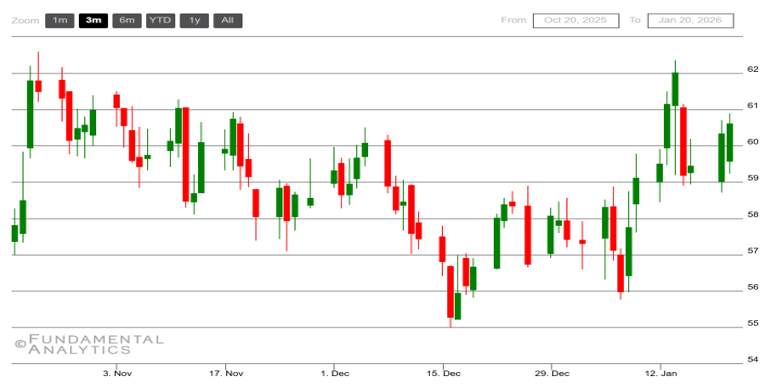
Source: Fundamental Analytics
WTI swung on shifting fundamentals: OPEC+ kept output steady, while IEA/OPEC signalled ample 2026 supply. U.S. crude stocks rose, widening the WTI-Brent spread as Venezuelan barrels returned. Temporary Kazakh outages and renewed Iran/Strait of Hormuz risk added upside, but easing tensions trimmed premia. Overall, inventory builds, cautious demand projections, and soft winter demand largely capped rallies despite episodic geopolitical spikes.
Agriculture
Corn futures plummeted on ample supply and softened US exports
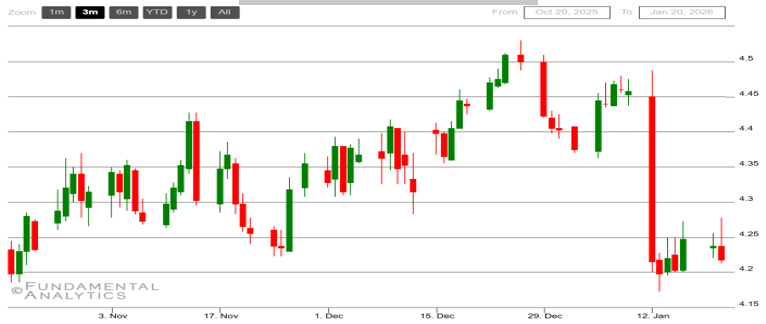
Source: Fundamental Analytics
CBOT corn softened as USDA’s January update raised 2025/26 U.S. production and ending stocks, while Grain Stocks showed larger Dec-1 inventories, reinforcing ample supply. Losses were partly offset by South American risk—Argentina’s Pampas turned drier, threatening late-planted corn. Margin stress for U.S. growers also underpinned a floor despite tepid demand conditions and cautious feed/ethanol usage outlooks near-term in USDA guidance.
Welcome to our monthly newsletter which covers key developments in major non-US markets. With this newsletter, we highlight corporate, debt, and monetary policy news in European, Asian, and Latin American markets. We end this piece with a spotlight on commodities.
European Markets
Corporate and Business News
- Rio Tinto has entered discussions to acquire Glencore, signaling the potential creation of a mining mega‑merger that could reshape the global copper market and pressure competitors into defensive consolidation. The transaction is expected to face significant regulatory scrutiny, with authorities in China and other jurisdictions likely to require divestitures.
- Czechoslovak Group surged in its Amsterdam market debut, surpassing a €30 billion valuation and underscoring strong investor demand for Europe’s defense industrial base. The strong opening positions the company as a pivotal player in meeting the region’s expanding security and procurement needs.
- ASML surpassed the $500 billion valuation mark as accelerating AI‑driven capital‑expenditure upgrades continue to fuel a powerful upcycle in semiconductor equipment—despite management’s notably cautious outlook for 2026. The milestone reinforces ASML’s position at the center of advanced chipmaking and highlights the structural demand underpinning next‑generation lithography technologies.
- Airbus reported 793 aircraft deliveries, retaining its lead over Boeing while securing additional A220 commitments from AirAsia—though overall momentum remains constrained by ongoing supply‑chain challenges.
- Deutsche Börse has agreed to acquire Allfunds for approximately €5.35 billion, strengthening its position in the fund‑distribution ecosystem. The transaction is aimed at expanding operational scale while unlocking meaningful cost and capital‑expenditure synergies.
- Beazley has rejected Zurich Insurance’s £7.7 billion approach. The move underscores increasing bid discipline among Europe’s leading insurance consolidators.
- EQT moves into private‑equity secondaries with a $3.2 billion deal for Coller Capital. The transaction marks a significant shift in the European alternatives landscape
- Société Générale will cut 1,800 roles in France as its turnaround plan accelerates. The bank intends to rely primarily on attrition and redeployment rather than forced layoffs.
- Rheinmetall is deepening its push into naval defense following its acquisition of Lürssen’s warship business. The company has also indicated that further bolt‑on deals are likely as it broadens its platform portfolio.
- UBS has secured initial approval for a U.S. national‑bank charter. The decision paves the way for a broader American expansion as the bank completes the integration of Credit Suisse.
Debt & Monetary Policy News
- The ECB signaled an extended policy hold, with meeting accounts indicating no urgency to adjust rates. Headline inflation has returned to target, growth projections have strengthened, and policymakers appear comfortable with market expectations for stable rates through 2026. ECB leadership cautioned about potential external‑policy spillovers, identifying possible divergence with the Federal Reserve and rising trade uncertainties as key risks. Even so, the central bank’s baseline outlook continues to assume a stable policy stance.
- The Bank of England’s easing cycle has paused amid more challenging optics, following a narrow cut to 3.75%. A subsequent uptick in CPI to 3.4% and a series of hawkish MPC speeches have led major banks to delay expectations for the next policy move.
- The Swiss National Bank reiterated its “on hold for longer” position, with Davos‑week remarks stressing central‑bank independence and expressing comfort with near‑zero inflation. Recent polls and meeting minutes suggest the policy rate is likely to remain at zero through 2026.
- The Riksbank outlined a steady policy trajectory, with minutes indicating that the 1.75% rate is expected to remain unchanged through 2026 under the baseline scenario. Policymakers remain vigilant regarding activity and inflation developments.
Asian Markets
Corporate and Business News
- Sunway has launched an approximately 11 billion ringgit bid for IJM, positioning the deal to create one of Malaysia’s largest integrated construction and property groups. The offer, which includes a mix of cash and new shares, comes amid heightened political scrutiny and would significantly expand Sunway’s scale if completed.
- Alibaba is preparing an IPO for its chip unit T‑Head after restructuring it into an employee‑owned entity, sending its shares higher on the report. The listing would join a wave of Chinese semiconductor offerings as Beijing accelerates support for domestic AI‑chip production.
- TSMC reported a 35% jump in fourth‑quarter profit to a record level on surging demand for AI‑related semiconductors. Management signaled continued strength in 2026 and highlighted plans for expanded U.S. manufacturing capacity, including additional Arizona fabs.
- Lenovo is pursuing partnerships with multiple global LLM developers to embed AI capabilities across its PCs, phones and wearables. Its “orchestrator” strategy, unveiled at Davos, aims to build an ecosystem‑wide AI layer powered by partners such as Mistral AI, Humain, Alibaba and DeepSeek.
- Shareholders of Hang Seng Bank have approved HSBC’s nearly US$14 billion plan to take the lender private. The move deepens HSBC’s strategic focus on Hong Kong and aims to unlock operational synergies across its regional franchise.
- Airwallex has acquired South Korea’s Paynuri to secure key payments and foreign‑exchange licenses needed for direct on‑the‑ground operations. The deal follows Airwallex’s US$8 billion valuation round and supports its broader Asia‑Pacific expansion strategy.
- Inspira Global will invest up to 34.16 billion rupees to gain control of Restaurant Brands Asia, the operator of Burger King India, marking Everstone’s full exit. The transaction includes equity infusions, warrants and an open‑offer requirement, positioning Inspira to lead a renewed growth strategy for the franchise.
Debt and Monetary Policy News
- The Bank of Japan maintained its policy rate at 0.75% while reaffirming a hawkish inflation outlook, noting that a weaker yen could continue to push import‑driven price pressures higher. Policymakers signaled that further rate hikes remain likely, with Governor Ueda stressing vigilance over yen‑related inflation risks and emphasizing data‑driven tightening ahead.
- The Reserve Bank of India announced a liquidity injection exceeding $23 billion through bond purchases, FX buy/sell swaps and new repo operations to ease funding stress. Officials said the measures aim to stabilize yields and the rupee as system liquidity tightens and borrowing costs rise.
- The People’s Bank of China cut interest rates on targeted structural policy tools and indicated that additional RRR and broader rate cuts remain possible in 2026. The central bank emphasized the need to maintain ample liquidity and support credit conditions amid changing financial structures and soft economic momentum.
- China Vanke has requested a 90‑trading‑day extension on 5.7 billion yuan in onshore bond repayments to avert default as liquidity pressures deepen. Bondholders will vote on the proposal this month, alongside alternative plans involving partial upfront repayments and enhanced credit protections.
- The Bank of Korea held rates at 2.50% and signaled that the easing cycle is effectively over, citing heightened financial‑stability risks as the won trades near 16‑year lows. Officials removed prior guidance that hinted at future cuts, underscoring a more cautious stance amid persistent FX volatility and capital outflow pressures.
Latin American Markets
Corporate and Business News
- Shell is evaluating the potential sale of some or all of its Vaca Muerta shale assets in Argentina and has begun sounding out prospective buyers. The review forms part of a broader portfolio‑optimization effort as the company reassesses capital deployment across its global upstream operations.
- Brazil’s CSN has initiated a wide‑ranging divestment program, including a planned sale of its cement assets, to accelerate balance‑sheet deleveraging. Management is targeting R$15–18 billion in debt reduction as it refocuses on core steel and mining businesses.
- Trafigura has shipped the first Venezuelan crude cargo under its newly authorized 50‑million‑barrel supply arrangement. Repsol is expected to receive its allocation in mid‑February as commercial flows resume under updated export permissions.
- Repsol, ENI and Maurel & Prom are seeking U.S. licenses to export Venezuelan crude through arrangements linked to PDVSA. The companies aim to formalize commercial flows under evolving sanctions guidance while maintaining compliance with U.S. oversight requirements.
- Valero—alongside Phillips 66—has begun purchasing Venezuelan crude under the U.S.–Caracas agreement permitting up to 50 million barrels of exports. The purchases mark a further normalization of trade channels as refiners diversify feedstock supply.
- Halliburton has started recruiting for roles in Venezuela, signaling a potential return to the country’s oilfield services market following President Maduro’s outreach to foreign investors and a $100 billion investment pitch to the United States. The hiring activity suggests the company is preparing for a gradual reopening of operational activity.
- Venezuelan Interim President Delcy Rodríguez has submitted a proposed overhaul of the country’s hydrocarbons law, granting operators greater autonomy and improved access to export proceeds. The reform aims to attract new investment and modernize the operating framework across the sector.
- Brazilian fintech PicPay is targeting a valuation of up to $2.46 billion in its planned IPO. The company aims to raise as much as $434 million, with shares marketed in the $16–$19 range to support expansion and strengthen its capital base
Debt and Monetary Policy News
- Brazil is expected to begin its first interest‑rate cuts in nearly two years this March as policymakers respond to weakening industrial activity and sluggish economic momentum, signaling a shift toward a more accommodative stance to bolster domestic demand. Softer‑than‑expected inflation at 4.26% for 2025, which came in comfortably within the target range, has further strengthened expectations that the central bank will move earlier and more decisively on monetary easing.
- The Brazilian central bank has ordered the liquidation of Will Financeira, a unit of Banco Master, as part of a broader crackdown on institutions exhibiting liquidity shortfalls. It has also mandated the liquidation of brokerage REAG (CBSF), marking a further extension of supervisory actions linked to the Banco Master situation. The action underscores regulators’ heightened focus on balance‑sheet resilience and systemic‑risk containment.
- Argentina’s economic activity contracted 0.3% year‑on‑year in November—the first decline of 2025—underscoring persistent macroeconomic fragilities despite recent stabilization efforts. The downturn has prompted downward revisions to growth forecasts for both this year and 2027, with analysts emphasizing that regaining access to debt markets and improving external financing conditions will be essential to restoring a sustainable expansion path.
- Argentina has completed repayment to the United States for prior currency‑swap support used to stabilize domestic markets during periods of acute volatility. The reimbursement is viewed as an important step in rebuilding credibility with international partners.
- A major group of Venezuelan bondholders has signaled readiness to begin restructuring talks once formal authorization is granted. The creditors’ coordinated stance could help accelerate negotiations aimed at resolving the country’s longstanding default.
Commodities Spotlight
Energy
WTI futures experienced strong volatility during the last month, returning from a $55 low mark
Source: Fundamental Analytics
WTI swung on shifting fundamentals: OPEC+ kept output steady, while IEA/OPEC signalled ample 2026 supply. U.S. crude stocks rose, widening the WTI-Brent spread as Venezuelan barrels returned. Temporary Kazakh outages and renewed Iran/Strait of Hormuz risk added upside, but easing tensions trimmed premia. Overall, inventory builds, cautious demand projections, and soft winter demand largely capped rallies despite episodic geopolitical spikes.
Agriculture
Corn futures plummeted on ample supply and softened US exports
Source: Fundamental Analytics
CBOT corn softened as USDA’s January update raised 2025/26 U.S. production and ending stocks, while Grain Stocks showed larger Dec-1 inventories, reinforcing ample supply. Losses were partly offset by South American risk—Argentina’s Pampas turned drier, threatening late-planted corn. Margin stress for U.S. growers also underpinned a floor despite tepid demand conditions and cautious feed/ethanol usage outlooks near-term in USDA guidance.
