
The year 2026 started with a bang! Maduro is out, the oil sector prepares for new dynamics, the US declared that it will run Venezuela for the foreseeable future – disavowing Maria Corina Machado – while allowing US oil companies to shape its future. The new National Security Strategy (NSS) is at work, and regimes around the world (Colombia, Cuba, and Iran were openly warned) are questioning who is in the middle as the Symplegades appear on the horizon.
The United States was founded as an experiment – the idea that a democratic republic can endure ran against history’s teachings, as discussed at the end of this commentary –seeking a historical destiny. There are cyclical rhythms that mark American geopolitical thinking. Those rhythms have to do with the character of the particular administration in office, its national priorities and interests, but it cannot ignore universal moral absolutes and rights recognized in its founding principles and the Constitution.
The current geopolitical environment is not merely about change. It is primarily about the rate of change, or what mathematicians would call the second derivative. There is no doubt that repression, brutality, authoritarianism, electoral fraud, corruption, and their similar cancerous derivatives do not belong in a civilized society, and the sooner they are removed, the healthier the society will be. We are in the midst of dazzling technological and scientific revolutions – like in the time of revolutions two centuries ago, as the Industrial Revolution was unfolding – accompanied by geopolitical devolution. “The law of acceleration,” Henry Adams said, “definite and constant as any law of mechanics, cannot be supposed to relax its energy to suit the convenience of man.” Are we about to admit that current developments are a drop, and our ignorance about the forthcoming developments represents the river that ends up in an unknown ocean?
Uncharted change could be demoralizing, but as Emerson said, we cannot mistake the sound of a popgun for the crack of doom. Needless to say that the pale horse of nuclear weapons represents a fatal exception. The unfolding of history is marked by continuity and discontinuity. The past and forthcoming shocks increase the velocity of history. As for oil prices, while naturally someone might conclude that the action taken in Venezuela will force prices down (due to the abundance of oil reserves in Venezuela, which are the largest in the world), we should also remember that reserves are not the same as oil supply.
But for now, let’s change course and relate the market outlook to the unfolding developments. Overall, earnings prospects continue looking promising; however, such an assessment overlooks the fact that about 50% of those projected earnings for the S&P 500 are coming from less than 10 companies. Having said that, we cannot ignore the fact that even the circularity of those earnings is uplifted by an economic growth trajectory stimulated by fiscal and monetary measures (which are already unfolding). Both of those forces are admittedly powerful, and hence the temptation to join the consensus of analysts for another year with double-digit gains in the equity markets. Nevertheless, we choose to be cautious for a number of reasons, so let’s start with the following graph.
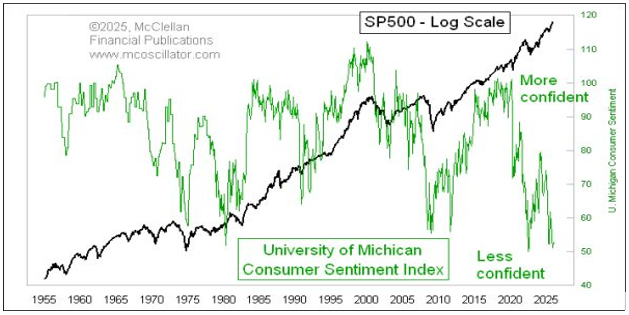
Consumer confidence seems to be at its nadir for the last 70 years, but the market keeps rising due to the endogenous stimulus of fiscal and monetary measures that can be afforded. The question, of course, is whether they can really be afforded, given the unsustainable debt levels in the US and abroad. And while there might be a bit more room for that stimuli, the employment growth numbers do not inspire confidence. Real purchasing power seems to be fragile, and cheap gasoline is not a panacea. If consumer confidence gives in, political power will feel the heat, and asset prices will be subjected to repricing. Recession might not be far away.
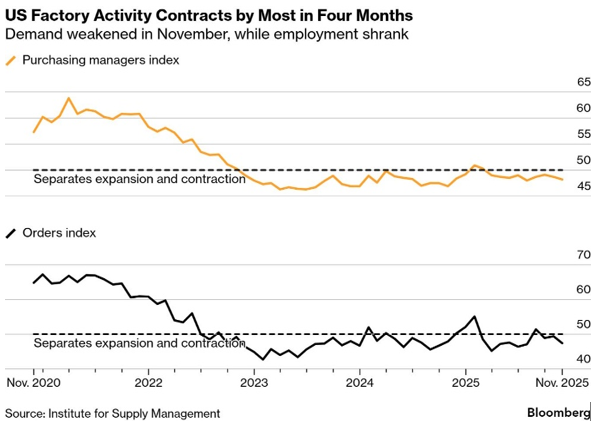
The figure above also relates to hard data, as shown below. The manufacturing index has been below 50 (the level that signifies contraction) for nine straight months. Rising production costs (8% year-on-year annual increase), elevated policy uncertainty, and declining orders are not elements that inspire confidence.
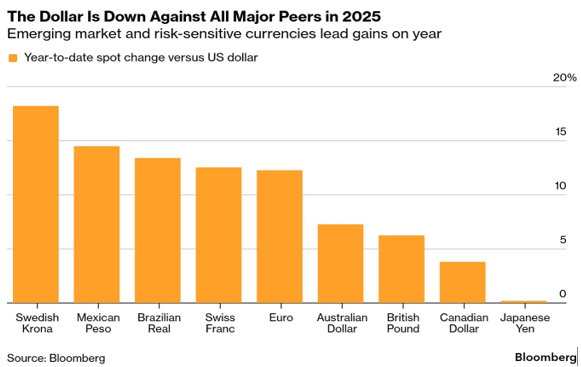
Declining strength of the dollar is expected to continue, but hopefully not at an accelerating pace (which would imply imported inflation and declining confidence in US policies). The fundamental reasons for such anticipated USD decline are the same: fiscal profligacy and loose monetary policy.
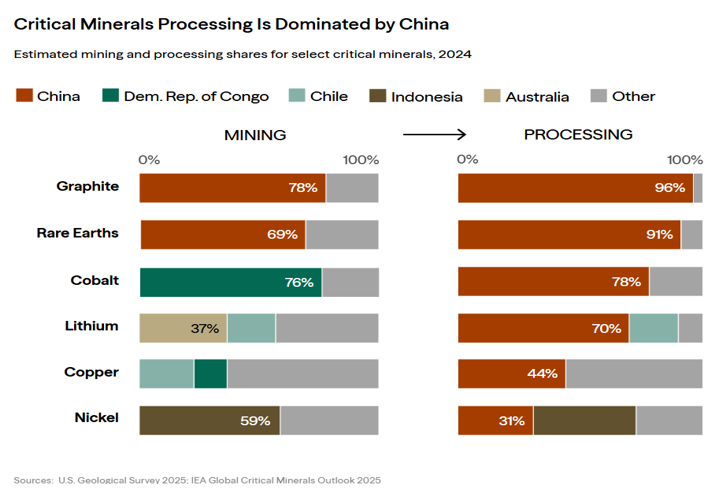
So, as we are trying to visualize the forthcoming changes, we are looking at some critical navigation issues that by themselves may not represent chokepoints, but if they are put together, they could alter the trajectory. Those issues relate to critical minerals, of which China controls a good chunk, associated with recent Chinese policies, which themselves indicate a willingness to manipulate those for the sake of geopolitical power. As the Council on Foreign Relations recently stated: “China’s near-total control over many critical minerals and rare earth elements and Beijing’s willingness to weaponize the dominance put the world on notice.”
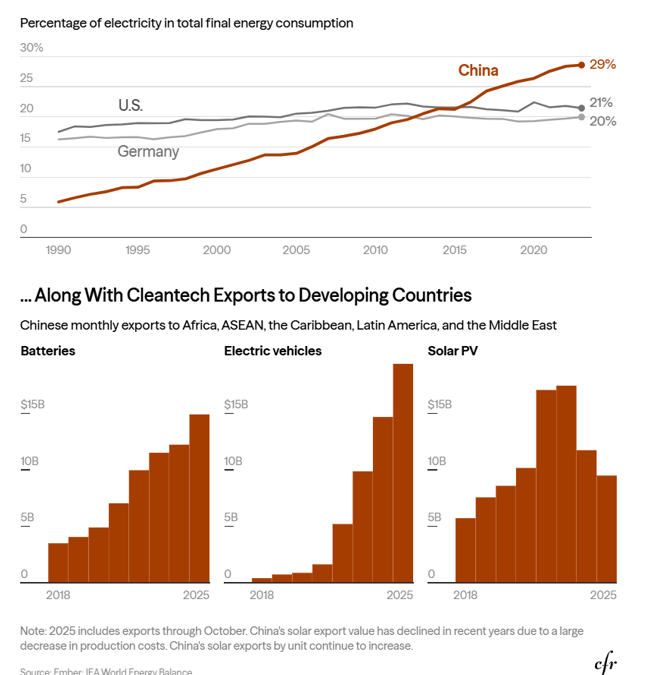
Similarly, the rise of the electrostate as a supplement and replacement of the petrostate brings the issue of smart growth and the need for smart power grids to a new level of understanding. The rising demand for electricity and the equivalent percentage of energy produced by electricity will shape the future of a service-oriented economy. The fact that China has surpassed both the US and Germany signifies that policies need to be redirected. The rising risks of a power failure (especially if it happens in the midst of major cyberattacks) that would require an extended period to be fixed multiply the economic and financial risks.
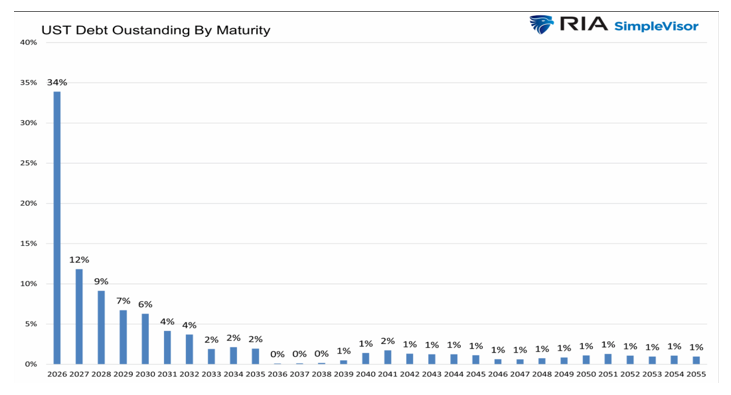
A misfiring of policy represents – especially the one related to the “maturity wall” – the next critical issue. Just in 2026, close to $10 trillion of US debt is maturing (about one third of the total), followed by trillions more in subsequent years. That debt originated at very low rates, so consequently its refinancing is raising some (limited for now) red flags, given that refinancing will be at significantly higher rates during a time that the US needs to maintain goodwill with outside funding sources. Not only will the costs rise, but earnings will be affected (as the costs of borrowing will increase), trust in the dollar may take a hit, the Fed may be forced to monetize the debt, and stagflationary forces may start unfolding.
Returning to the geopolitical sphere, we cannot neglect existing as well as emerging conflicts, or the future of shaky regimes that may implode around the world (Ukraine, Sudan, Thailand/Pakistan, the Middle East, including the rising conflict between UAE and Saudi Arabia, the Sahel, Iran, India/Pakistan, China/Taiwan, Rwanda/DRC, etc.), at a time when Europe may start facing its most perilous phase in decades. The epicenter of the international order (force is not an option to be used in order to abolish sovereignty, and might is not equivalent to being right) is being questioned at a time when Chinese power is rising. The consequences cannot be known at this stage. Is regionalism ceding power in Asia? Questioning long-standing alliances at a time of exponential change could be a recipe for miscalculation.
The brilliant Alfred North Whitehead said that the two occasions in history “when the people in power did what needed to be done about as well as you can imagine its being possible” were the ages of Augustus and the framing of the American Constitution. The Founding Fathers passionately ransacked the classical historians for ways to escape the classical fate. “To live without having a Cicero and a Tacitus at hand seems to me as if it was a privation of one of my limbs,” John Quincy Adams said, echoing the same thoughts that Thomas Jefferson had expressed.
Later on, Henry Adams concluded: “I firmly believe that before many centuries more, science will be the master of man. The engines he will have invented will be beyond his strength to control. Some day science shall have the existence of mankind in its power, and the human race commit suicide by blowing up the world.”
Really, who is in the middle?
