
January 9, 2026 | Volume III, Issue 1| The FACS Team
Welcome to the January edition of the Carbon Market News Roundup, our monthly briefing on the evolving landscape of global carbon markets and climate-related regulation. Our previous issues, along with the rest of our commentaries, may be read here.
In this issue, we examine how Europe’s carbon policy framework is moving decisively from transition to full implementation across compliance and voluntary markets. EU ETS prices closed the year at multi-year highs as markets priced in tightening supply, declining free allocation, and the definitive entry into force of CBAM from 2026, while policymakers reinforced long-term signals through updated state aid rules and a binding 2040 emissions-reduction target. Maritime decarbonization enters a more demanding phase as shipping faces full ETS exposure from 2026, the inclusion of non-CO₂ gases, revised auction calendars, and new technical guidance on methane-slip verification under FuelEU and EU MRV.
At the same time, CBAM shifts from reporting to financial compliance with the adoption of default emission values and proposals to expand scope, close circumvention loopholes, and introduce targeted support for EU industry. Against this regulatory backdrop, voluntary carbon markets continue to recalibrate as issuance remains disciplined, retirements softened in 2025, and corporate demand is increasingly focused on higher-integrity credits as companies integrate voluntary markets more strategically into long-term net-zero pathways.
EU ETS – Regulations Updates
European carbon prices hit two-year high in December
Halina Yermolenko, GMK Center
European Sting
2040 climate target: Council and Parliament agree on a 90% emissions reduction – Consilium
European Commission
Trading Economics
European carbon markets closed the year with renewed momentum, as EUA prices climbed to a two-year high in mid-December amid tightening expectations for the post-2025 period. Prices for the December 2025 contract peaked around €85/t, while market attention increasingly shifted to the December 2026 benchmark, which rose above €87/t and is now widely seen as the key reference for future compliance costs. The year-end rally portrays both seasonal factors, such as the pause in primary auctions over the holiday period, and deeper structural dynamics. Market participants are positioning for a supply-constrained environment from 2026 onwards, mainly driven by declining free allocation, the full entry into force of CBAM, and growing long positions held by financial investors. Against this backdrop, consensus forecasts now point to a steady upward trajectory in EUA prices, with estimates converging around €85/t in 2026, breaching €100/t in 2027, and approaching €126/t by 2030 as policy tightening accelerates.
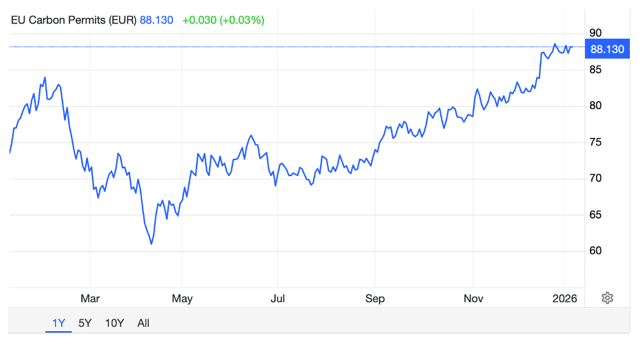
Source: Trading Economics
Alongside market developments, policymakers are adjusting the regulatory architecture to manage rising carbon costs and competitiveness risks. In December, the European Commission amended the ETS State aid Guidelines to address the heightened risk of carbon leakage faced by a broader range of energy-intensive industries. The revisions expand eligibility for indirect cost compensation to additional sectors, raise aid intensity for existing beneficiaries, and introduce new flexibility for Member States to support sectors demonstrably exposed to international competition. The longer-term policy signal was further strengthened by a provisional agreement between the Council and the European Parliament to amend the European Climate Law and introduce a binding 2040 target of a 90% reduction in net greenhouse gas emissions compared to 1990 levels. The agreement confirms the central role of the EU ETS in the post-2030 climate framework, while allowing for limited flexibility through high-quality international carbon credits from 2036 onwards and a reinforced role for permanent removals. It also postpones the launch of ETS2 for buildings and road transport by one year, to 2028, reflecting concerns over affordability and social impacts.
Maritime & Shipping Updates
New EU ETS rules take effect from January 2026: What you should know
Safety4Sea
Intertanko
EU guideline for reporting and verifying actual methane slip for FuelEU and EU MRV/ETS
DNV
Revised 2026 EU ETS auction calendars published – Climate Action
European Commission
The EU ETS entered a decisive phase for maritime transport in 2024, with the sector’s first year of inclusion confirming both the system’s operational readiness and its growing regulatory reach. According to the European Commission’s 2025 Carbon Market Report, shipping companies surrendered allowances covering more than 99% of their required emissions by the September deadline, signalling a smooth onboarding of the sector into the ETS. The system now applies to 100% of emissions from voyages within the EEA and emissions at berth, and to 50% of emissions from voyages between EU and non-EU ports. While only CO₂ emissions were covered during the initial phase-in period, compliance costs are ramping up rapidly. Shipping companies were required to cover 40% of verified 2024 emissions in 2025, 70% of 2025 emissions in 2026, and from January 2026 onward will face full exposure. This escalation coincides with broader cap adjustments under the ETS, including a rebasing of the cap, the cancellation of allowances linked to the maritime phase-in, and an overall tightening of supply as the system aligns with the EU’s strengthened climate ambition.
Regulatory complexity for shipping increases further from 2026 with the extension of the EU ETS to non-CO₂ greenhouse gases and the interaction with FuelEU Maritime. Methane and nitrous oxide emissions from maritime transport will fall under the ETS from January 2026, requiring shipping companies to surrender allowances not only for CO₂ but also for these additional gases. In this context, the European Commission has issued new guidance allowing operators to apply verified, actual methane slip values instead of conservative default factors under both FuelEU Maritime and EU MRV/ETS. Given methane’s high global warming potential, the ability to certify lower slip rates, particularly for LNG-fuelled vessels equipped with newer engine technologies, can materially reduce reported emissions and compliance costs. At the same time, revised EU ETS auction calendars published in December reflect the scale of maritime integration, with over 54 million allowances linked to the 2024 phase-in to be cancelled from future auctions, while additional allowances are being introduced to account for non-CO₂ maritime emissions.
EU CBAM Updates
Implementing Regulation on determining default values for the CBAM into force on 3 January 2026
Tulli
Commission strengthens the Carbon Border Adjustment Mechanism
European Commission
CBAM: Expansion of CO₂ border adjustment in the pipeline
Dr. Markus Böhme and Fiammetta Kremer, Taylor Wessing
EU expands carbon border tax to garden tools and washing machines
Alice Hancock, Financial Times
The EU has taken a decisive step toward operationalising the Carbon Border Adjustment Mechanism as it enters its definitive phase. On January 3rd, the implementing regulation establishing default emission values for CBAM goods entered into force, following its publication in the Official Journal at the end of December. From January 1, 2026, importers will be required not only to report embedded emissions but also to purchase and surrender CBAM certificates, with default values available where verified actual emissions data cannot be obtained. This marks a critical transition from the reporting-only period to full financial compliance and provides a fallback mechanism intended to ensure continuity of the system while encouraging non-EU producers to move toward verified emissions reporting. Guidance on the application of default values is expected to be further clarified by the Commission, but the regulation already establishes a clear compliance baseline ahead of the first surrender obligations.
In parallel, the European Commission has moved to strengthen and future-proof CBAM through a package of proposals responding to lessons from the transitional phase. These measures aim to close circumvention loopholes, reinforce enforcement powers, and expand CBAM’s scope to downstream steel- and aluminium-intensive products from 2028, covering roughly 180 additional goods ranging from machinery and industrial equipment to household appliances. The proposals also introduce enhanced traceability requirements, stricter treatment of misreported emissions, and the incorporation of scrap into emissions calculations to avoid competitive distortions. To address remaining carbon leakage risks, the Commission has proposed a temporary decarbonisation fund for 2026–2027, financed in part by CBAM revenues, to support EU producers that remain exposed as free allocations under the EU ETS are phased out.
Voluntary Carbon Market News
Michelle Appeah, Sustain Craft
Ian Mackay, ESG News
Voluntary carbon credit market builds momentum, as focus shifts to ‘higher-quality credits’
Amber Rolt and James Murray, Business Green
Slow December leaves annual retirements at lowest level since 2020
Carbon Pulse
Recent data for November 2025 point to a market that is stabilising on the supply side while facing softer demand dynamics. Credit issuance reached 16.0 million units, broadly in line with the same period last year, but remained below historical averages, reflecting tighter methodologies and more conservative crediting across major registries. Gold Standard accounted for more than half of total issuance, while Verra’s share continued to decline. By contrast, retirements fell sharply to 6.5 million units, a decline of more than 50% year-on-year, with notable weakness in REDD credits and a greater share of retirements coming from energy projects. Labelled credits remained highly concentrated: Article 6 and CORSIA labels were issued primarily for cookstove projects in Rwanda and Gambia, while removal and Core Carbon Principles (CCP) labels were largely limited to US improved forest management projects. Pipeline activity remained steady, with new nature-based and carbon dioxide removal projects registered across Latin America, Africa, and Asia, and continued investor interest in IFM, ARR, and agricultural land management projects.
At the same time, corporate engagement with voluntary markets appears increasingly deliberate rather than opportunistic. A Morgan Stanley survey of large global companies shows that more than 90% of existing buyers plan to continue purchasing voluntary carbon credits, with many expecting volumes to rise over time as part of broader net-zero strategies. Importantly, credits are increasingly viewed as a complement to internal decarbonisation rather than a substitute, with most companies expecting the majority of emissions reductions to come from operational improvements and value-chain measures. Demand is becoming more selective, concentrating on higher-integrity credits aligned with emerging quality standards, even as supply remains constrained. However, this underlying demand strength has not yet translated into higher retirements as annual retirements in 2025 fell to their lowest level since 2020, with a particularly weak December contributing to a 4.5% year-on-year decline.
Recommended Reads
EU rules out UK exemption from carbon border levy until markets link
Kate Abnett and Sussana Twidale, Reuters
As the Paris Agreement turned 10, what has it achieved?
Climate Change News
EU trade commissioner proposes temporary exemption of fertilisers from CBAM
Carbon Pulse
Saudi Arabia positions itself as carbon trading hub for Asia, Global South
Shotaro Tani, Nikkei Asia
To explore insights and tools driving carbon compliance and markets, visit the FACS website here!
