
We’re pleased to announce that the Fundamental Analytics Carbon Services website is now live—explore insights and tools driving carbon compliance and market access here.
The FACS platform, linked to ICE, enables direct EUA trading and streamlined onboarding for CBAM-affected markets.
Welcome to our monthly newsletter, Carbon Market News Roundup, the goal of which is to introduce our audience to a new asset class market in the making: the carbon market. Our previous issues, along with the rest of our commentaries, may be read here.
European Commission Consults on CBAM Extension and Announces Plans to Protect EU Exporters
James Bee, Paul Davies, Toon Dictus and Michael Green, Jdsupra
Article 6 credits kept out of EU ETS as Brussels puts forward 90% climate target for 2040
Frédéric Simon and Emanuela Barbiroglio, Carbon Pulse
EU’s $250 billion-per-year spending on US energy is unrealistic
Kate Abnett and Arathy Somasekhar, Reuters
Euro Markets: Tariff news fails to lift EUAs out of range
Finlay Johnston, Carbon Pulse
Fossil power demand could drive EU ETS emissions increase for first time in years
Roy Manuell and Finlay Johnston, Carbon Pulse
The European Commission took further steps to fortify its carbon market. It opened a consultation to expand the new Carbon Border Adjustment Mechanism to more downstream products and announced plans for an export-focused measure by year-end to shield EU manufacturers from carbon leakage on foreign markets. EU institutions also reached a provisional deal in June to simplify CBAM – including a broader exemption for importers under 50 tonnes/year of covered goods, replacing a much lower threshold – with formal adoption expected by September. Meanwhile, Brussels proposed a 2040 climate law targeting a 90% reduction in net emissions from 1990 levels, reserving up to a 3% slice for international credits but explicitly keeping those offsets out of the EU Emissions Trading System.
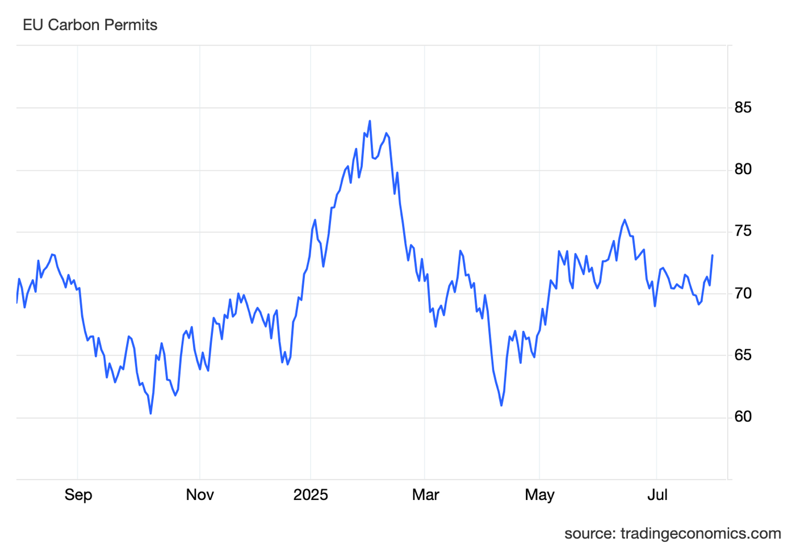
On the market front, EU carbon allowance prices traded in a narrow range through July, hovering in the €70s per ton, showing little reaction to policy news. Even a new EU-US trade framework which included a pledge for the EU to buy $250 billion/year in U.S. energy over three years and an announced 6% cut in EU ETS auction volumes for September-December failed to spark a sustained rally in EUAs. Analysts noted that a surge in fossil-fueled power generation during the first half of 2025 could make this year the first since 2022 to see rising ETS emissions. By late July, EU member states had also allocated roughly 75% of their free 2025 allowances to industry, keeping most of this year’s quota in circulation despite tightening supply ahead.
Maritime & Shipping Updates
Shipping industry presses EU to align ETS with IMO’s incoming carbon levy
Sara Stefanini, Carbon Pulse
Tighter carbon rules, slower economy to erode bunker demand growth, IEA says
Enes Tunagur, Reuters
The global shipping sector is entering a pivotal phase as regulatory divergence and economic headwinds reshape its decarbonization trajectory. Industry groups are pressing the European Union to harmonize its maritime emissions trading system (EU ETS) with the International Maritime Organization’s (IMO) proposed global carbon levy. The goal: a unified pricing framework that reduces compliance complexity and avoids market fragmentation. Yet EU policymakers remain firm, touting the ETS’s transparency and enforceability as strategic advantages.
This tension comes as the IMO prepares to formally adopt its carbon pricing mechanism in October 2025, with implementation slated for 2027. The levy—expected to generate $10–13 billion annually—would fund the sector’s transition to zero-emission fuels and technologies. However, behind the scenes, EU negotiators are reportedly reconsidering their stance, with some signaling openness to alternative revenue models like credit trading. Such shifts could undermine the broader coalition backing the levy and dilute its climate finance potential.
Meanwhile, the International Energy Agency forecasts a plateau in marine fuel demand through 2030, citing tighter emissions rules and sluggish global trade. Bunker consumption is expected to stagnate around 5 million barrels per day, with rising freight and insurance costs compounding the slowdown. This decoupling of shipping activity from fuel growth underscores the urgency of transitioning to cleaner propulsion systems.
Emerging Compliance Markets
Malaysia’s upcoming carbon tax could raise $213 mln annually
Arshreet Singh, Carbon Pulse
China signals shift to absolute compliance carbon market cap by 2030
Ivy Yin, S&P Global
China carbon market faces challenges as coverage expands
Chia-Erh Kuo, Carbon Pulse
Brazil eyes nearly $4 bln in climate finance with global asset managers
Graham Gibson, Carbon Pulse
July marked a turning point for emerging carbon markets, as three economies—Malaysia, China, and Brazil—announced major steps toward pricing emissions and attracting climate capital.
Malaysia’s decision to implement its first carbon tax in 2026 is a milestone for Southeast Asia. At an estimated RM1 billion ($213 million) in annual revenue, the tax will initially target carbon-intensive sectors, reinforcing domestic climate goals while easing friction with the EU’s Carbon Border Adjustment Mechanism. Cost pressures will mount for export-oriented industries, and while subsidy reforms remain politically sensitive, they’re increasingly linked to this broader decarbonization agenda.
China’s latest ETS policy guidance represents an even more structural shift. The national scheme—currently based on intensity benchmarks—is set to evolve into an absolute cap-and-trade system by 2030. That transition aligns China with global carbon market norms, particularly as it expands beyond the power sector to heavy emitters like steel and cement. Trading volumes are rising, and allowance prices show resilience, yet structural hurdles remain.
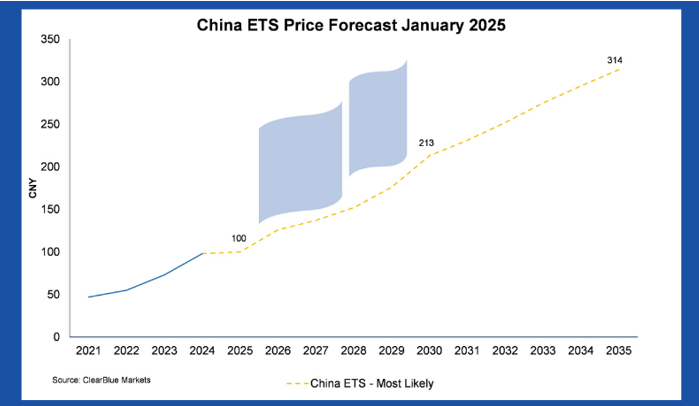
Source: ClearBlue Markets
Analysts warn that policy consistency and market liquidity will determine whether the system matures or plateaus.
In Latin America, Brazil is stepping up its climate finance ambitions ahead of hosting COP30 in Belém. The government’s partnership with global asset managers could mobilize nearly $3.6 billion toward renewables, conservation, and infrastructure. Brazil’s stated priorities—equitable finance, forest protection, and fossil phase-out—signal a strong bid for leadership within climate diplomacy and may lay the foundation for a regulated domestic carbon market.
Across these cases, a common theme emerges: rising ambition matched by structural gaps. Market credibility depends on pricing transparency, coverage expansion, and institutional capacity—not just headline announcements. Still, if Malaysia follows through, China sustains ETS reforms, and Brazil delivers on green investment, we may be witnessing the foundations of a more plural and resilient global carbon pricing landscape.
Recommended Reads
Carbon markets can help fill the climate finance gap. Here’s how we can unleash their potential
Mark Kenber, Reuters
Top central banker defends climate work after US pushback
Kenza Bryan, Financial Times
Special Report Asia-Pacific Climate Leaders
Financial Times
The climate needs a politics of the possible
The Economist
