
The Wooden Nickel is a collection of roughly a handful of recent topics that have caught our attention. Here you’ll find current, open-ended thoughts. We wish to use this piece as a way to think out loud in public rather than make formal proclamations or projections.
1. Keep the Main Thing the Main Thing
Like many others at the current juncture, I’ve enjoyed going through Liaquat Ahamed’s 1873, a history of what would become known as “the Long Depression.” I was particularly struck by a comparison made in the first half of the book between two of the more dominant banking franchises, Barings and the Rothschilds. Ahamed writes:
“While Barings generated annual profits of $250,000 a year in the early part of the nineteenth century, so much of it was paid out that its capital base stagnated -as late as 1850 it was the same as it had been thirty years earlier. As a result, while individual Barings were often very wealthy… the bank itself was starved of capital.” In 1850, at the start of the boom, Barings had barely $5 million in capital, whereas Rothschilds had $40 million.”
Continuing:
“By 1870, Barings had less than $15 million in capital compared to Rothschilds’ $200 million.”
It may seem trivial to complain about a capital base that only tripled, but keep in mind two points. First, on a time horizon of twenty years, we’re talking about roughly a ~5% CAGR. Second, as Ahamed points out, Barings employed significantly more leverage, borrowing roughly $5 for every $1 of equity.
For whatever reason, the historical anecdote recalled how many people, unwisely in my belief, pick stocks or even build entire portfolios around the notion of yield or income. Far too often I see investment theses or whole accounts structured in such a way that the first filter is something along the lines of what yields well regardless of whether the underlying business or structure of a portfolio is set up for long-term success. At its best, it is a well-intentioned oversight but one that still forgoes sustainability at the expense of being able to consume today. At worst, it’s a product of laziness. One of hope that the entry point is just cheap enough that a high yield can make up for an eroding base by enough to squeeze out a positive return.
The shortcoming is not that yield is bad or investing for income is wrong. It is the hope, after all, for all of us to be able to retire and reap the fruits of past savings and sacrifice. But my issue with the practice is that, at its core, the mistake is in making secondary considerations the primary objective and priority; it is the proverbial tail wagging the dog. Rather than first considering reasonable return assumptions or what underlying risks are, it asks what it will pay out. Much like the character Wimpy in Popeye (who famously wants a hamburger today and will pay us later), no one asks if the underlying asset is money good. That is what sets it up for disappointment at some point down the road.
It may not feel like it in the moment, but I’d argue it is the riskier path for two reasons. One, opportunity costs are real. They may not drain capital or consume cash, but they are real hurdles if nothing else then to the analysis that should be done before identifying securities or building portfolios as a whole. Second, and most important, by not prioritizing where capital will be rewarded best, your portfolio ends up more fragile/less resilient. No one knows the face or extent of risks around the corner. Expanding your capital base builds up the buffer to be able to take losses down the road. Finally, and it’s the risk that decimated Barings less than two decades after the Long Depression, an obsession with yield, in unhealthy, unstable, and ebullient markets, will push you further to buy riskier assets for the sake of yield. In the case of Barings, pushing deeper into foreign markets nearly sank the firm when Argentina went bust in 1890.
There’s a reason “more money has been lost reaching for yield than at the point of a gun.”
2. Watch What They Do, Not What They Say
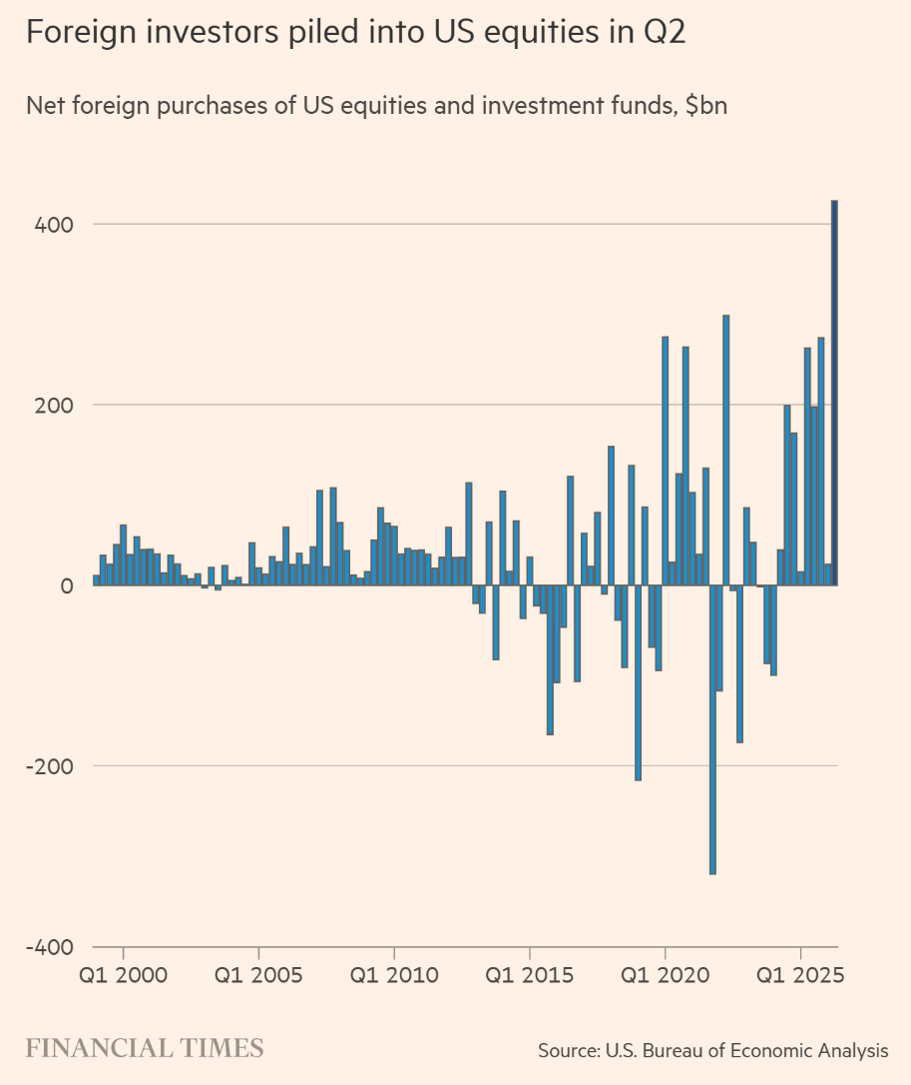
The Financial Times writes: “Foreign investors made a record $942bn in net purchases of US equities and investment fund shares in the 12 months to July, accelerating a shift in overseas investment towards American stocks and away from debt. The flows represented the highest rolling 12-month total in Treasury data going back to 1985.”
I struggle to see how someone can argue in good faith that investors are soberly weighing the pros and cons of partaking in the most liquid and ever-present debt markets for fears of fiscal doom only to simultaneously throw caution to the wind in a relatively rich market further down the capital stack.
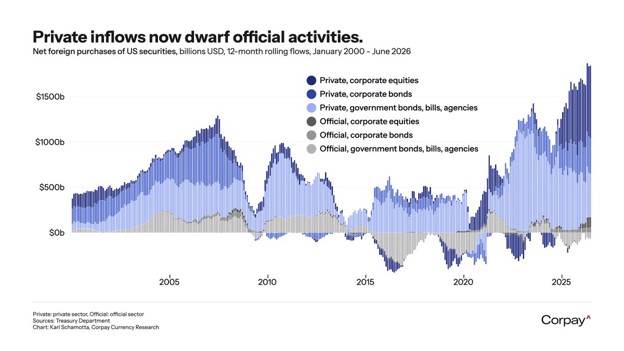
There’s an active debate as to what extent the current bond sell-off occurring globally is driven by shifts in monetary policy, fiscal balances, growth dynamics, portfolio positioning, or some mix of the above. As always, there is the loud minority harping about the imminent end of the USD-based system. And as usual, the histrionics lose out to facts and data, where the dollar continues to sit in essentially the same place as a proportion of global reserves as it has for the last 15 years. Moreover, definitions of the drivers and actors behind global reserves remain stubbornly antiquated; as more and more of global surpluses are made outside the official sector, it spells a boon to the USD. Private flows of dollar-based securities dwarf the official sector; they have for years, but commentary and mental models have yet to update. As a result, analysis and conclusions become more hysterical and theoretical rather than grounded.
3. Recommended Reads and Listens
a. The Tampa Bay Rays, Herd Behavior, and Compounders
b. Religious Scholars Met with Anthropic. What They Heard Stunned Them.
c. How US Mortgage Bonds Can Trigger a Vicious Loop for Treasury Yields.
