
Welcome to the latest edition of the Carbon Market News Roundup, our bi-weekly briefing on the evolving landscape of global carbon markets and climate-related regulation. Our previous issues, along with the rest of our commentaries, may be read here.
Carbon markets are growing up fast and growing teeth. This week’s stories show climate pricing moving deeper into hard economic infrastructure. Shipping coalitions and ESG framework pricing in decarbonization regardless of how IMO talks resolve. Brussels continues to weave CBAM revenue into its core budget and procurement law. Voluntary markets professionalize supply chains from Baghdad to East Africa to meet a coming quality squeeze. Geopolitical friction, industrial pushback and fiscal appetite are all colliding with carbon pricing’s steady embedding into trade, finance and investment decisions. This in turn is forcing every actor, public or private, to treat carbon cost as permanent.
EU ETS – Regulations Updates & EUA Price Movement
The ETS review and carbon credits: how many tonnes, how many credits?
RenewableMatter, Jacopo Bencini
Democrata, Agencias
Industry and NGO alliance urges Germany to keep ETS revenue in climate fund
Clean Energy Wire, Carolina Kyllman
Czech, Slovenia premiers urge EU rethink on energy security
Montel News, Valerija Hozjan, Peter Palcec
The EU carbon market is caught between tightening and loosening pressures at once. On the supply side, Brussels’ ETS review proposal would let the Commission auction up to 260 million allowances to fund purchases of international Article 6 credits from 2036, a first concrete step toward opening the EU market to outside offsets, though the mechanics remain contested. Meanwhile political resistance is building on two fronts. Spain’s Club de Exportadores has called for ETS and CBAM to be suspended altogether, arguing the two act as an “internal tariff” that erodes export competitiveness, while Czech and Slovenian leaders have renewed calls for the EU to rethink its approach amid energy-security concerns. Pulling the other way, a 15-strong German alliance of industry and NGOs is defending the status quo, urging Berlin not to divert ETS revenue away from its Climate and Transformation Fund. Together, the overall trend shows that carbon-price integrity is growing more and more into a live political battleground on multiple levels.
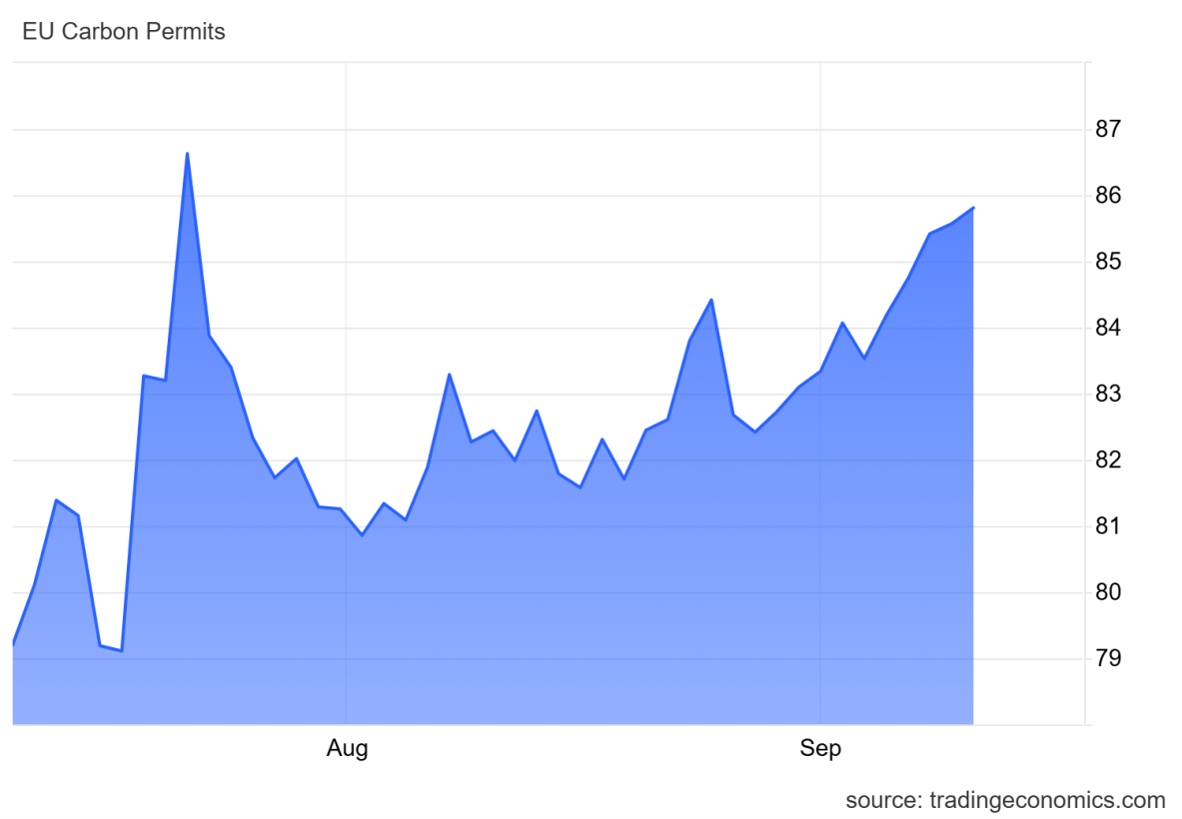
That tug-of-war shows up in the price action. EUAs dropped to a low near €79 in early August before spiking above €86 mid-month, then spent the rest of August oscillating in the €81-84 range as the competitiveness pushback from exporters and Central European governments weighed against firmer fundamentals. Since early September, prices have climbed steadily to almost €86, coinciding with the ETS review proposal’s 260-million-tonne credit facility moving forward and Germany’s industry-NGO alliance publicly defending ETS revenue ring-fencing — signals that, for now, the market is reading continuity and reform over any prospect of the system being watered down.
Maritime & Shipping Updates
UK shipping bodies launch alternative maritime fuels coalition
Gasworld, Dominic Ellis
ESG increasingly seen as a commercial priority for maritime industry, LR says
Safety4Sea, The Editorial Team
Shipping looks at ‘new world order’ at industry’s largest trade fair
Riviera, Jamey Bergman
Hellenic Shipping News
Maritime carbon markets are being shaped this month by a collision of politics and pragmatism. At SMM 2026 in Hamburg, IMO Secretary-General Arsenio Dominguez insisted that multilateralism remains alive even as geopolitics dominates member-state discussions, a backdrop that coincided with the IMO’s ISWG-GHG-22 talks in London on the Net-Zero Framework. Those negotiations remain contested. At MEPC 84, 55 countries backed the NZF as drafted while 51 favored reopening it for weaker targets and no carbon price, with proposals ranging from Tuvalu’s push for a flat levy to Japan’s and Liberia’s calls to dilute or abandon the framework. Yet even amid this uncertainty, industry voices from ports to fuel producers kept calling for the framework’s carbon-pricing revenues, worth an estimated $10-15 billion annually, to be preserved and directed toward a genuine transition rather than diluted for short-term relief.
Against that unsettled policy backdrop, industry itself is moving ahead. The UK Chamber of Shipping and CLIA’s new Alternative Maritime Fuels Coalition, bringing together fuel producers, ship-owners and technology developers, is explicitly pushing for a technology- and fuel-neutral policy approach and demanding that UK ETS maritime revenues be recycled into decarbonization rather than absorbed elsewhere. This is a domestic echo of the IMO Fund debate. Meanwhile, Lloyd’s Register’s new ESG guidance argues the sector has moved past treating sustainability as compliance: with vessels ordered today running 20-25 years, LR frames ESG performance as a direct driver of financing costs, charterer acceptance and asset value. Together, the four stories point to a maritime carbon market bifurcating along two tracks. On the one hand, a slow, contested multilateral process at the IMO, and a faster-moving commercial and coalition-driven push where operators are pricing in the transition regardless of how Geneva-level politics resolve.
EU CBAM Updates
Carbon emissions and e-waste levies are favourites for new EU budget revenue
EURActiv, Nicoletta Ionta and Victoria Becker
Parliament rapporteurs seek to tighten ’Made in EU’ rules
Eurometal
CBAM in 2027: importers need a precise plan for certificate purchases
American Journal of Transportation , Dagmara Barwa
UK recognizes 16 overseas carbon pricing schemes for CBAM relief
SteelOrbis, Elif Kefeli
Four otherwise unrelated developments this month point to the one tangent. CBAM is moving deeper in the trajectory of a structural feature of EU trade and fiscal architecture. Brussels is now eyeing carbon-border revenue as core budget financing, with CBAM proceeds named among the favored “own resources” for the 2028-2034 EU budget alongside e-waste levies. In parallel, Parliament rapporteurs are tightening “Made in EU” content rules under the Industrial Accelerator Act, tying procurement preference to Paris-alignment and minimum European content thresholds. Practically, the mechanism is hardening operationally too. The UK has now recognised 16 overseas carbon-pricing schemes for CBAM relief in relation to its own national scheme, and from February 2027 EU importers face a live certificate-purchase market tied weekly to ETS auction prices, with scope expanding to 180 further processed goods. Together, these show carbon pricing being wired directly into procurement law, budget planning and import logistics rather than sitting apart as an environmental levy.
What links these stories is the steady embedding of carbon cost into the plumbing of supply-side economics itself. Where CBAM was once framed primarily as a leakage-prevention tool, it is now simultaneously a revenue instrument for the EU budget, a lever for industrial-policy conditionality through “Made in EU” content rules, and a genuine compliance obligation that importers must forecast, hedge and finance like any other input cost. The UK’s mutual-recognition list and the EU’s own certificate market show carbon pricing becoming interoperable across jurisdictions, forcing companies to treat embedded-emissions data with the same rigor as customs classifications or freight costs. For procurement teams, financial planners and trade compliance functions alike, carbon border pricing is a mainstream input into sourcing decisions, budget forecasts and competitiveness policy, with the practical mechanics now catching up to the political ambition set years earlier.
Voluntary Carbon Market News
Is the Cheap Carbon Credit Era Coming to an End?
Carbon Credits, Saptakee S
East Africa Carbon Markets Get Boost From New VCMI Partnership
Carbon Herald, Theodora Stankova
Iraq’s GCCE and Germany’s Sutco sign major waste-to-resource deal in Baghdad
Iraqi News, Jawad Al-Samarraie
New partnership formed to advance sustainable and equitable carbon markets in East Africa
EinPresswire, Marchmont Communication
The voluntary carbon market’s supply side is visibly gearing up for a tighter, quality-driven future. Patch and Sylvera data suggest the era of cheap, oversupplied credits may be ending, as capital investment in future supply already runs roughly five times ahead of current sales, with investment-grade credits already commanding sharp premiums over commodity offsets. Frontier-market stories show project developers responding to that signal directly. VCMI and the Eastern Africa Alliance have formed a partnership to build the market infrastructure, validation capacity and national strategies East Africa needs to convert its 10% share of global voluntary credit supply into real economic value, targeting a potential $1 billion opportunity by 2030.
Iraq’s GCCE-Sutco waste-to-resource deal in Baghdad tells the same story at project level. A 6,000-tonne-a-day facility designed to generate up to 2 million tons of certified carbon credits annually alongside fertilizer and sustainable aviation fuel, explicitly framed as “sovereign carbon market integration.” Together, these stories suggest the VCM’s next phase will likely be about which regions build the institutional plumbing needed to convert raw abatement potential into bankable, premium-grade credits. As buyers grow more selective and structural demand starts outweighing behavioral demand, East Africa and Iraq are positioning early to capture that shift rather than compete on the low-quality end of an increasingly two-tier market.
To explore insights and tools driving carbon compliance and market visit the FACS website here!
