
Welcome to the latest edition of the Carbon Market News Roundup, our bi-weekly briefing on the evolving landscape of global carbon markets and climate-related regulation. Our previous issues, along with the rest of our commentaries, may be read here.
Carbon markets are entering a more complex phase, where ambition is increasingly shaped by competitiveness, implementation and credibility. This edition examines the EU ETS as policymakers recalibrate its future while prices remain resilient; maritime carbon pricing as regional schemes proliferate amid a push for a global framework; CBAM as technical implementation collides with geopolitical resistance; and voluntary markets as nature, emerging economies and market infrastructure move centre stage. Across each story, the same question emerges: can carbon markets expand without sacrificing the clarity, stability and trust on which they depend?
EU ETS – Regulations Updates & EUA Price Movement
MEP calls for ‘clarity’ on planned shake up of EU’s ETS scheme
EUreporter, Martin Banks
EU Policy Reviews Risk Hindering ESAF Ramp-Up
Aviation Week, Victoria Moores
Billions from Europe’s carbon market raise questions over where the money goes
EUAlive, Adam Radolinski
From the Green Deal to the Clean Industrial Deal: EU climate adaptation plan also taking shape
Oenergetice.cz
The central theme across this fortnight’s coverage is a shift from climate ambition towards investable delivery. The proposed ETS overhaul offers industry a slower glide path where it is delaying the CBAM-linked phase-out of free allocation and easing the post-2030 reduction rate but makes support increasingly conditional on concrete decarbonization investment. Aviation adds a sector-specific warning. Uncertainty around the ETS and related policy reviews could weaken incentives for airlines to pay the premium needed to scale electro-sustainable aviation fuels. Meanwhile, scrutiny is intensifying over the use of carbon revenues.The question is no longer simply how much the ETS raises, but whether those billions are visibly recycled into industrial transformation, household support and clean investment rather than disappearing into general budgets. The wider policy backdrop reinforces this direction, with the Green Deal increasingly reframed through a Clean Industrial Deal focused on competitiveness, simplification and resilience.
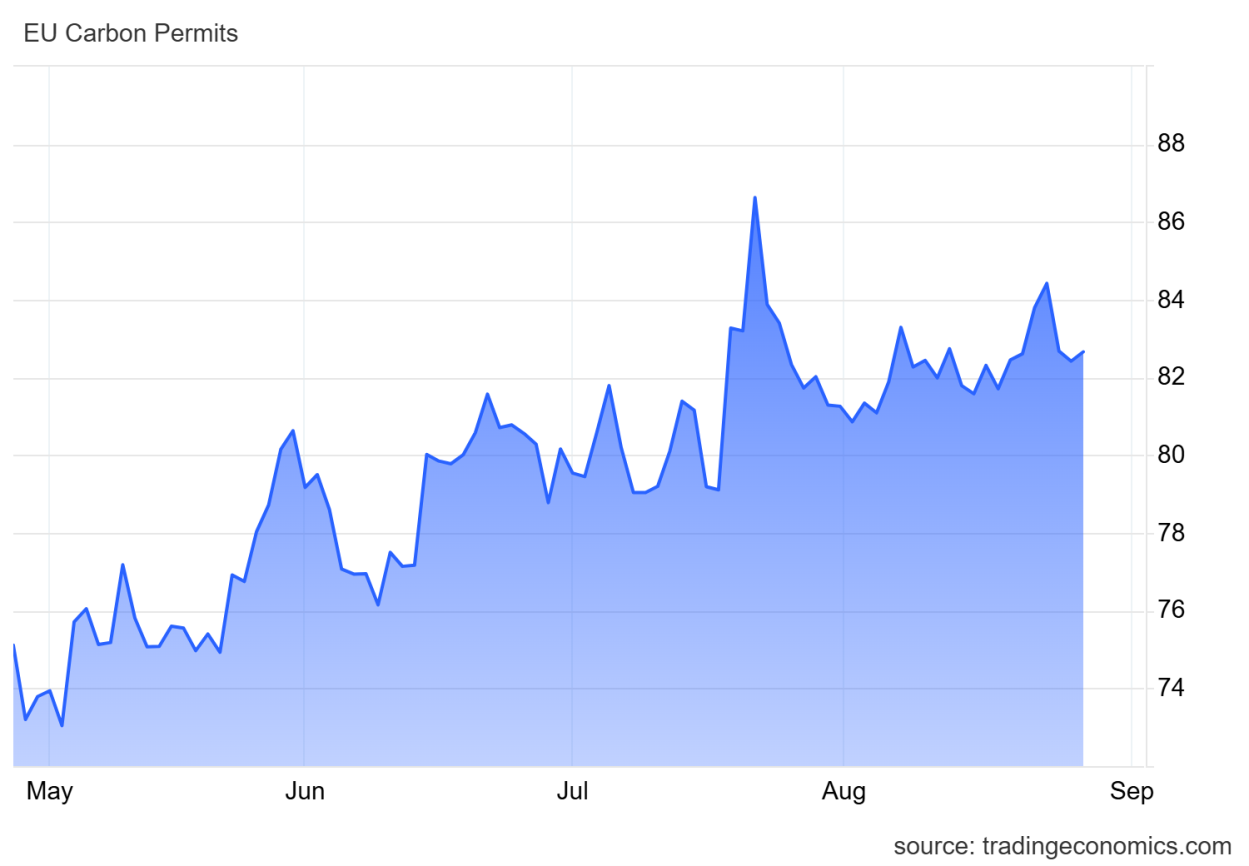
The EUA prices capture a market caught between near-term policy uncertainty and longer-term confidence in carbon pricing. The market has avoided a deeper breakdown, repeatedly finding support near €81 and recovering toward €83–84 by the end of the period. That resilience is notable. Proposed reforms may soften elements of the post-2030 tightening path and extend free allocation, but they also preserve the ETS as the core mechanism and strengthen the link between carbon costs and decarbonization investment. The result is a more range-bound, policy-sensitive market rather than a decisive bearish repricing.
Maritime & Shipping Updates
Portugal seeks EU ETS relief over Sines port competitiveness fears
CarbonPulse, Roy Manuell
Battle over cleaning up shipping set to resume at London talks
Climate Home News, Joe Lo
Shipping could consume 25% less energy by 2050 if IMO adopts Net-Zero Framework, consultants say
CarbonPulse, Bryony Collins
UK extends emissions trading to shipping
CyprusShippingNews, GARD
The maritime carbon pricing landscape keeps it’s fragmenting into overlapping regional regimes, and the friction is starting to show. The UK became the latest jurisdiction to bring shipping into its carbon market, extending the UK ETS to domestic voyages and in-port emissions from 1 July, with offshore vessels following in January 2027 and international voyages potentially in scope from 2028. That puts the UK alongside the EU ETS, which has covered EEA-linked maritime emissions since 2024, as one of roughly 40 ETS-type schemes now in force worldwide. But more coverage means more seams for cargo and vessels to slip through. Portugal is lobbying Brussels for relief from EU ETS rules at the Port of Sines, arguing the levy is pushing traffic toward non-EU competitors in Morocco. Together, these stories show that every scheme that closes an emissions gap also risks opening a competitiveness gap, and operators, ports and charterers are left navigating a widening, unevenly enforced patchwork rather than one coherent global price signal.
The alternative to this scheme-by-scheme fragmentation is the IMO’s Net-Zero Framework (NZF), and the stakes of getting it adopted are becoming clearer. New consultant analysis suggests global shipping could cut energy consumption by 25% by 2050 if the NZF is adopted, versus a future left to regional rules alone. This is a striking quantification of what’s lost without a unified global mechanism. Yet that outcome is far from assured. Talks resuming in London next week will see the US and Saudi Arabia push alternatives, including a Liberia-backed plan that analysts say would roughly halve the NZF’s emissions cuts and swap its target-and-fee structure for a carbon trading system with no central Net Zero Fund. Four other proposals, from Tuvalu, Brazil, Japan and the NZF’s original backers, are also on the table, with a decisive vote possible by December. The fork in the road for governments markets is clear: either governments land a strong, harmonized global framework this year, or shipping continues down the path of a fragmented, regionally-driven set of systems.
EU CBAM Updates
EC publishes sector-specific CBAM guidance for iron and steel to help non-EU operators
Eurometal, SteelOrbis Editorial Team
China, India, Russia reject CBAM as punitive measure
Balkan Green Energy News, Vladimir Spasić
EU corrects CBAM default values, selected aluminium products and unknown-origin precursors affected
ALCircle, issued by SMM
ALFED calls for urgent UK CBAM clarity as January 2027 deadline approaches
ALCircle, issued by ALFED
CBAM is persistently shifting into a live geoeconomic instrument, and the reaction is polarizing along familiar trade-bloc lines. Brussels is deep into the plumbing of implementation, issuing detailed sector-specific guidance for iron and steel to help non-EU operators calculate embedded emissions, and correcting default values for aluminum products under a new implementing regulation. The UK, meanwhile, is replicating the model rather than resisting it, with its own CBAM due in January 2027. But the countries most exposed to the mechanism are pushing back hard. China, India and Russia, through the BRICS bloc, have formally denounced CBAM as a unilateral, punitive and protectionist measure that undermines developing countries’ climate efforts. This is a significant statement given that iron and steel alone account for roughly 90% of India’s CBAM-covered exports to the EU. CBAM is becoming an accepted, exportable template among aligned Western economies even as it hardens into a symbol of North-South trade friction and a rallying point for BRICS coordination on climate and trade policy.
However, even within the CBAM bloc, the mechanism’s growing complexity is itself becoming a competitiveness and diplomatic liability. The EU’s retroactive correction of default values for aluminum shows how technical recalibrations can abruptly reshape exposure for trading partners and importers alike. In the UK, the Aluminum Federation’s urgent call for implementation clarity ahead of the January 2027 deadline echoes the EU’s own bumpy rollout, with unresolved questions on default values, verification and recognition of overseas carbon costs. Read against Portugal’s earlier competitiveness complaints and BRICS’s rejection of CBAM as punitive, carbon border pricing is a genuine instrument of trade policy, but its immaturity is generating friction on multiple fronts at once. CBAM’s credibility as a climate tool is now bound up with its credibility as a stable trade regime.
Voluntary Carbon Market News
The case for putting nature at the heart of carbon markets
Corporate Knights, Mark Mann
ASM, Francis Mwangi
Mongolia and GGGI sign deal to strengthen green development cooperation
Kazinform, Adlet Seilkhanov
Environmental, Carbon Markets Platforms Climate Impact X, Carbonplace to Merge
ESGToday, Mark Segal
Environmental Defense Fund’s Chris Costello makes the case that regulated compliance markets are leaving their biggest opportunity on the table: nature. With the exception of New Zealand, none of the world’s 60-plus compliance schemes currently price emissions from deforestation, wildfires or ecosystem degradation, despite Costello estimating that properly designed nature-based markets could deliver eight to 14 gigatons of annual reductions. That same expansionary logic is playing out on the ground in Kenya, where the government and World Bank are exploring how to fold circular-economy activities like recycling, composting and methane capture into the country’s carbon market pipeline, and in Mongolia, where a new agreement with the Global Green Growth Institute aims to build the institutional and legal capacity needed to attract climate finance and green investment.
None of that expansion works, though, without the infrastructure to support it. This is where the merger of Climate Impact X and Carbonplace comes in. By combining CIX’s exchange and price-discovery capabilities with Carbonplace’s multi-registry settlement network, the two platforms are explicitly betting that carbon markets need the “same robust infrastructure that helped traditional financial markets mature,” as the companies put it, spanning both voluntary and compliance schemes across geographies. Overall, carbon markets are trying to grow up on three fronts simultaneously: deepening what can be credited (nature), widening who can access the system (Kenya, Mongolia and other developing economies building the policy and institutional scaffolding to plug into climate finance), and consolidating the trading and settlement rails needed to move credits at scale and with integrity. The common thread, and the shared risk, is credibility.
To explore insights and tools driving carbon compliance and market visit the FACS website here!
